
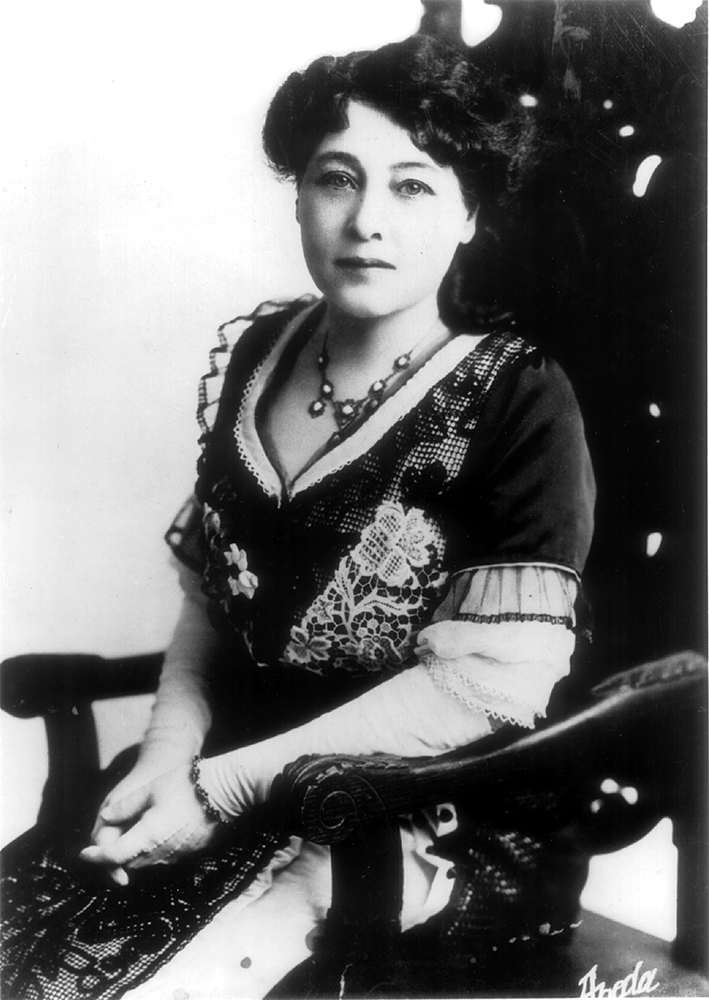
Alice Guy-Blaché – By Apeda Studio New York – Collection Solax, Public Domain, 1896
Alice Guy must be placed where she belongs: at the beginning. Not adjacent to the invention of cinema, but inside it. Not as an exception, but as the first to understand what it could become. She stands not only as the first woman film director, but as the first fiction film director. Before cinema had language, she gave it intention. Before it had structure, she gave it narrative.
At Gaumont in the mid-1890s, while others were still documenting fragments of reality, she staged scenes, constructed stories, directed performers. La Fée aux Choux is the creative gesture at the birth of cinema as an authored act, she orchestrated meaning. This distinction is essential. It is the difference between recording the world and reinventing it.
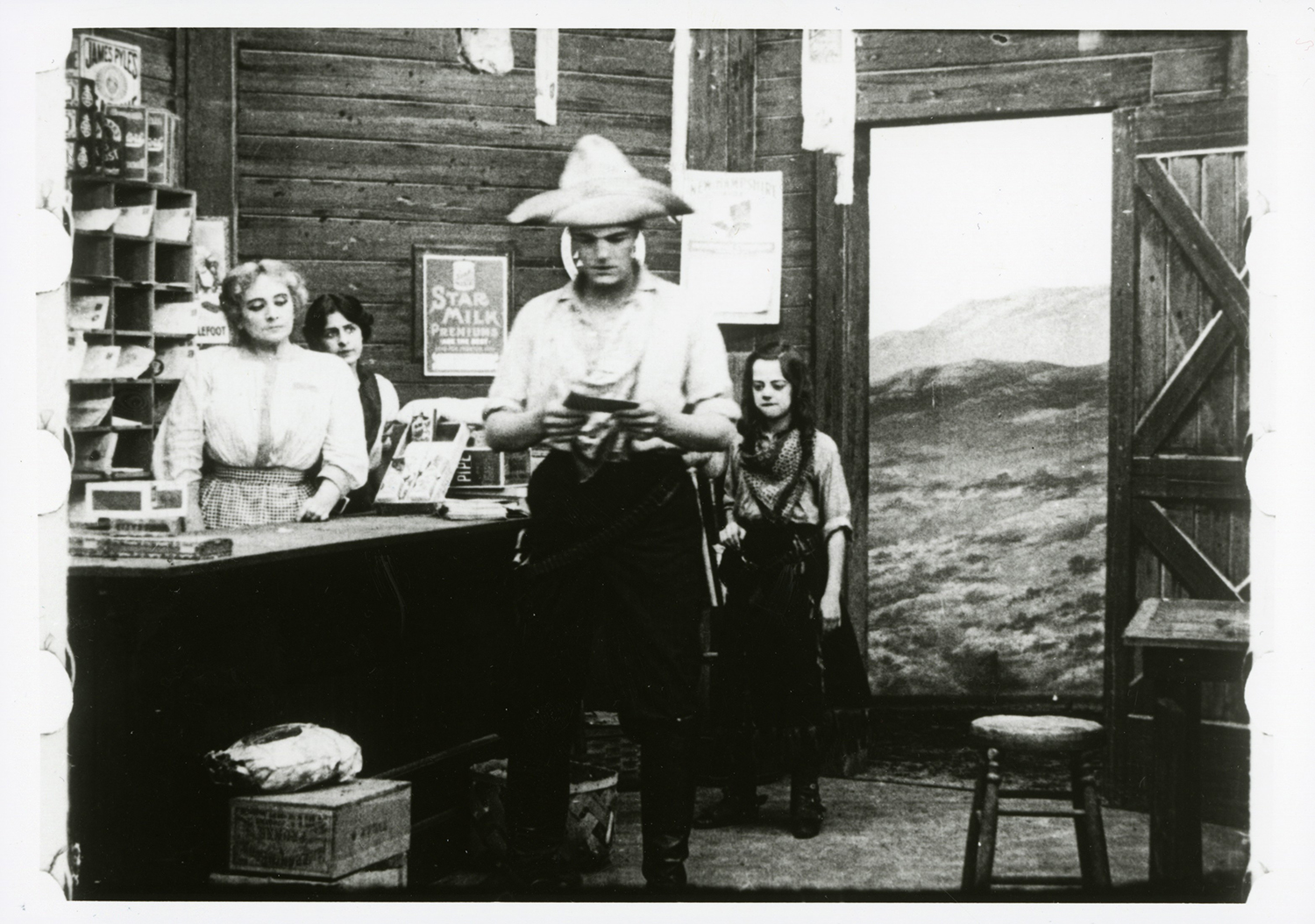
Still from Two Little Rangers (1912), Alice Guy-Blaché
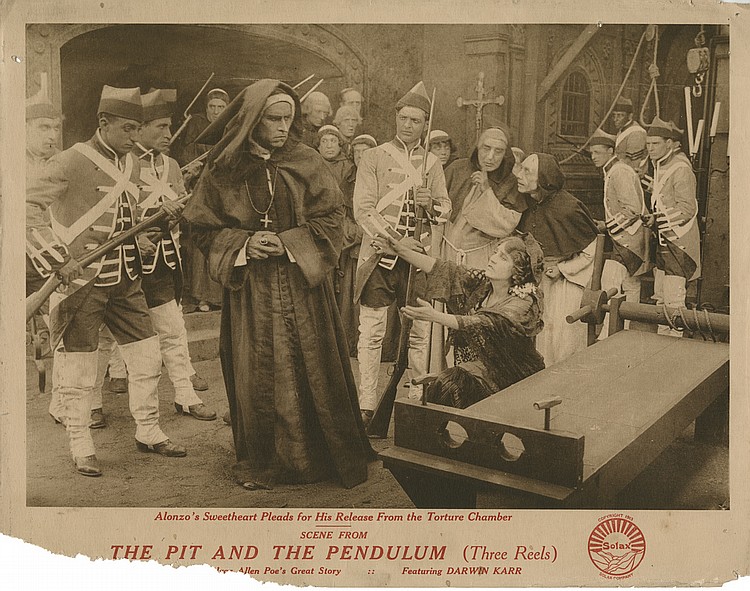
Lobby card for the silent film The Pit and the Pendulum directed by Alice Guy-Blaché (1913)
To recognise Alice Guy as the first director is therefore not revisionism. It is a correction of perspective. And within that correction lies something more discreet, yet just as decisive: the realisation that, from its origin, cinema carried within it the possibility of another gaze.
In 2018, she created the Alice Guy Prize to restore a broken continuity, to place Alice Guy not at the margins of cinema history, but at its origin, and to inscribe contemporary women directors within that lineage. Through her work — editorial, critical, and historical — she has contributed to reshaping the narrative of cinema, not by rewriting it, but by correcting its omissions.
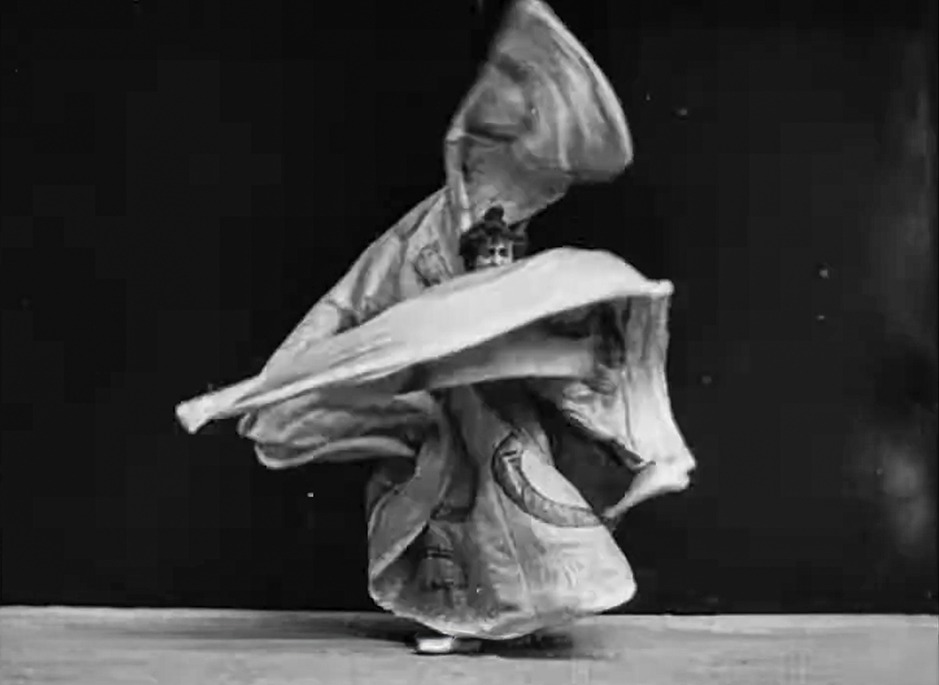
The Serpentine Dance performed by Linda Esbrard, Alice Guy (1902)
I think it remains important to speak of cinema in the feminine, of women’s cinema, of cinema by women directors, of women filmmakers’ cinema — whatever term the filmmakers themselves choose. First, because it is, in some measure, different. Not fundamentally different from men’s cinema, but different nonetheless. In 95 per cent of cases, the central character is a woman, often confronted with women’s experiences. These are subjects generally mishandled by male screenwriters and male directors, or else treated through cliché and caricature. I am not saying that all women are geniuses, not at all, but on the whole they tend to have a finer grasp of female psychology. Men always say that writing women is very difficult. As long as parity has still not been achieved, to continue speaking of women’s cinema it ennobles it by defining it.
For me, it is not symbolic, because it rewards contemporary films. Since women are still largely excluded from the major prize lists — festival awards, the Césars — even if things are improving, and there are more and more women at the Oscars and in major festivals, the prize as I conceived it performs two functions at once. It brings Alice Guy back into view, and it places today’s women directors within a line of transmission, within the continuation of Alice Guy’s work. So no, it is more than symbolic. It tells women directors today that, even if they still have to struggle because the adversity facing them is greater, they should know that there are role models in the history of cinema, and that at the very beginning of cinema there was already a woman making films. They were called animated views at the time, but they were films nonetheless, and she made them very early.
And when directors today become aware of this, it reassures them, steadies them, because they realise that the adversity they keep encountering is not accidental: it is constructed. Otherwise one might think it is simply something one suffers individually. But then they see that it is built into the world itself, that the world is organised in this way, and that they do indeed have their part to play in it. Put simply, they discover that the system is deeply patriarchal, and that women before them fought against it and succeeded — not necessarily by trying to destroy the system, that was not the point — but by making careers, making films, building bodies of work, accomplishing something, and doing so in another era, one we tend to imagine as less modern than our own, which is not true.
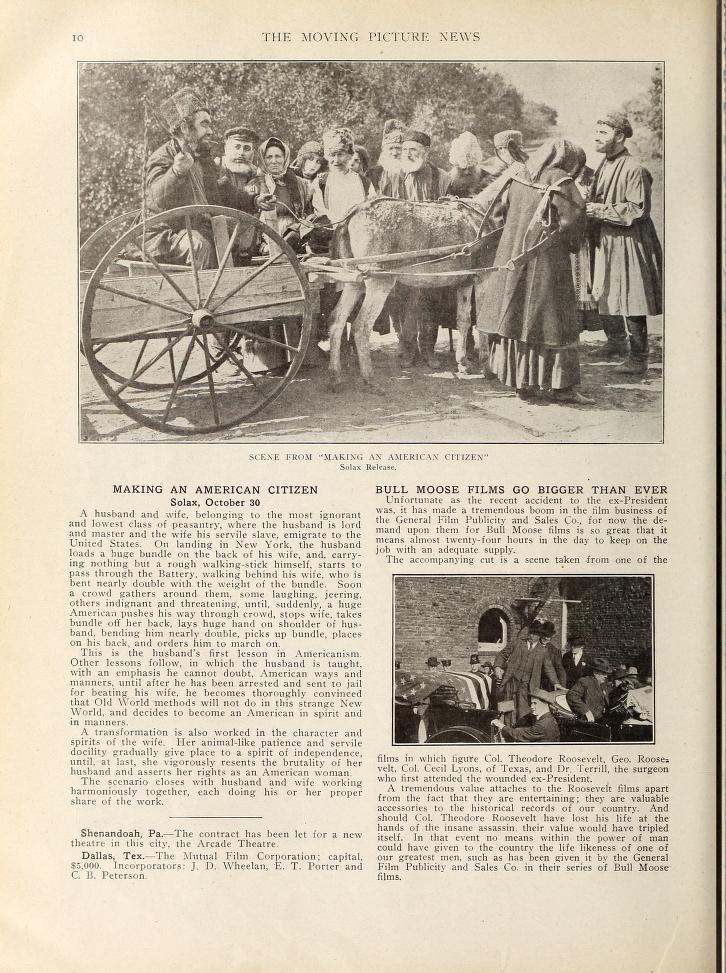
Alice Guy drew above all on her observation of the world around her. She began with everyday situations and placed them within narratives that were certainly highly dramatised, highly fictionalised. But she also drew greatly on her own life.
In the book I wrote, I looked closely at what in her personal experience may have inspired her films. For example, when she arrived in the United States, at Ellis Island, she saw an Italian family in which the husband handed all the parcels and all the children to his wife, while also mistreating her. Then a policeman arrived and said: no, here in the United States it does not work like that. So all the parcels were given to the husband, and he had to carry them. A few years later, in 1912, she made a film called The Making of an American Citizen, which tells that story. Except that in her film the family is Russian, and the transformation happens in several stages. It is about how he becomes a true American citizen: feminist, respectful of his wife, and so on.
It is a vast question, and it depends on the country. In the United States, one has the impression that women now reach the prize lists, that they are being honoured. This is often linked to questions of diversity as well. In the case you mention, (Autumn Durald Arkapaw to win Best Cinematography, Oscars 2026) that cinematographer is not only a woman, she is also a woman of colour. That is a subject discussed far less in France than in Anglo-Saxon countries.
So does this remain a niche, a marginal demonstration, or is it a genuine female success?
After MeToo, there was certainly a growing awareness that women were insufficiently represented in cinema, even though they had in fact been very present at the very beginning. What is not widely known is that in early American cinema there were as many women as men making films. They were then deliberately pushed out once cinema became an industry, because they were prevented from joining the unions, and one had to be unionised in order to work in Hollywood. So in practice they were sidelined, except for actresses.
So to answer your question: in the United States, MeToo did help shatter a situation that was truly scandalous. At the time, only 6 per cent of films were directed by women. Quite quickly that rose to around 15 or 20 per cent, but that is roughly where things stand. There has also been recognition for women of colour and women from certain minorities, because intersectionality means an accumulation of disadvantages.
In France, the story is different. At the beginning of French cinema there was indeed one woman, but she was very much alone. Then there was roughly one woman per decade throughout the history of cinema, until the 1970s and 1980s, when feminist movements within society began to change things. Women entered cinema in greater numbers, and from the 1980s onwards we began to plateau. I take the percentage of women directors because it is symptomatic of the rest: around 20 to 25 per cent of films directed by women. It dipped slightly in the 2000s, then rose again, but we still cannot get beyond 30 per cent.
So: do women have a place? Yes. Do they have talent? Unquestionably. Are they allowed to make anything other than the sort of cinema to which they are confined, that is, lower-budget cinema, with budgets a third smaller than men’s, on more marginal subjects, or social subjects? Some horror films, yes; some gore perhaps. But very few women make anything other than what they are told to make, or permitted to make. They do not make science-fiction films. They do not receive the major budgets. A €48 million budget, like Gilles Lelouch’s, for example: that simply has never happened.
The large budgets are almost entirely controlled by men, with teams composed almost entirely of men.
Is that because they are still denied the necessary credibility in the eyes of financiers?
There was a Swedish woman who put it very well, someone who oversaw both the Cinematheque and the Ministry of Culture. She said: men are judged on their potential, women on their experience. And that, fundamentally, has not changed in society.
The problem with cinema is that it is a global market, and recognition is international. If you are not recognised by the major festivals, then things remain difficult.
And independent festivals like Sundance, for instance, which has undeniably made its mark?
But even there, not as much as one might think. The United States are more international in outlook, yes, and of course they have done more, but the Oscars, which remain the quintessence of American cinema, have awarded Best Director to only three women in ninety-eight editions. So in that sense one could almost conclude that France is nearly a paradise for women.
And what of Berlin, Venice, Cannes? At the Berlinale, things are relatively regular. In Italy too, at Venice, there are more women rewarded than at Cannes.
Yes, there are somewhat more. Even for the Golden Lion, there have been more. Agnès Varda, for instance, received a Golden Lion in Venice, whereas at Cannes she received only an honorary Palme — in other words, she never truly won there.
Spain, for example, is currently a model when it comes to the place of women, the recognition of women, and the whole question of violence against women. They are far ahead of us. We French have a certain condescension towards the Spanish, yet in fact they are much more advanced than we are. The Italians are more ambiguous, but still stronger on this than we are.
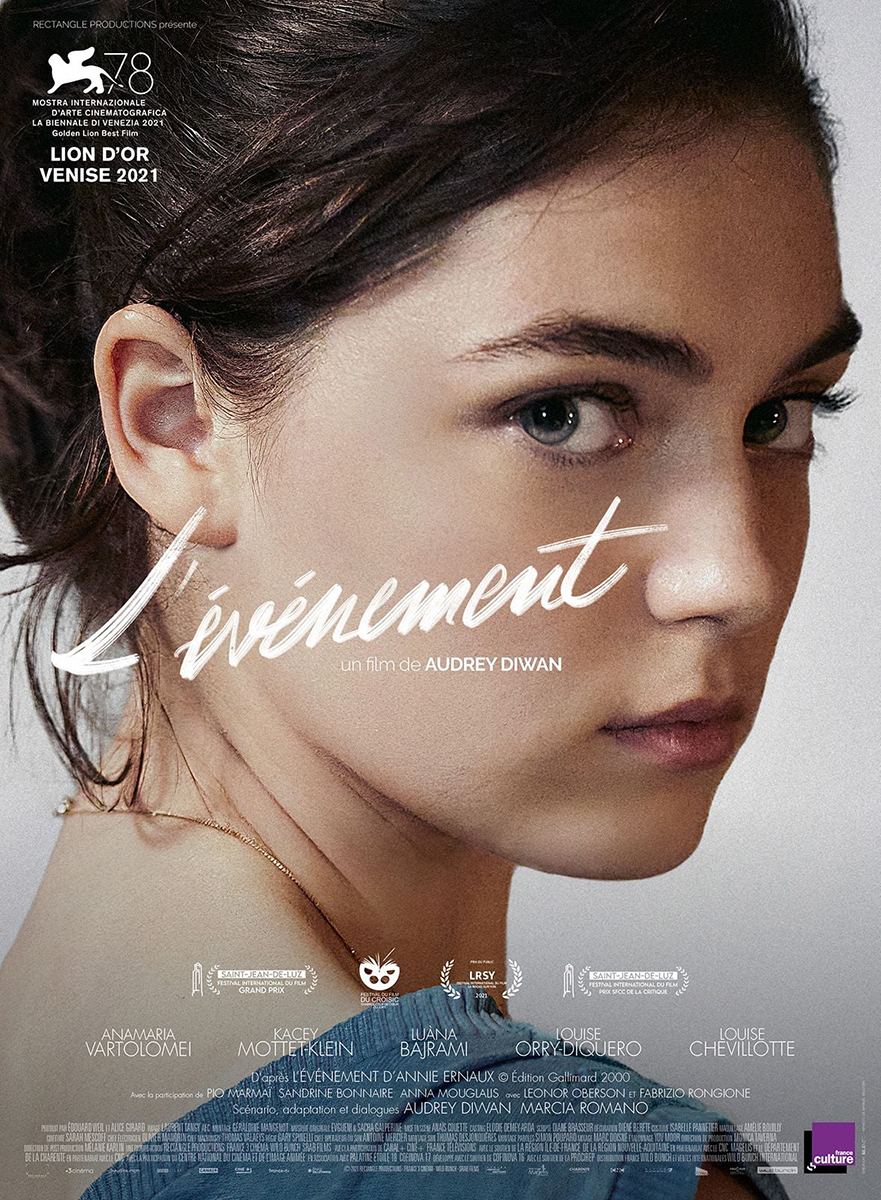
In the end, more women have been rewarded at Venice than at Cannes. Take Audrey Diwan: that sort of thing had never happened at Cannes. She won the Golden Lion in 2021. There was also Laura Poitras, the American documentarian, who won the Golden Lion in 2022. And that in itself is significant, because even a male documentarian has little chance of winning the Palme d’Or; a female documentarian has none at all.
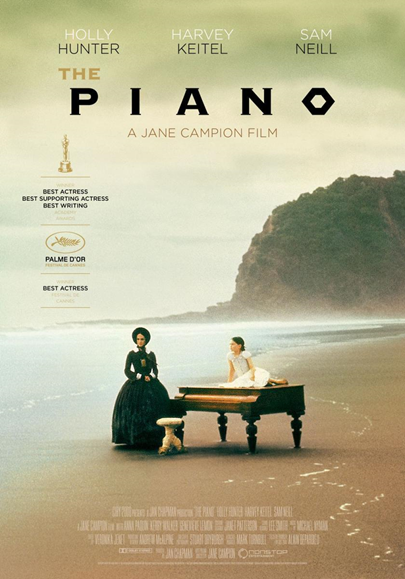
At Berlin there must be around ten women directors who have received the Silver Bear for Best Director. The Berlinale is the most feminine of them all. In comparison, it seems strikingly so. Venice must be at six or seven already, so rather more. And then Cannes is at three feminine awardees. Jane Campion in 1993 with The Piano, the first woman director to win the Palme d’Or, Julia Ducournau’s Titane won the Palme d’Or in 2021, and Justine Triet’s Anatomy of a Fall won the Palme d’Or in 2023 and the Oscar for Original Screenplay in 2024. So there it is. And yet at the same time, France is still said to be the country that allows women most readily to make films.
I am not specialised in platform cinema. The prize concerns only films released in cinemas. But when Netflix arrived, it was at the very moment when MeToo was still extremely powerful, before the present backlash. So at the level of discourse, they were very avant-garde on these issues.
Whether they truly followed through in production is another matter, and that would need to be verified. It is more difficult to assess because platform films are opaque. There are a few major names, of course, but often, as with television, it becomes hard to know who actually directed what. Or else one big name is used to direct part of a series, and after that one no longer knows. So yes, it would require proper investigation.
The genesis of the prize is twofold, but in fact quite simple. I had been a film journalist for a very long time. One day I went to see a documentary by Julie Gayet, in which she asked a number of women filmmakers — French women first — whether such a thing as women’s cinema existed.
In that film, she raises Alice Guy. Agnès Varda speaks of Alice Guy. Afterwards, when Julie gave her presentation, I went to speak with her. This was in 2012. And she said: well yes, it is hardly as though Alice Guy had ever been recognised in proportion to what she did. And I remember thinking: I have worked in this profession for twenty years, and I do not know Alice Guy at all. So I went home and looked her up, as everyone does, on Wikipedia. There were three or four lines. Today the French Wikipedia entry runs to fifty-seven pages. In thirteen years, what has happened for her is extraordinary.
I became interested in her. I asked all my critic friends about her. They said, well, if we do not know her, it must be because the work was not very good, and because not much can have survived. That was the attitude.
Then, by chance, my daughter was living in Washington and asked me to join her there because she was lonely. In the end she was very busy, so I wandered into the Library of Congress and began researching Alice Guy. I was received extraordinarily well. In this case the United States were more interesting They said: at last, a Frenchwoman who has come here interested in this woman. There they call her Alice Guy Blaché, using her married name. They opened every door to me with remarkable generosity. So I discovered a great many things I had never known. It validated, in a sense, my attraction to Alice Guy. And above all, they showed me the films, because all the films she made in the United States are now held on legal deposit at the Library of Congress.
I was able to see the films. I was able to see her work. And as a critic, that was immensely significant. I realised that I had been right against my colleagues: it was French sexism, really. From then on, I kept telling myself that Alice Guy’s work absolutely had to be shown. They did not want to hear of Alice Guy? Fine, let the historians have their reservations. But we would prove them wrong through the quality of the films themselves.
I carried that with me for some time. Then MeToo happened, the Weinstein affair. And I thought something truly significant had to be done for women. At the time I was writing a book, and during a pause I happened to be looking at the Prix Goncourt. Nobody really knows what the Goncourts themselves did, but that does not matter. Their name circulates. And if one is curious, one goes and looks.
I thought: I shall create a prize called the Alice Guy Prize. I shall use the ceremony to show her films little by little, and to build an audience who will return each year. At the very least they will discover her. They will see whether they like it. Since many of the films are funny, if people laugh, then one knows they still work. And at the same time we will reward a contemporary woman director, who will herself be in the position of spectator, watching these films and inscribing herself within that history.
Because it was a history that did not exist, or rather, one that had never been told.
That is the genesis. In truth I thought about it less than this explanation suggests. The idea came to me quite suddenly. It takes much longer to explain it than it did to have it. The intellectual process had already taken place upstream; the decision emerged naturally. People often say the best ideas are those that simply arise. I do not know whether it was a brilliant idea. But I can see that it works, and that it has had an impact. It was rather audacious, although I myself did not grasp the audacity of it at first.
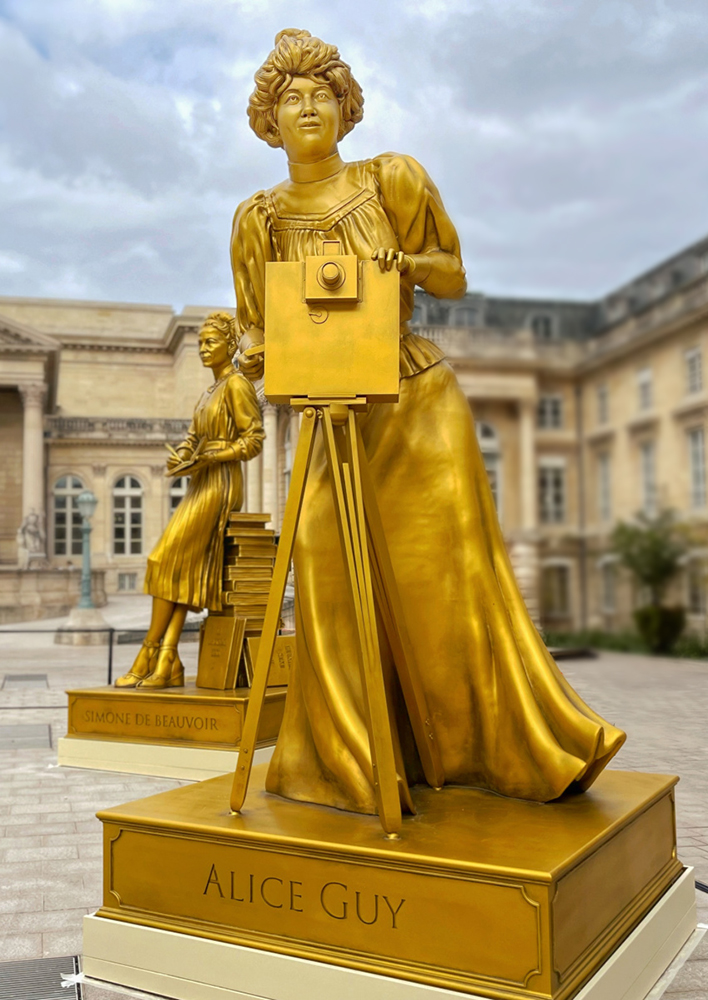
There are obstacles, of course. There are still people who resist the subject. But in the end we succeeded with this prize. Not only because of me — there were other initiatives too — but I was conscious that speaking every year about Alice Guy would, eventually, make her enter people’s minds. Whereas a documentary, or a book, however successful, remains fleeting in the end. And then the consecration came when her statue emerged on stage at the opening ceremony of the Paris Olympic Games. At that moment I thought: there, it is done.
She no longer belongs to us. She lives her own life. She is the first woman filmmaker to have a statue in a street in France. Abroad, I do not know. But in France, certainly. And that is wonderful, because actresses are honoured by cinema all the time.
Yes, but that is something else again, because the director is the position of power. It is the most important role. It is the one through which a film is made. One might even say, in a sense, that she helped create the role of the woman director.
As for emancipation: I do not have the impression, even though there are new narratives, and women do undeniably bring new narratives, especially women from mixed or different cultural backgrounds, women who are not the bourgeois women of the 6th arrondissement, as men so often were, that the new narratives of cinema come chiefly through women.
And yet actresses, who so often complain that they are confined to roles defined for them, do find in women’s narratives a stronger form of emancipation than in men’s cinema. In any case, the star remains very often a man. Not exclusively, but often enough.
As for true stories of emancipation with a strong female character made by a man — there is Erin Brockovich, but there are not ten thousand examples if one looks closely. Very often these are heroines carried by women’s narratives. Women’s destinies do not interest men all that much.
I studied art history and never once encountered Alice. Something so fundamental was simply absent. Why?
Yes, that is absolutely clear. Curiously enough, I try to follow how things evolve in the other arts as well as in cinema. The world of cinema is still profoundly traditional, profoundly conservative, oddly so, given that one imagines those who make cinema to belong to the progressive side of society. At least, that is what we ask of them.
They are progressive in discourse, but not so much in reality, and certainly not within institutions.
I find that institutions in the visual arts have evolved much further on this question. There are now many museums with signage, contextualisation, proper attention to these issues. It is all very recent, but it exists. In cinema, no.
For example, there was that absolutely marvellous exhibition at the Centre Pompidou, Women in Abstraction, where one saw all those women who had nourished the great movements. We now acknowledge that where there is a major artistic current, there may well have been a woman at its origin. In the Bauhaus, for instance, that is quite obvious. Even Jackson Pollock’s action painting is now regularly discussed in relation to Janet Sobel’s earlier all-over and drip techniques
while Sonia Delaunay is rightly recognised as one of the pioneers of abstraction.
Precisely. So there is now recognition of this. We know these women were mistreated by history, but institutions are at least attempting to place them back where they belong. Their names remain less well known, of course; that is true. But in cinema this process has barely begun. It is really not an art form that has evolved much in that respect.
I even remember a portal on the arts created for young people. I do not know whether it still exists. When I looked at music, one was beginning to recover women composers; there was at least some discussion of Mozart’s wife, of interpretation, of extraordinary voices, and so on. But the cinema page on that same portal, designed for young French students, did not name a single actress. Not one woman. There was nothing.
Can the Prize also serve to bring women from the past back into view, not only women directors working today?
I wrote a book called 100 Great Films by Women Directors, which is a history of cinema told entirely through films by women directors. Unfortunately it is now out of print. I am trying to work on that, because, oddly enough, it was successful. Fortunately, because it was necessary. I have done a great deal of that work. And of course I now have a body of knowledge that allows me to cite, to make connections, to build references.
What has changed is that when today’s women directors stand out, there is now only a minority — admittedly sometimes a very noisy one — who condemn them immediately, as happened for example with Julia Ducournau. But that is still only a minority of men. We now understand that one no longer questions women directors’ talent in the way one once did. Before, if they were absent, it was assumed to be because they had no talent. That, at least, is beginning to end. But there is still a difference between no longer dismissing them, and truly honouring them, championing them, citing them.
I sometimes amuse myself by looking at a site called LaCinetek, and each time I think: I am going to see how many women directors, how many films by women directors, are cited by their peers.
For the Guy Prize, it is the audience that votes. The five finalists — the five films that have been cited most often — are then presented to a jury of professionals from the worlds of culture and cinema. But I could not apply that model to short films, because it is very difficult to see all of them. So I decided to create partnerships with festivals, which gave me a territorial anchorage and allowed me to observe new tendencies in cinema. Sometimes these are first films. The idea is to recognise the talent of very young directors.
At the moment I have six partnerships, from Marseille to La Réunion, via Brest, and each time there is animation, each time there is a local ecosystem. All genres are included, because my purpose is to recognise all the talents and all the creative liberties of women. We have been doing this for some time now, so we now have a sort of small panel that is fairly representative of film creation in France. There are a great many talents, of course, even if at this stage it is still a little early, because of the time it takes to make a first feature.
But I think one can see quite quickly which filmmakers will rise to the surface. That does not mean they will all go on to build careers, but in any case some of them are genuinely very talented, and they already have something to say. That, to me, is deeply interesting.
Acknowledgment: This encounter with Véronique Le Bris was made possible through Emmanuel Denizot (partant.eu), whose commitment to cinema and the arts continues to foster meaningful connections.