Created in March 2018 by Véronique Le Bris, founder of the first women’s web magazine devoted to cinema, cine-woman.fr, the Alice Guy Prize was conceived not as a symbolic gesture, but as an act of restoration. Its principle is both simple and exacting: each year, it honours a French-majority feature film directed by a woman and released theatrically during the preceding year. Yet behind that clarity lies a deeper ambition. The prize was founded in order to bring two movements together in one and the same gesture: to recognise the work of women directors today, and to restore Alice Guy to her rightful place at the origin of cinema itself.
That dual movement is what gives the prize its force: it reopens a lineage that history had obscured. In placing a living filmmaker alongside the name of Alice Guy, the prize insists that women do not enter cinema belatedly, nor by exception. They belong to its first chapter. For Véronique Le Bris, this was never simply a matter of tribute. It was a way of redrawing the map of film history, while also confronting a present in which women directors still struggle for financing, recognition, and authority. The Alice Guy Prize therefore functions at once as a prize, a platform, and a corrective: it honours a film, but it also transmits a history.
Its annual ceremony has become part of that mission. Each edition is conceived not only as an award presentation, but as a moment of remembrance and re-inscription, where Alice Guy’s pioneering work is brought back into view through dedicated programming, and where today’s filmmakers are placed in direct conversation with that inheritance. In this sense, the prize does something rare: it binds memory to the present tense. It refuses to treat film history as a closed canon, and instead makes it active, contested, and transmissible.

Véronique Le Bris, ©Marco Tassini, 2026
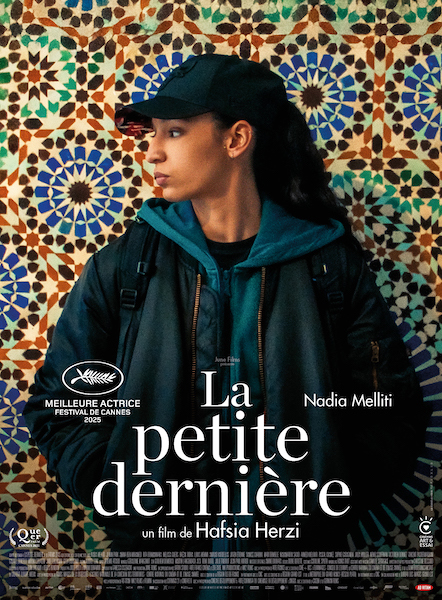
The forthcoming ninth edition will take place on Wednesday 15 April 2026 at the Max Linder Panorama in Paris, where the jury will award the Alice Guy Prize to Hafsia Herzi and the team behind La Petite Dernière.
The film, Herzi’s third feature, is adapted from Fatima Daas’s autobiographical book and follows the youngest daughter of a loving and devout Muslim family as she enters university and discovers new horizons, new desires, and a more complex sense of self. Its trajectory has already marked the season: unveiled in Official Competition at the 2025 Cannes Film Festival, it went on to receive the award for Best Actress for Nadia Melliti, the Queer Palm, the Prix Louis Delluc, and a César for Most Promising Actress.
This ninth edition also bears the mark of growing public engagement. A total of 105 films were eligible, and 6,717 internet users, a record, took part in selecting the five finalists. The final jury brought together Thierry Klifa, Nathalie Azoulai, Louis Derungs, Damien Megherbi, Laetitia Dosch, and Lina Soualem, recipient of the 2025 Alice Guy Prize. As ever, the evening will not only celebrate the winning film, but will also pay tribute to Alice Guy through a special programme, reaffirming the essential idea at the heart of the prize: that the recognition of women directors today gains its full meaning only when it is placed in continuity with one of cinema’s true beginnings.