Figure of Ma, Spring/Summer 2027
By Alexandra I. Mas
There are shows that leave a sentiment in the body. Satoshi Kondo’s Spring/Summer 2027 collection for Issey Miyake made a real emotional imprint. Watching fabric rise, settle and undulate around the models, I felt the emotion of seeing the shapes of his idea. Figure of Ma was a masterpiece of that passage: from thought to cloth, from cloth to movement.
Presented at the Dojo de Paris on 2 October, the collection explored Ma through the interval between the body and what clothes it. Air entered that relationship. A step changed its dimensions; a turn gave it another shape. The silhouette existed for a moment, then became something else.
The opening gave this thought a physical presence. Lead dancer and choreographer Tess Voelker began with a piece whose restraint held an expressionist intensity. Her fellow performers joined her around a vast expanse of pale, skin-coloured fabric. Lifted and set in motion, it floated into a swelling, almost spherical volume: a temporary space of existence, held open by the energies moving through it. Before the first look, we had already witnessed the collection’s essential gesture. The body could make room around itself.

Koki Nakano performed his original music on a Steinway & Sons piano. Invited into the development of the concept alongside Kondo, the composer participated in the collection’s formation. Sound and clothing had grown through an exchange, and that intimacy could be felt in the show. A phrase unfolded as a volume opened; the dancers’ gestures made the distance between hearing and seeing seem very small.
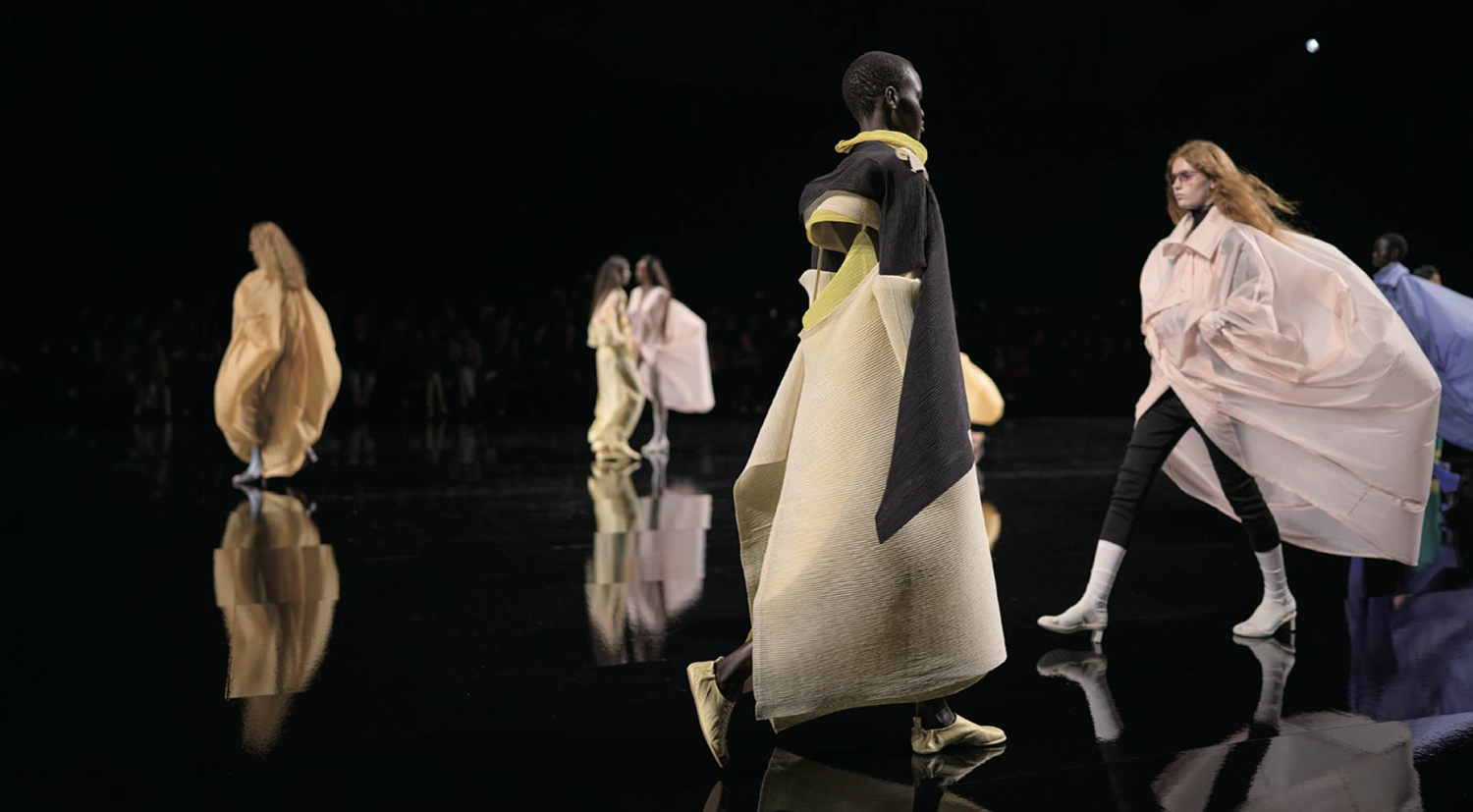
Then came the clothes, with their layers of colour and great expanses of light fabric. Their scale gave movement somewhere to travel. Material drifted beyond the shoulder, gathered around the torso, billowed at the legs. Through transparency and superposition, one colour entered another, deepening or softening according to the light and the body’s position. Even at their most expansive, the forms retained an ease that made them imaginable in life.
Hoods and scarves extended this language. Draped around the head or drawn through the garment, they allowed a silhouette to be adjusted, sheltered, opened again. In DRAPED ENSEMBLE, scarves could pass through twists and gathers, becoming part of the construction. There was pleasure in that possibility of rearrangement: a garment could receive something of its wearer’s temperament each time it was put on.
The pleats carried their own rhythm. CAPRICE brought colours together in a construction that let them sway across one another, while the horizontal folds of TEMPO PLEATS bounced with the moving body. Their precision served a living, changeable form. Superpositions gave the eye several surfaces to follow, yet the clothes remained fluid. Walking completed them.
This was an ever-young spirit expressed through curiosity and play. There was room for a complex personality within these layers, for withdrawal beneath a hood, for exuberance in an unfolding volume. Freedom appeared in the simplest physical acts: lifting an arm, lengthening a stride, turning without having to negotiate with what one wore.

And then there were the torsos.
COCOON BODY brought a different kind of closeness. Bodices followed the moulded contours of the human form, with sculptural breasts emerging beneath what appeared to be delicate layers of silk. Their sensuality was tender. Nudity seemed to surface from within the material, as though the body had left an impression that the garment was quietly revealing. There was something moving in this suggestion of a presence beneath another presence.
Created with Wacoal Corp., the series adapted Melooop, a patented three-dimensional moulding technology first used for bra cups. A torso mould attached to a robotic arm received a spray of molten resin, forming fine fibres through the melt-blown process. The method recalls a silkworm making its cocoon, accumulating the substance of a covering around a form.
The human hand remained within that technological process. Dampened garments were arranged around mannequin torsos; the subtleties of their draping were captured through 3D scanning and transferred to the mould. Both anatomy and the traces of cloth entered the resulting surface. What emerged held the memory of wearing: the fold, the contact, the way material had rested against a body.
For all their sculptural definition, these forms could move with their wearer. The eye encountered the ambiguity of body and covering, while the material retained the possibility of breathing motion. According to the house, the raw material contains 60 per cent plant-derived resin pellets, and production trimmings can be returned to the process as raw material. The research extended from the making of the form to the handling of what remained.
Kondo’s achievement lay in making this investigation felt. We could see the intelligence of the construction, but its deepest effect arrived through sensation. The collection offered an intimate understanding of liberty: the space to inhabit one’s clothes, to move within them, to let a private rhythm become visible.
The house’s words speak of fabric “allowing air within as it begins to breathe”. By the end of the show, that breath seemed to belong to all of us.
CAMPER × ISSEY MIYAKE
The dialogue between body and material continues underfoot. Peu Lift pairs an arched heel, echoing Camper’s bridge logo, with soft leather straps that play asymmetrically around the toes. Peu Formula takes its mould from a worn pair of Peu Form, preserving the contours and irregularities left by movement. A lightweight, wearable sculpture, it carries the trace of the body into its next step.