by Alexandra I. Mas
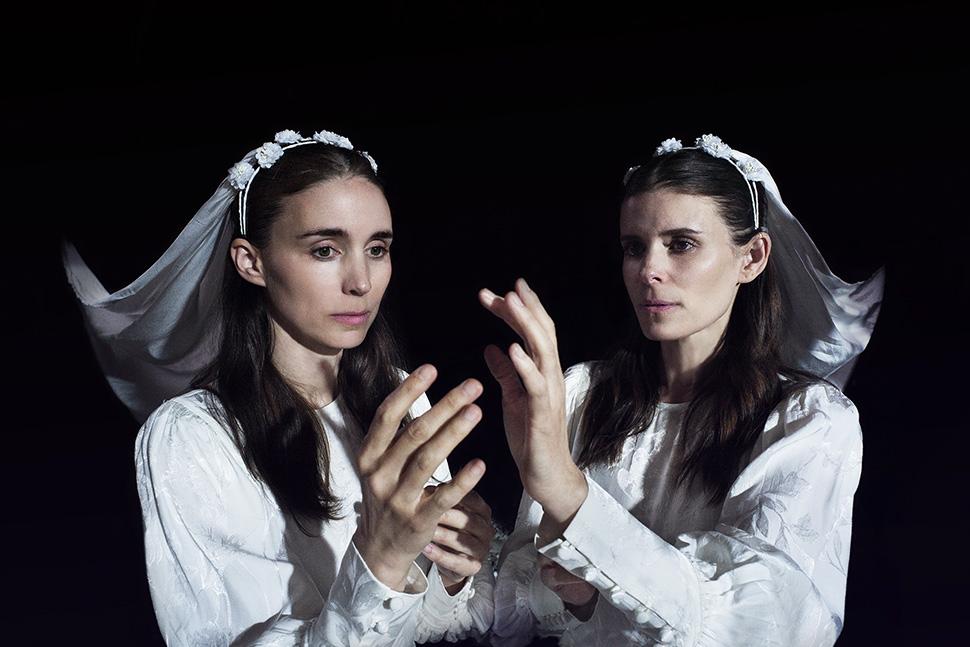
In Bucking Fastard, two sisters, Jean and Joan Holbrooke, have withdrawn so completely from the codes by which the rest of us organise reality that the place they inhabit seems almost inaccessible from the outside. They speak in unison. They dream the same dreams. They love the same man. They even make the same slips of the tongue.
Inspired by a true story, Herzog’s film could easily have become a psychological study of pathological fusion, isolation or obsession. Instead, he does something far more Herzogian: he turns strangeness into poetry.
The question is no longer simply why are these women like this? It becomes: what if their reality is as coherent as ours?
Two Against the World
Kate Mara and Rooney Mara inhabit the sisters with a staggering, at times deliberately provocative symbiosis. Their synchronisation is unsettling precisely because it resists the gestures through which cinema usually distinguishes one character from another. Speech, movement, intention, even desire, seem to circulate between them.
Herzog does not give us privileged access to their consciousness. We cannot see the world as Jean and Joan see it. Instead, we watch the world reacting to them. Courts attempt to regulate them. The press attempts to explain them. Some want to help; others see something to exploit. But Jean and Joan seem to exist elsewhere. Obsessive and obsessional, they read existence as one, and in a language profoundly different from ours. Even love obeys a different geometry here.
Where does one sister end and the other begin? Is their extraordinary union a refuge, a prison, a language, or all three at once? Kate and Rooney Mara never attempt to make that bond comfortable for us. Perhaps that is why the tunnel matters so much. After a heartbreak, the sisters decide to tunnel through a mountain.
“Everyone should take on a tunnel through the mountain.”
It is absurd. It is monumental. And it is an almost perfect metaphor. Most of us encounter an obstacle and search for a path around it. Jean and Joan decide to go through. They are not adapting themselves to the landscape; they are excavating a passage through it. Inch by inch, rock by rock, they pursue a destination that may matter less than the act itself.
The tunnel becomes labour, obsession, escape and belief. Perhaps even utopia, and a quest for love. There is something deeply moving beneath the apparent irrationality of Bucking Fastard: the possibility that the sisters are not simply fleeing our world but searching, with extraordinary determination, for one in which they might exist without translation. What happens when two people cannot, or refuse to, accommodate themselves to the reality surrounding them?
They dig.
“You Cannot Go Out Because You Cannot Be In”
One of the film’s most extraordinary lines comes during an encounter with the keeper of a cave, on the margins of a tourist attraction. The logic is deliciously nonsensical. And yet it says almost everything. The sisters are neither entirely inside nor entirely outside. They challenge the elementary categories upon which social order depends: one or two, singular or plural, autonomous or dependent, rational or irrational. Before something this unfamiliar, language itself begins to malfunction.
“You cannot go out because you cannot be in” could almost be the film’s philosophical proposition. Society knows how to deal with those who belong and those who leave. What proves infinitely more difficult is someone who remains physically among us while inhabiting an entirely different conception of reality.
The Poetry of the Absurd
For Herzog, absurdity is rarely merely comic. It is a fissure. Through it, another understanding of human existence can suddenly appear.
The love, the caves, the impossible undertaking of piercing a mountain, the humour of the tourist train, Bucking Fastard accumulates images hovering between the tangible and the surreal. Reality becomes slightly unstable without ever ceasing to be real. And Jean and Joan Holbrooke existed. Herzog nevertheless refuses the limitations of reconstruction. Biography becomes something closer to a fable: two women moving through a society that considers them strange while they, perhaps, find it equally incomprehensible. Who, then, is observing whom?
The sisters can be funny, disturbing, touching and exasperating, sometimes almost simultaneously. We instinctively wait for individuality to reassert itself and restore the familiar order. Herzog understands that expectation and denies us its comfort. Perhaps every Herzog film contains, somewhere, a mountain, whether literal or metaphysical: an impossible landscape against which human beings measure the enormity of their desires. In Bucking Fastard, Jean and Joan penetrate the mountain. Their undertaking may appear absurd, but perhaps all absolute convictions do from the outside.
Love does. Faith does. Art certainly does.
To spend years excavating rock because you believe there must be a passage through it is madness only until we recognise how many invisible mountains we spend our own lives attempting to cross. Jean and Joan simply make theirs visible. Herzog does not ask us to understand them, but to remain with their strangeness long enough for our certainty about our own normality to become slightly less comfortable.
Do you dig?