Signal’s Take Over the City of Prague
by Alexandra I. Mas
I walked through the Baroque buildings, looked at the Gothic spires and Renaissance façades, the Habsburg grandeur blending into a living organism, the Signal Festival, which unfolded along three routes of immersive, augmented-reality, and experiential installations.
For a few nights, the entire city became a stage of light, perhaps the most contemporary form of art, touching the public in such a direct, emotional way. Prague was overflowing with visitors following the free experiences that illuminated cathedrals, public squares and even the river Vltava.
But how did this wildly popular festival reach its thirteenth edition, and continue to grow? From disappointment to impossible missions, managing an art festival can be a desert road. The hardest thing, especially in the beginning, is finding financial support, but also the physical space to host such monumental art pieces. You have to navigate politics, urban restrictions, and still find the right curatorial vision. How do you present to the Ministry of Culture a project made of artworks that don’t even fit into their traditional categories? How do you convince them that an entire city will not only accept, but desire this contemporary form of art? You enter an extraordinary matrix, and you know, to stay genuine, you’ll have to find your way out of it at some point. Supported today by the Ministry of Culture and sponsors like Mercedes and Glo, founder Martin Pošta, the driving force behind Signal Festival, shares the winding, inspiring path that led here.
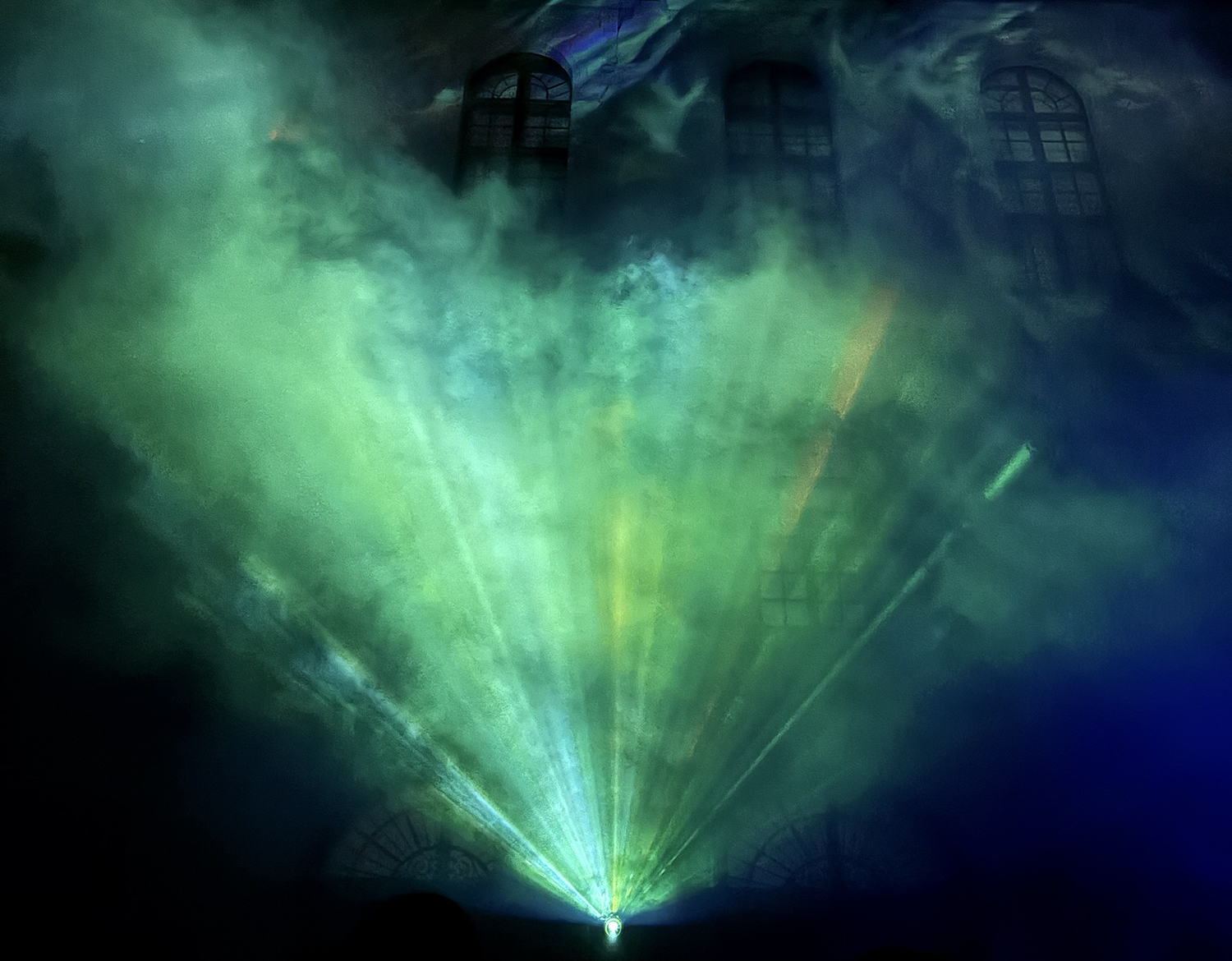
On the cover you can see a detail of the experience that spoke most closely to my own sensibility. Robert Seidel’s MLHA (FOG) deployed in the courtyard of the Clam-Gallas Palace, a jewel of Baroque style, the work dissolved architecture into light and mist. Seidel’s projection merged digital abstraction with historical grandeur, creating a hybrid space. Dense layers of fog acted as a living canvas, absorbing the video’s spectral abstract textures. The palace walls, once witnesses of imperial ceremony, appeared to soften and vibrate. The soundscape by Nikolai von Sallwitz enveloped everything in a low, magnetic pulse, turning the experience almost tactile. MLHA (FOG) meditates on our relationship with technology, but without anxiety, the digital can still be human, energy and matter, art and science, emotion and structure may yet find equilibrium.
Signal Festival is a celebration of digital and creative culture, merging contemporary visual art, urban space, and advanced technology. Now the most visited cultural event in the Czech Republic, it draws over 500,000 visitors each year and in 2025 received the prestigious PRIX NUMIX for International Digital Art. The programme showcases leading international and Czech artists in visual art and light design while supporting emerging talent through educational and professional initiatives.
Alexandra Mas : It was one projection that started it all, wasn’t it?
Martin Pošta : Yes. We were a small studio commissioned to do a projection on Prague’s world-famous Astronomical Clock Tower in 2010. From that moment, everything changed, we were recognised, and we started travelling the world as a studio. That was the spark: a combination of geekism and love for art. That defines me, really, I love technology and I love art. The two complete each other perfectly.
The first edition of Signal was, quite literally, a wish list of artists we admired. There was no official curation. We just said: these guys are doing amazing things, let’s bring them here. We reached out, not really knowing how any of it would unfold. And they came. That’s how it began.
A.M.: How many art pieces did you have for that first edition?
M.P.: Around thirty. Honestly, anything that emitted light could be considered art at that time! We illuminated buildings, bridges, even boats moving along the river. We tried everything possible. We realised the city itself was our playground.
Do you know Sila Sveta? They’re an internationally known, former Russian collective now based around the world. They weren’t so famous then. I remember one night, we were on a boat, controlling the city lights with a phone, switching Prague Castle and the surrounding buildings on and off like a game. Imagine that! It wouldn’t be possible now, but back then it was pure joy, the city became alive in our hands.
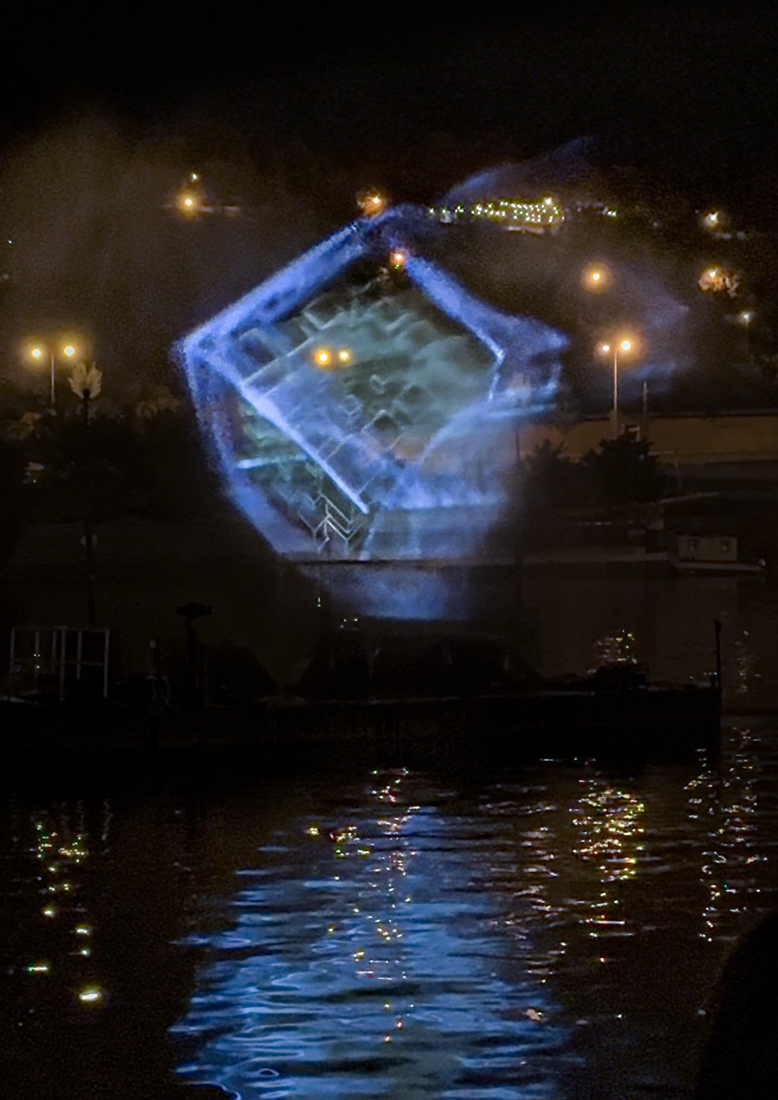
Tzolk’in Light
Peppercorns Interactive Media Art – Dvořák Embankment, Vltava River
By the banks of the Vltava, the air itself became a canvas. Tzolk’in Light, a 3D projection on a screen of mist unfolded above the river like a living apparition. Created by the Taiwanese collective Peppercorns, the installation draws its name from the ancient Mayan calendar Tzolk’in, a symbol of time’s cyclical nature and the pulse of natural energy.
The work speaks of creation and extinction, of rhythms that long predate humanity. Through spirals of light and sound hovering over the dark water, it reminds us of our fragile place within the vast continuum of existence. In an age ruled by speed and anxiety, Tzolk’in Light offers what its creators call a way out of time scarcity…breathe, remember, we are but a single beat within the infinite pulse of life.
The reflections danced upon the Vltava River, merging with the city’s skyline. Water and light intertwined, erasing boundaries between image and element. For a few suspended minutes, all seemed to dissolve into pure vibration, architecture, nature, and time moving in unison.
Credits:
Artistic Director – Chin-Hsiang Hu | VisualDesign – Yu-Hao Lee | Sound Design – Cheng-Yeh Han | Marketing and Social Media – Li-Li Chang
A.M.: How did the public react to that first Signal?
M.P.: We created a monster, in the best sense. A Frankenstein moment. We brought something to life that was stronger than we ever imagined. Quarter of a million people came. Everyone was shocked, What on earth is happening? But they loved it, instantly.
A.M.: Let’s talk about the recent trilogy Ecosystems. What’s the story behind it?
M.P.: That was the idea of our head curator, Pavel Mrkus, an internationally respected artist. Three years ago, we changed our curatorial model. Instead of five of us curating together, we invited one leading curator each year to set a direction. Pavel brought this concept of ecosystems, not just ecological, but human, social, artistic ecosystems. The networks we live in, the invisible structures that define us.
It had to be open enough not to limit the artists. Because when you curate Signal, you start with a vision, but then politics, permits, logistics, and weather all start reshaping it. Half of our works are newly commissioned every year, so we needed a theme flexible enough to survive reality. The trilogy had three stages. The first was Quest, the second Connections, and the last, 2025, Solutions. Through them, we’ve been asking how art can respond to the state of the world without pretending to fix it.
A.M.: A kind of reflection rather than resolution.
M.P.: Exactly. Art as a compass, not a cure. And this year, it became unexpectedly political. We have a work within a European project focused on disappearing ecosystems, in our case, a natural area at the confluence of great rivers in the Czech Republic. It’s a rare European rainforest, now endangered. Two weeks before the festival opened, the newly nominated Minister of Ecology announced he wanted to revoke its protection status. Suddenly, our installation became painfully relevant.
A.M.: I have the impression that before COVID, we had advanced so much, ecologically, socially, artistically, and then it all collapsed. Everyone became this spoiled child allowed to do anything because they had suffered. We went backwards thirty years.
M.P.: I agree. Suddenly the present became more important than the future. People stopped recycling, stopped caring, survival eclipsed perspective.
A.M.: You also co-created Spotlight in Bucharest.
M.P.: Yes, that was another improbable story. We were invited to project on Ceaușescu’s Palace, the Palace of the People. While there, I met the organiser and half-jokingly told him, “Call me if you ever want to start a festival.” He did, in February, saying he wanted it in May! I told him, “I’m not a wizard,” but somehow, we did it. We brought together artists and friends, whatever we could gather, and it worked. Two editions later, I was in love with Bucharest, with its raw beauty. I made great friends, like Mădălina Paşol from the digital arts festival Radar.
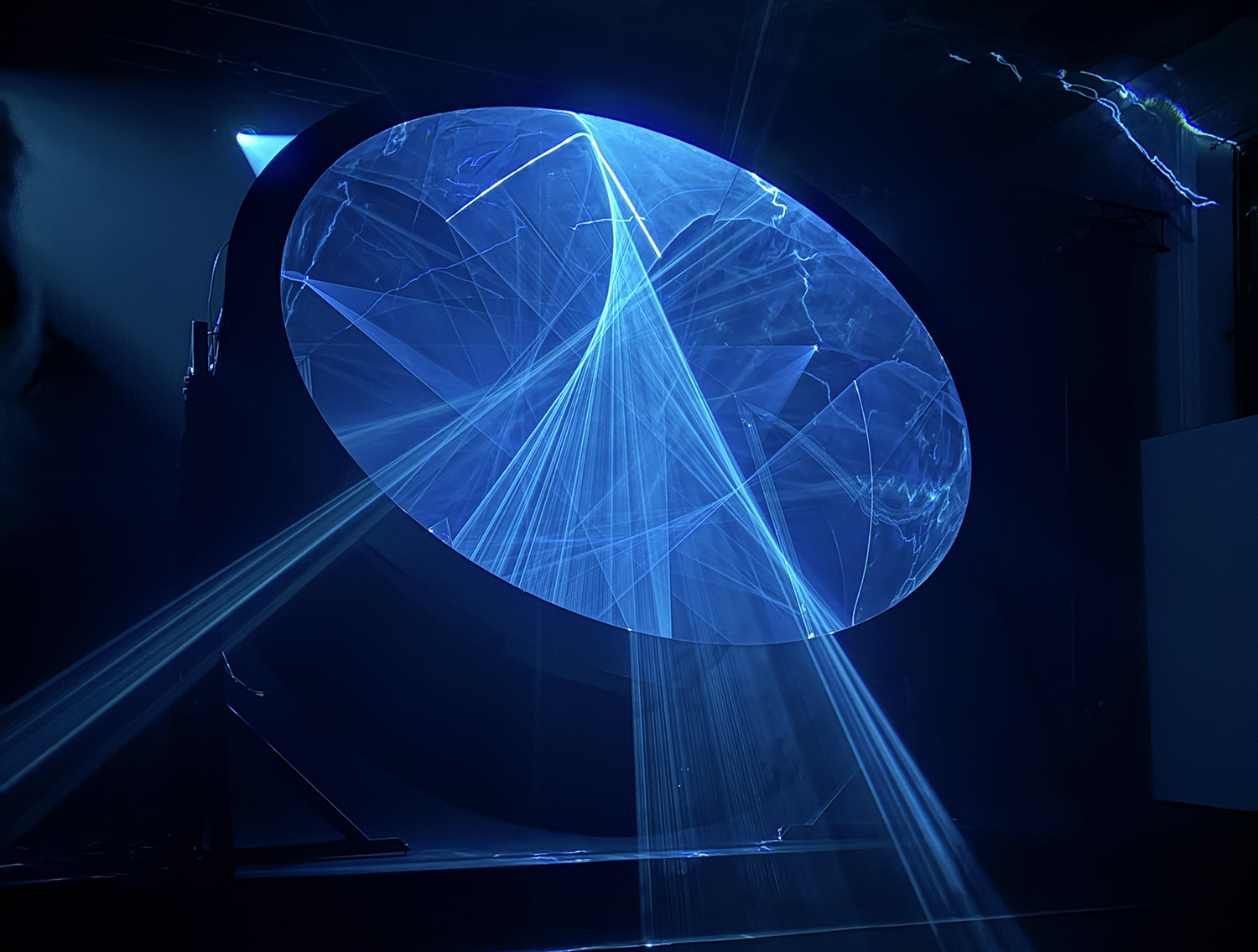
Dinner with a Hyperobject
Tadej Droljc – Savarin Riding Hall, Prague – Installation partner : Run OpeRun
Perhaps the most disquieting of this year’s Signal installations, Dinner with a Hyperobject by Slovenian artist Tadej Droljc engulfs the viewer in an experience that defies scale and definition. Using sound, light and a strange machine, Droljc constructs a sensory environment that seeks to consume the spectator, to transport them into the vast, invisible dimension of what philosopher Timothy Morton calls a hyperobject: phenomena so immense in time and space that they exceed human comprehension.
Installed in the monumental Savarin Riding Hall, itself a Baroque relic of control and order, the piece becomes a kind of metaphysical engine, vibrating, pulsating, confronting us with the realization that intelligence, rhythm, and awareness may not belong solely to humankind. The audience is drawn into this shifting organism of light and resonance. Its effect is both troubling and magnetic, an encounter that redefines the limits of perception. We are left suspended between awe and discomfort, between the architectures of history and the algorithms of the future.
A.M.: Tell me about Signal Inside.
M.P.: Signal Inside came from necessity. Some artworks were too delicate or too intimate for outdoor exposure. In 2016, we had Tundra – a brilliant ex-Russian collective – create a site-specific piece inside a construction site. People waited three hours to get in. After this we understood the need to introduce a small entrance fee, five euros, to manage the flow. It became a way to welcome the more fragile or contemplative pieces. Today, Signal Inside includes twenty works, seven ticketed, thirteen free, keeping accessibility while preserving intimacy.
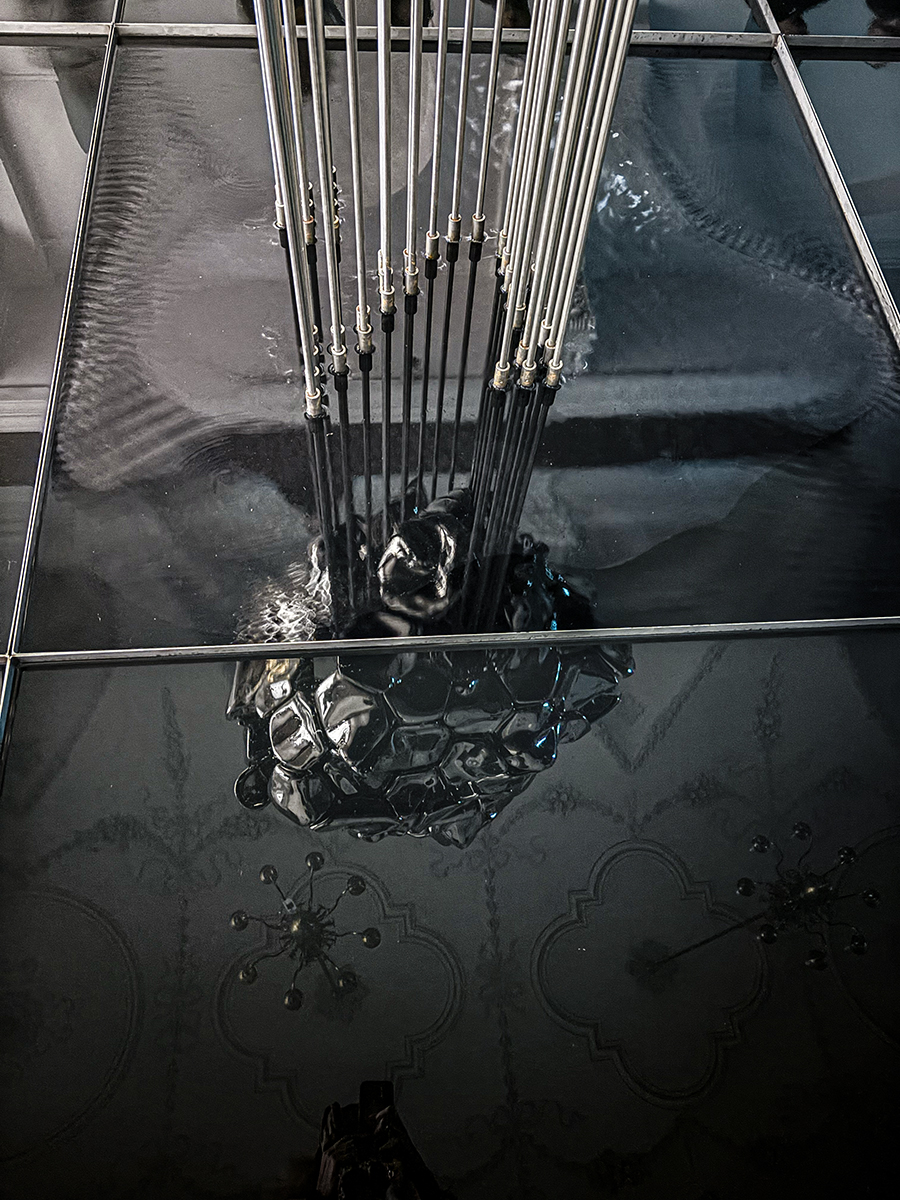
Installation partner : Jewish Museum in Prague
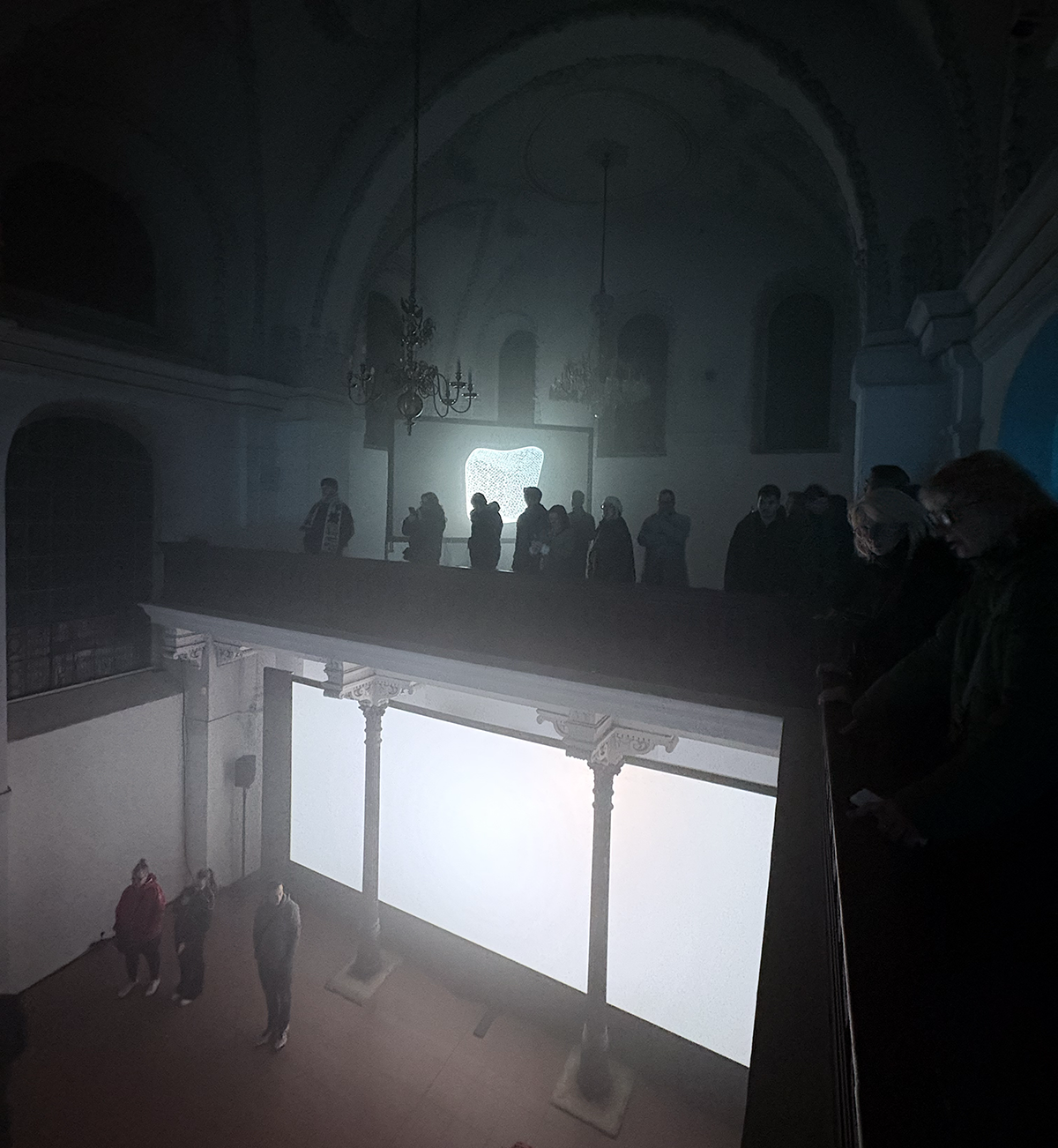
Jan Poš – The myth of Hyperreality
Installation at the Klausen Synagogue, Signal Festival Prague
Within the solemn walls of the Klausen Synagogue, Jan Poš creates a dialogue between the tangible and the immaterial. His installation investigates how physical and digital realities merge into what he calls a hybrid space, a state where the real and the virtual coexist in hyperreality. Using 3D computer software, Poš captures and materializes invisible phenomena such as energy, the flow of information, and magnetic fields, translating them into sculptural forms. The synagogue is transformed into a provisional research site, where the visitor becomes a kind of scientist-archaeologist, uncovering the secret processes hidden within a mysterious meteorite-like object. The Baroque building itself, once the largest synagogue in Prague’s former ghetto, amplifies the meditative strength of the work. Its centuries-old resonance holds the deep vibration of Poš’s creation, imposing a state of self-introspection, where light, matter, and memory merge.
Martin Pošta is also the founder of Signal Space, a permanent gallery for digital and immersive art, created by the team behind Prague’s Signal Festival. Located in the city center, it offers a curated program of cutting-edge installations by international and Czech artists. Signal Space bridges technology, creativity, and public experience, bringing the future of art into a physical, year-round space.
Signal Space was born out of the success of Signal Festival and the vision of the founder and participating artists, who saw the need for a permanent home for digital art. It provides contemporary digital artists from around the world with a platform to showcase their work and connect with a global audience, amplifying their reach and impact beyond the festival itself.
A.M.: And Signal Space?
M.P.: That’s our newest and most ambitious venture, a permanent venue. It just opened two weeks ago. I’m still exhausted! The curation will renew every six months. We wanted to bring permanence to something so ephemeral. The festival burns bright for three days and vanishes, now we have a place to sustain that energy year-round.
A.M.: I saw the selection, some pieces are of true museographic level.
M.P.: Thank you. It was risky, the building is a national heritage site. Legally, architecturally, it was a labyrinth. But I had one certainty: the art. Most works are adaptations of proven pieces by artists I trust completely, they are friends, collaborators, people whose integrity I know.
A.M.: Shohei Fujimoto, for instance, his Intangible Forms was breathtaking.
M.P.: Yes, he’s been with us before, and I love how he reinvents that piece for every site. Playmodes are dear friends too; we’ve known each other for over a decade, working together on festivals from Barcelona to Miami.
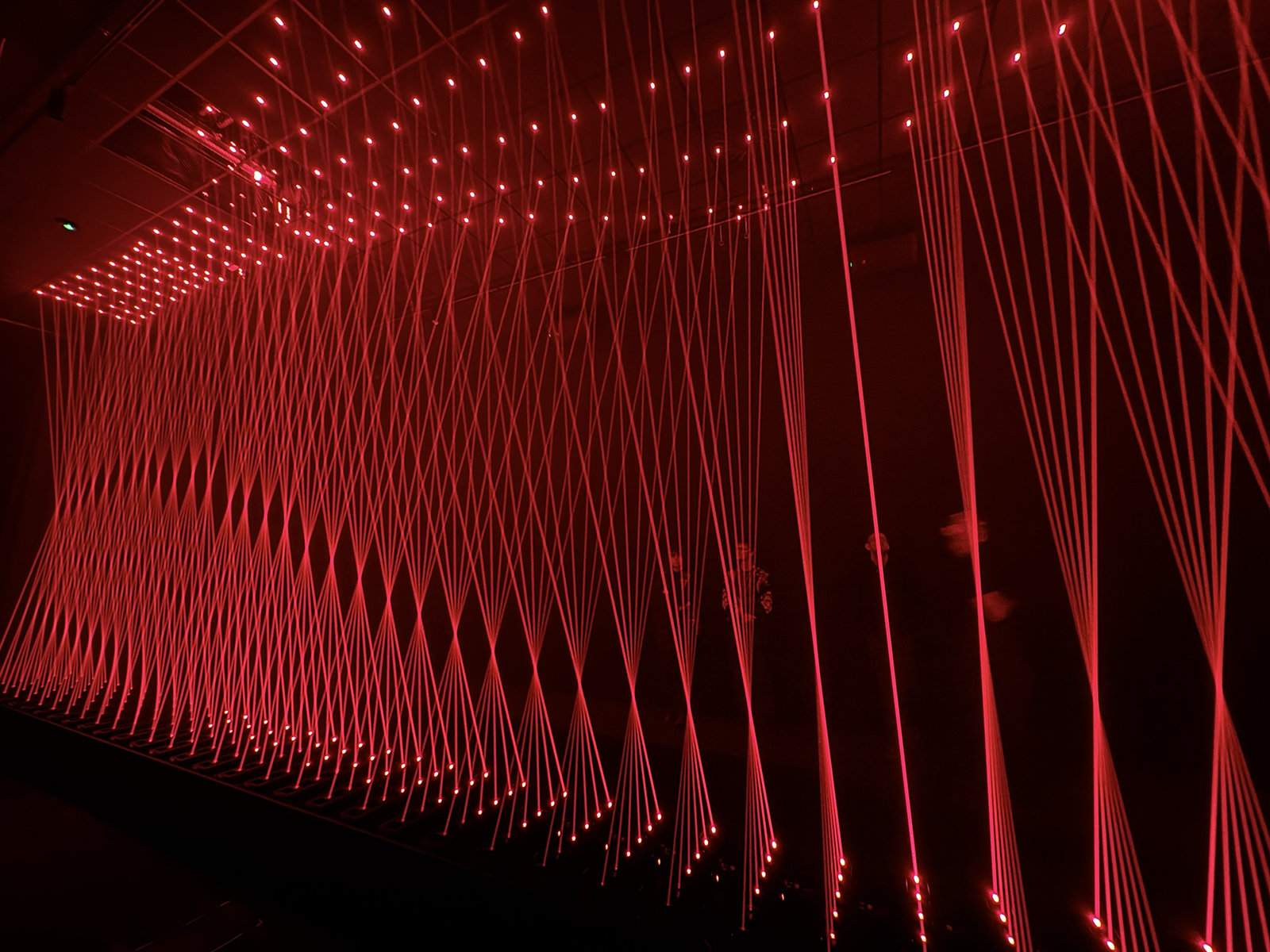
Intangible Forms
Shohei Fujimoto – Signal Space
A.M.: The piece with the underwater creatures, that was Marcos Kay, right?
M.P.: Yes, underwater, unreal, bioluminescent anemones that don’t exist, but feel alive.
A.M.: You seem pragmatic, capable of managing chaos. How do these works affect you emotionally?
M.P.: It must move me. It’s that simple. Over the years, I’ve grown more critical, maybe harder to reach, I’ve seen too much. But when a work grips you from within, when it shakes something fundamental, that’s what matters. Many of these artists are scientists, engineers, researchers. When someone translates knowledge and emotion into art that truly moves you, that’s excellence.
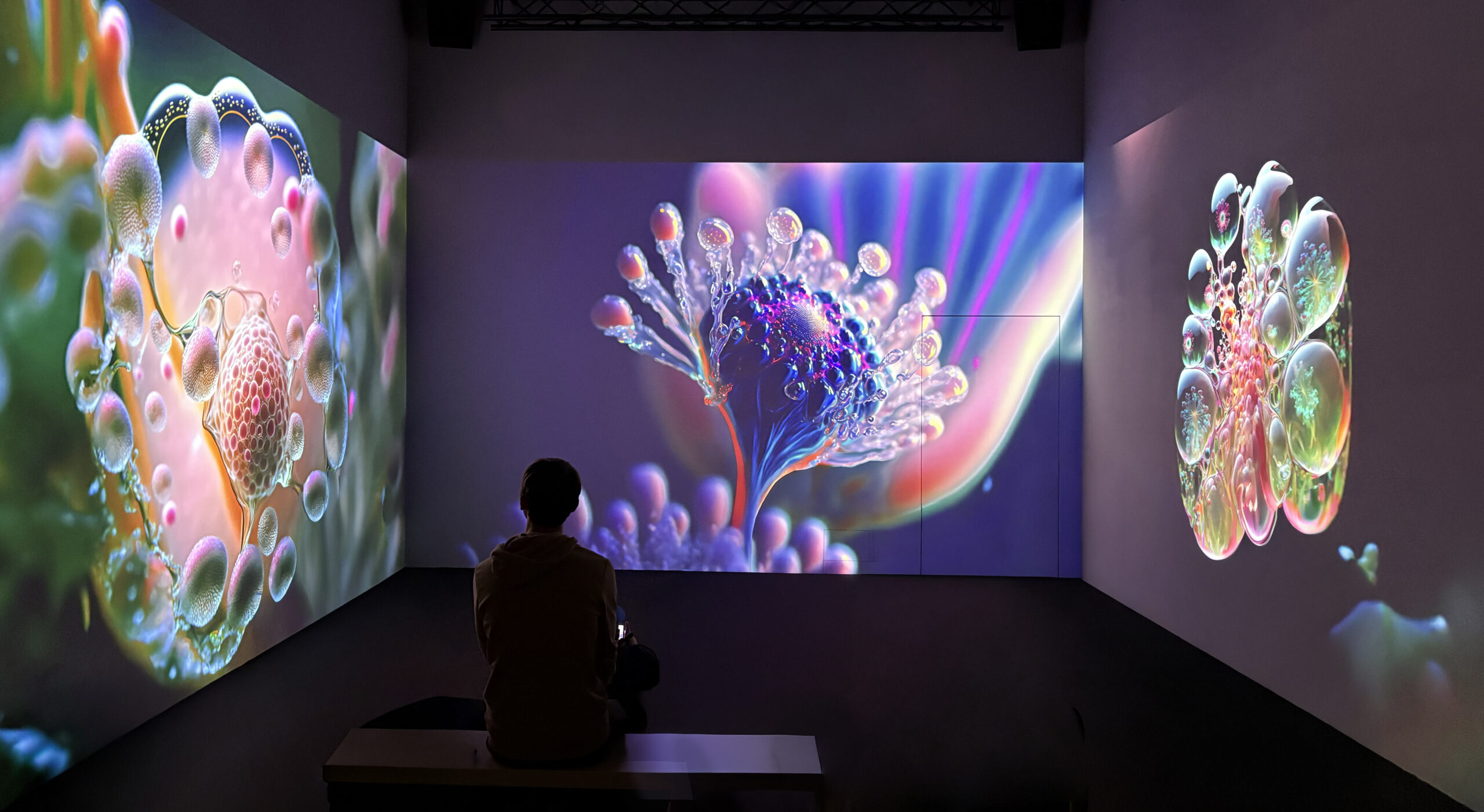
aBiogenesis
Markos Kay (MRK) – Signal Space
Standing before Markos Kay’s aBiogenesis, moments after speaking with the festival’s founder, I felt as though I were witnessing the very principle behind Signal Festival. Kay’s work, rooted in the intersection of art and science, reimagines the “lipid world” theory, suggesting that life began through lipids forming membranes, fragile boundaries between chaos and coherence, between nutrient and consciousness. This primordial act is translated into visual motion: birthing structures, digital matter mimicking the organic. MRK’s practice inhabits a unique tension between the virtual and the material. His aesthetic blends cyberpunk clarity with the intuition of nature, a collision of biology, neuroscience, artificial life, and posthuman philosophy. What emerges is a form of meditation, an attempt to visualize the spark that separates information from being.
Today, Signal Festival is a landmark on the global art map. Between the public’s affection and its founder’s vision, it’s evolving into a permanent platform, with a studio for emerging artists and even an experiential playground for children. Prague becomes what it has always been: a city of light, intellect, and wonder, its façades alive, its baroque ornaments refracted through layers of code and light. Stone is now shaped in photons. Every step felt like crossing a threshold, between the past and what art might yet become. The city itself is a collective studio, a museum, a laboratory, our poem, hosting reflections of data and dream. In this dialogue between centuries, the Signal Festival stands as an act of cultural continuity. The creative mind that once imagined cubist buildings now programs laser and sound; the same spirit of vision, that central European hunger for transcendence, murmurs beneath the cobblestones. Light became language, and the city answered, because Signal Festival is all about perception, about how we look at the world and how art continues to rewrite the very texture of reality, reminding us that everything can be reborn through beauty. I realised that the festival does not simply take over the city. It reveals it.
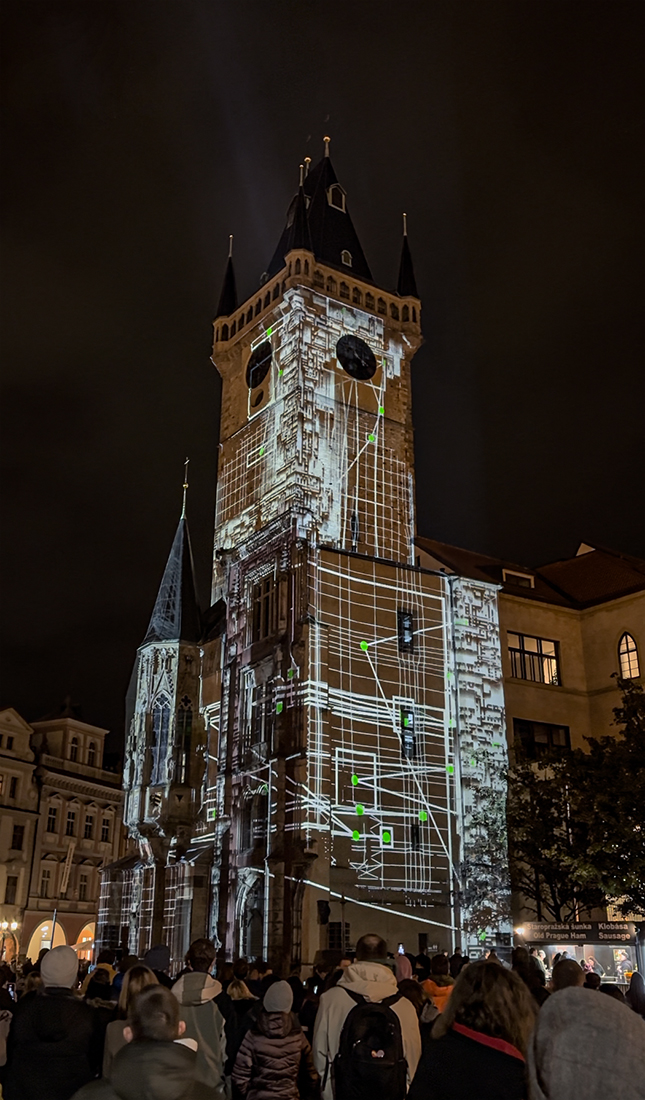
OVERLORD
mammasONica (Italy) – Old Town Hall Tower, Prague
Each year, Prague’s renowned Astronomical Clock Tower becomes a stage for light and thought, a dialogue between time and technology. This year, under the support of the Italian Cultural Institute in Prague, Prague City Tourism, and Prague 1, the Italian collective mammasONica transformed the Gothic landmark into a pulsating monument of data and emotion.
Their video mapping OVERLORD examines the fragile balance between the rational systems that now govern our lives and the raw, unpredictable pulse of human feeling. Across the tower’s medieval façade, numbers, codes, and glowing architectures cascaded in hypnotic loops, a living feedback system teetering between saturation and collapse, a metaphor for our own data-driven world. OVERLORD is a mirror, asking whether we still possess the instinct to listen beyond algorithms, to trust intuition over quantification.
Text and photography © Alexandra Mas, 2025.
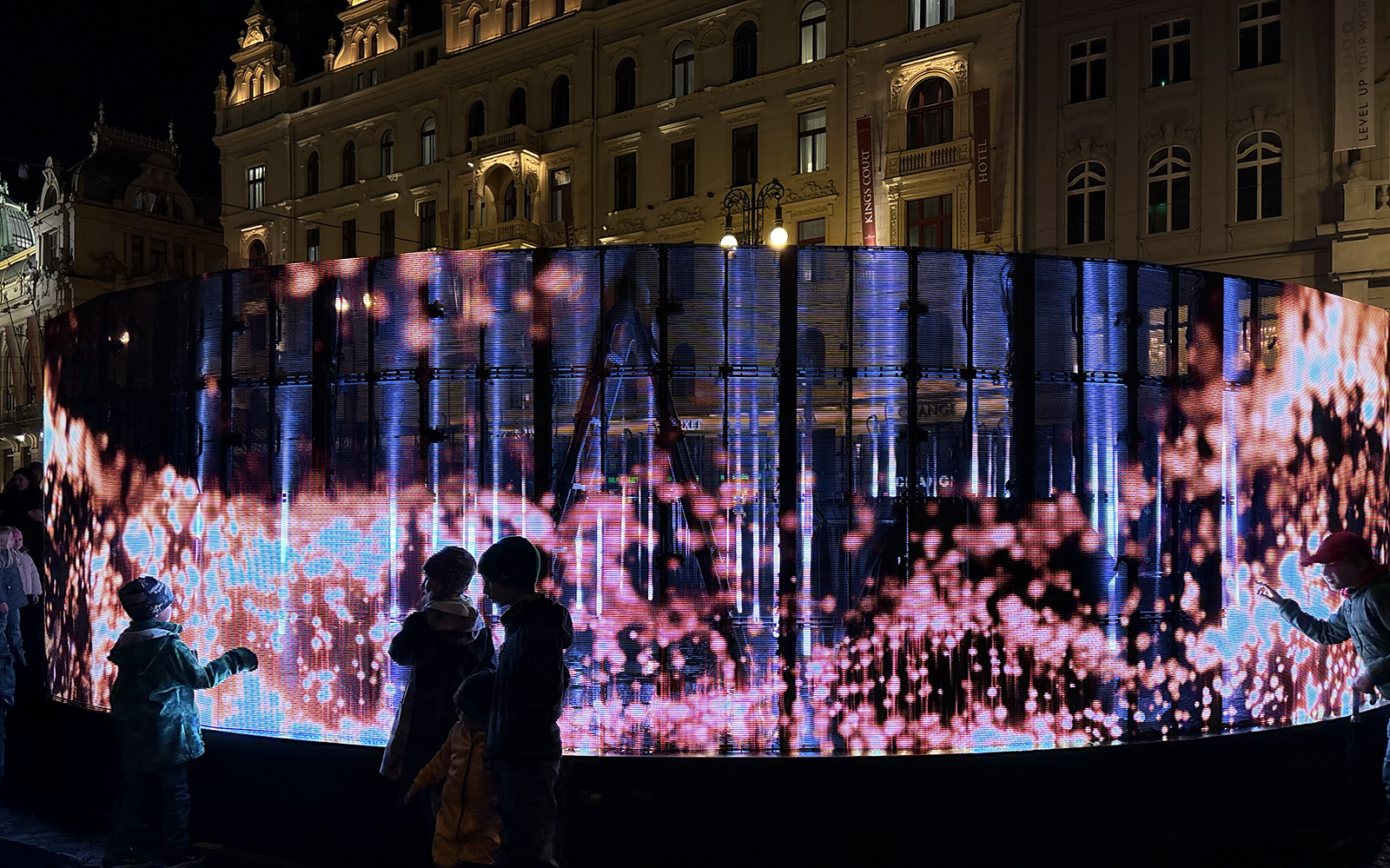
Between Mountains and Seas
Peppercorns Interactive Media Art – Republic Square, Prague