
Written by Alexandra TOUCHARD
It is striking to observe that, in the light of the twenty-first century, Italian baroque cinema has risen once more from the depths. This, at least, is the position defended by Alistair Fox in his 2022 volume Melodrama, Masculinity and International Art Cinema. In the chapter devoted to Guadagnino, titled “Visual Aestheticism and the Queer Prestige of Melodrama: Call Me By Your Name (2017) and Luca Guadagnino’s Desire Trilogy,” the author defines this baroque mode as a cinema acutely aware of the aesthetic weight of its subject matter, shaped by a culture of prestige—opera, Renaissance painting—and marked by a musical use of the camera, often relying on long sequences, close shots, and travelling movements (Fox 177). This baroque impulse, once embodied by Italian filmmakers such as Bertolucci or Visconti, is today upheld by contemporary directors like Paolo Sorrentino and Luca Guadagnino. As Fox reminds us, these filmmakers share “an obsession with a polished representation of youthful beauty.” This is evident in Guadagnino’s work, where youth is rendered as a static, almost marble-carved beauty—whether in Oliver in Call Me By Your Name (2017), Eugene in Queer (2024), or the trio Art, Tashi, and Patrick in Challengers (2024).
What distinguishes Guadagnino, however, is his recurring focus on desire and on the sexual and romantic quests of homosexual characters, or characters whose sexuality is, at the very least, fluid. The director himself makes this link explicit in an interview conducted by Adrien Naselli for Têtu in February 2018: “I have always explored desire. It is something I know, something in which I have even drowned.”
In this study, we will examine three films by Guadagnino which—despite their stylistic differences—present notable similarities in their treatment of desire. We will first consider Call Me By Your Name (2017), adapted from André Aciman’s 2007 novel, which recounts a summer in the Italian countryside and the romance between young Elio and the older Oliver, recruited by Mr. Perlman (Elio’s father). We will then turn to Challengers (2024), centered on a rivalry between two longtime friends and tennis players, Art and Patrick, who compete not only for their place within the sport but also for the heart of the irresistible Tashi, a former tennis prodigy. Finally, we will examine Queer (2024), released the same year, which immerses us in the sticky, humid Mexico of the 1950s to follow the doomed romance between an aging, wealthy junkie (Lee), played by Daniel Craig, and the young, handsome Eugene, who is himself in search of identity.
We will explore how these three films function as a triptych within Guadagnino’s filmography, and how each—through distinct narratives and artistic directions—addresses the impossibility, futility, and pain of homo-romantic and homo-erotic desire.
The Ef(fusion) of Desire and the Pretext of the Feminine
Each of the three films under study illustrates an effusion of desire—namely, a sincere, uncontrollable, almost palpable manifestation of the protagonists’ longing as experienced by the viewer.
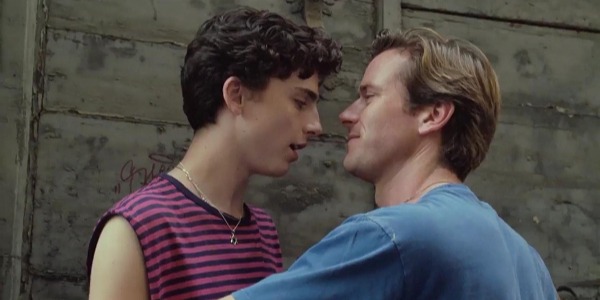
In Call Me By Your Name, Guadagnino adopts a naturalistic aesthetic within a bucolic, almost idyllic landscape of the wild Italian countryside of the 1980s. He fills the frame with a shifting palette of blues, beiges, greens, and yellows. Without falling into the extravagance of colour (as is the case in Pedro Almodóvar’s cinema, for instance), Guadagnino opts for a natural yet beautifying colorimetry. According to Fox, this way of filming space expresses the idea that the protagonists evolve in a comfortable environment in which they can “assert their deepest selves” (Fox 185). Indeed, it is within this corner of paradise that Elio is able to fully discover himself, and that Oliver is finally capable of embracing the homoerotic desire he represses in his everyday life.
If the world in which Elio and Oliver move appears as a kind of Eden—allowing the two young men to love freely—the sex scenes, by contrast, are filmed in a rawer way, stripped of embellishment or idealization. The first sex scene between Elio and Oliver reveals a relationship of dominance between Oliver’s body—more assured, taller, broader, and more experienced—and the slighter, more awkward body of Timothée Chalamet’s Elio. From the outset, we are confronted with an imbalance of desire: one is drawn to youth, the other to maturity and experience.
This sexual attraction of an older man toward a younger one recalls the initiatory relationships between masters and protégés in Ancient Greece. Indeed, paideia (from paiderastia, meaning “love for the younger”) was a common practice in Athens during the 5th and 6th centuries BCE, aimed at educating a young citizen theoretically, physically, and sexually. The learning process took place between an erastes (a mature man, a tutelary figure) who was the desirer, and an eromenos (an adolescent) who was the object of desire. Moreover, this attraction within both the novel and the film toward Greek folklore is already established through the professions of Mr. Perlman and Oliver, who work together on the excavation of an ancient artefact.
Thus, in Call Me By Your Name, desire becomes palpable through the sexual imbalance that emphasizes Elio’s initiation and the dominant posture Oliver exerts over him, recreating at the same time a homosocial ideal reminiscent of Ancient Greece. Let us recall that homosocial desire, as formulated by Eve Kosofsky Sedgwick in Between Men: English Literature and Male Homosocial Desire (1985), designates social, affective, or symbolic bonds between people of the same sex—particularly between men—without those bonds necessarily being sexual, though social pressures draw strict limits around the intimacy they may express (Sedgwick 1–3).
However, the paideia reproduced by Oliver and Elio was historically tied to education or desire, but never to love. The romantic dimension of their dynamic may well foreshadow the tragic outcome of a desire fulfilled.
Challengers, too, presents a hetero- and homoerotic sexual tension within a love triangle linking Art, Patrick, and Tashi. In a highly charged early sequence, Art and Patrick invite Tashi to their hotel room. The young woman accepts, and after an ambiguous conversation about a mutual masturbation experience the two men shared when they were younger—though they refuse to name its homosexual dimension—the protagonists end up sitting together at the edge of the bed: three bodies aligned. The young woman, positioned between the two men, kisses each one in turn, then guides them toward one another. Before Tashi breaks the tease, a close shot of Art and Patrick reveals a long, languorous kiss and their faces marked by desire—at which point the presence of the feminine has vanished entirely.

Tashi, Art et Patrick kissing on a bed – extract from Challenger by Luca Guadagnino – 2024.
This is a queer triangle in which the feminine presence is merely a pretext, a convenient veil meant to conceal the homoerotic charge binding the two male participants. This is, moreover, precisely the thesis proposed by Matthew Tinkcom in his chapter “Scandalous! Kenneth Anger and the Prohibition of Hollywood History” in the collection Out Takes. Tinkcom argues that although Hollywood claims to uphold a heterosexual moral order, its entire system is in fact structured around desire, transgression, and secrecy. For Tinkcom, Hollywood unconsciously expresses a repressed homosexual desire, thinly covered by the alibi of the feminine. Guadagnino, however, fully aware of this mechanism, delights in staging the concealment of homosexuality behind the feminine, thereby playfully representing the complexity of repressed desire. In doing so, he invites the spectator to desire—without boundary—alongside his characters.
This feminine alibi also appears in Call Me By Your Name from the very opening pages of the narrative, since Elio, before Oliver’s arrival, spends time with a French girl for whom he seems to feel no genuine desire. In Guadagnino’s cinema—particularly in relation to homosexual desire—the woman becomes a protective buffer, allowing male characters to experiment with, and gradually accept, their homoerotic impulses while avoiding a brutal or premature revelation.
In Queer, the attempt to conceal homosexuality is not enacted through the feminine but through geographical displacement—in this case, by fleeing to another country: Mexico. Lee (played by Daniel Craig) is portrayed as a pitiful man, consumed by drug and alcohol addiction and by his own irrepressible desire. The film opens on a date scene, shot in shot-reverse-shot, between Lee and a much younger man. The first line of the film is: “You’re not a fag. Are you?” This awkward encounter—wavering between humiliation and domination—sets the tone and immediately characterises a figure who is both deeply repressed and utterly consumed by his own longing.
Finally, it is crucial to note that for Guadagnino, desire is always tied to reciprocity, even to a form of fusion between two beings. Reciprocity is first visible in Challengers, where the two unspoken lovers, Art and Patrick, are also tennis rivals. The sport becomes a site of confrontation but also of exchange. It is through tennis that reciprocity is enacted—and with it, the erotic tension sublimated into the force each player puts into returning the ball to the other.
In Call Me By Your Name, Oliver asks Elio to call him by his name, and vice versa. Beyond simply experiencing reciprocity in desire, the gesture expresses a wish to merge with the other, to become the other. In his essay “A Review of Call Me By Your Name, Courtesy of Philology,” Justin Hudak rightly observes that Elio’s name is already contained within Oliver’s: “Oliver is already, at this early stage, inside Elio; at the same time, E-L-I-O is already, anagrammatically, inside O-L-I-v-E-r” (HUDAK 151).
In Queer, the psychedelic delirium sequence in the jungle between Lee and Eugene creates, visually—through the treatment of skin—the illusion of two bodies merging into one.
Thus, although desire is a recurring theme in Guadagnino’s work, consistently treated through the prism of intensity and fusion, even when veiled by the feminine, one must also consider the sensory dimension of desire that the filmmaker constructs through image and sound.
The Texture and Symbolism of Desire: Sex as Staged
Desire, in Guadagnino’s cinema, is conveyed above all through the sensory. Most of the time, it has little to do with dialogue. The director works extensively on texture and its symbolic charge in order to suggest desire without ever stating it explicitly.
Take, for instance, the famous peach sequence in Call Me By Your Name. In this scene, Elio touches a peach. The sound of his fingers on the fruit’s rough, fuzzy skin is amplified. The fruit’s opening, darkened by a chiaroscuro effect, unmistakably evokes an anus, into which Elio pushes his fingers to remove the pit and eventually masturbate. Throughout the sequence, the texture of the juice is emphasized by the play of light afforded by the attic in which the protagonist stands. The sound design, echoing the manipulation of the fruit’s pulp, is crafted so as to make the viewer feel the texture of the peach into which Elio enacts his fantasy. The moisture and roughness of the fruit convey the full erotic charge of the moment.
Moreover, the fruit itself, as an object onto which desire is transposed, is highly evocative. At the beginning of the film, Elio eats an apricot—a fruit whose name etymologically refers to the notion of “premature,” as Fox points out in her analysis (FOX 184). At this stage in the narrative, however, in the sequence in question—after Elio has already consummated his relationship with Oliver—it is a peach.
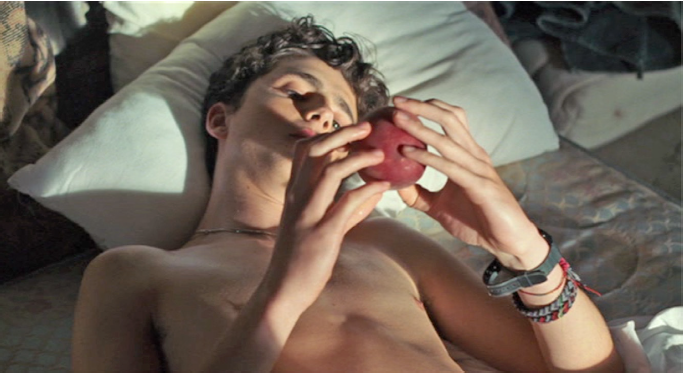
Elio touching a peach – extract from Call Me By Your Name by Luca Guadagnino – 2017.
The fruit inevitably recalls the fruit of knowledge tasted by Adam and Eve in the Book of Genesis. In the context of the film, it represents a form of self-knowledge for the protagonist, a moment of sexual awakening. The peach-picking scene thus works as a mirror, creating a contrast with the beginning of the film, in which the apricot signified his lack of experience in this domain. Moreover, in the Bible it is written that the fruit is given to man to taste:
“6. When the woman saw that the tree was good for food and pleasing to the eye, and also desirable for gaining wisdom, she took some of its fruit and ate it; she also gave some to her husband, who was with her, and he ate it.”
(The Bible, Genesis 3:6–7)
A few hours later (as suggested by the dimmer light in the following sequence), Oliver finds the fruit and, understanding what Elio has done, he tastes it. The sequence is therefore charged not only sensorially but also symbolically, reusing a biblical motif and bending it to the context of a scene centered on homosexual desire.
Furthermore, when speaking of the texture of desire, one must also consider the motif of water. As we know, symbolically water evokes the fluidity of desire and the eroticization of bodies. This is particularly evident in Ozon’s Swimming Pool (2003) and in Pedro Almodóvar’s La mala educación (2004), where the swimming pool becomes the birthplace of a previously unacknowledged desire (lesbian desire in Ozon’s film and homosexual desire in Almodóvar’s). The motif appears as well in Call Me By Your Name, through the pool in which Oliver bathes, triggering Elio’s first homosexual stirrings.
However, in Guadagnino’s work, water is also explored through dirt, humidity, and sweat. This becomes even more pronounced in Queer and Challengers. Queer gives us the example of Lee (Daniel Craig), who, attempting to detox in a tropical climate, is constantly covered in sweat. Guadagnino highlights this through numerous close-up shots that reveal the wrinkled texture of the character’s skin. Here, sweat serves less to provoke Eugene’s desire than to illustrate the unbearable addictions against which Lee struggles: drug withdrawal and the irrepressible urge to live out a homosexual desire repressed both by society and by his own prejudices.
In Challengers, sweat becomes a genuine marker of the homoerotic dimension of tennis. In Guadagnino’s vision, tennis operates as a metaphor for sex: it takes place between two people in a dynamic of exchange, it involves sweat and suggestive exhalations that resemble cries of pleasure, and—both because of the rules of tennis and Guadagnino’s deliberate choice—it always pits characters of the same sex against each other. Tashi even admits to the two protagonists that on the court, playing with an opponent “is like an intimate relationship,” because one must understand the other—their rhythms and patterns—for the match to exist.
In both Queer and Challengers, the director therefore relies on close-up shots as well as slow motion to convey the frustration in which desire implodes. Through this evocative cinematic language, Guadagnino teases the viewer and draws them into the desire experienced by his characters.
Inversion and Reversal of the Gaze: The Female Gaze
A shift in paradigms of looking.
Guadagnino’s representation of desire also emerges from a reversal of the gaze. Indeed, in cinema, sexuality has long been depicted through a masculine gaze that objectifies women’s bodies while simultaneously excluding female spectators from the desire that erotic scenes are meant to elicit in men. This is precisely the issue raised by Paul Julian Smith in his essay Desire Unlimited, where he cites Mary Ann Doane:
“In The Desire to Desire, Mary Ann Doane offers an excellent analysis of the complexities of the ‘woman’s film.’ Doane outlines the characteristics through which audiences were interpellated in such films: ‘closeness, passivity, over-identification’ (p. 2). Since the woman’s position in mainstream cinema is widely considered to resist narrativization (because it is ‘aligned with spectacle, space, or image’ [p. 5]), female spectators were encouraged to adopt ‘the impossible position of a purely passive desire’ (p. 7), a position of contiguity in which the body, too close, was ‘folded back upon itself’ (p. 12). Based on ‘temporal immediacy, spatial proximity, [and the] confusion of desire’ (p. 13), feminine fantasy was ‘de-eroticized’ (p. 18), trapped in ‘a dangerous intimacy with the image.’ Female desire in these films is thus a desire to desire, an inability to access the fetishistic distance that grants (heterosexual) men visual pleasure in narrative cinema.” (Smith 81–82)
This passivity of women—as characters and as spectators—described by Doane is therefore explained by a dangerous proximity to the image: an image shaped by heterosexual male desire, in which the feminine subject cannot recognize herself and is consequently deprived of pleasure. In Challengers, Guadagnino overturns the male gaze by offering a film guided entirely by the protagonist’s perspective. The film’s opening scene immediately signals this intention. The succession of shots reveals Patrick’s and Art’s body parts in slow motion (mouths, arms, torsos). The final shot is a close-up of Tashi’s (Zendaya’s) gaze. From the start, the film announces that what we are about to see—particularly the way male bodies will be eroticized throughout—is nothing other than the prism of the female protagonist.
Because of her injury, Tashi must stop playing tennis. Since she can no longer practice, all she has left is to watch tennis. Through this narrative detail, the woman adopts the position of the voyeur—a role traditionally assigned to men. The poster, in which the two men appear as reflections in the lenses of Tashi’s sunglasses, clearly indicates the viewpoint the film embraces.
Moreover, in the well-known bedroom sequence (mentioned in the first part), the protagonist is simultaneously an actor—since she initiates the beginning of a sexual encounter—a spectator, when she steps back to watch the two boys kiss, and a leader, since when she decides to go to bed, she immediately interrupts the foreplay among the three characters. Guadagnino thus restores a place for women within desire by objectifying, through his camera, not the female body but the male one.
Tashi is not merely the one who looks; she is also the one who initiates and commands. She is the figure for whom the two men compete. Finally, Guadagnino renders her desirable without reducing her to that single trait. She is also a skilled player, a cunning strategist, and a far more open-minded character than the two male protagonists, whose emotions are often governed by rivalry and by repressed desire.
Representation of Another Type of Masculinity
Guadagnino destabilizes traditional masculine stereotypes by offering an alternative ideal of virility to the one long upheld by mainstream cinema. It is no coincidence that the director chooses to cast Daniel Craig as the protagonist of his film. Craig is, above all, the actor of the 007 franchise—an embodiment of the heterosexual sex symbol, associated in the collective imagination with the irresistible dandy capable of seducing any woman he desires. Guadagnino twists this representation by turning the actor into a pathetic character, miserable in love, addicted to drugs, and homosexual. Through this provocative casting choice, the director seeks to shatter entrenched stereotypes surrounding masculinity and to unsettle the spectator.
This is also what Owen Gleiberman highlights in his Variety review, stating that “Craig turns his character into a literary dog—nasty and witty, shot through with vulnerability.” Furthermore, Guadagnino magnifies Eugene by frequently using slow-motion shots and subjective camera angles in the first part of the film. The characters that Guadagnino beautifies and sexualizes have little to do with the dominant idea of virility. Whether it is Elio, Eugene, or even Oliver, the objects of desire are often men with an androgynous appearance (slender, fine features, gentle expressions). Moreover, Guadagnino renders them desirable because of, rather than in spite of, their flaws and vulnerabilities.
Elio, for instance, is a young man whose movements are awkward and hurried. Eugene is lost and drowning in a desperate longing for love. All these traits contradict the confident, emotionless image that society encourages men to embody in its traditional conception of virility. This aligns with the argument proposed by Fox, who writes: “As cultural homohysteria declines significantly, a hegemonic and conservative form of masculinity will lose its dominance, and softer masculinities will be able to exist without social stigma functioning to control them” (Fox 193). He suggests, in fact, that Guadagnino’s cinema contributes to dismantling such stereotypes.
Thus, whether through the pop aesthetic of Challengers, the sticky, feverish atmosphere of Queer, or the naturalistic tone of Call Me By Your Name, Guadagnino films male characters who are desirable both to homosexual men and to women, all while deconstructing the rigid image of virility and desire.
Fallen Desire and Impossible Love
As we have seen, desire is a theme dear to Guadagnino. It is always irrepressible—it overwhelms the characters and most often leads them to their downfall. The most obvious example is undoubtedly the separation between Elio and Oliver in Call Me By Your Name, whose final sequence—a fixed, tight close-up on Timothée Chalamet’s face, illuminated by the fireplace, eyes filled with tears—draws the spectator into the wretched depths of an impossible love that extinguishes itself once winter arrives.
Fulfilled desire always brings about a form of romantic disenchantment. Despite the love that binds the two characters, one of them is not ready to affirm who he is, preferring a more conventional life. Indeed, at the end of the film we learn that Oliver is about to marry a woman. Contrary to appearances, it is Oliver who faces the greatest internal struggle. He is older, and yet he seems to have repressed an entire dimension of his homoerotic desire in favor of what society expects of him. At the end of the film, he confesses this to Elio when the latter admits having told his parents about their summer romance. Oliver replies: “You’re so lucky. My father would have disowned me.” This exchange between the former lovers suggests that any discussion of homosexuality is unwelcome within Oliver’s family.
This confirms Judith Butler’s theory regarding the performative dimension of language. Because words are performative and function as actions, to define oneself through sexuality or gender identity is to bring that aspect of oneself into existence. Thus, she explains that recognition by others—something Oliver lacks in Guadagnino’s work—is essential to the formation of identity. This is what she defends in “Critically Queer,” where she affirms that “the discursive condition of social recognition precedes and conditions the formation of the subject: recognition (…) forms that subject” (Butler 226).
Elio’s father, on the other hand, proves to be remarkably open-minded. He supports his son after Oliver’s departure and encourages him to fully embrace the sadness that overwhelms him, for it is the sign that the love he experienced was real. However, this utopian vision of the understanding, progressive parent is also questioned by Fox, who highlights the ambivalence of the parent/child dynamic in Guadagnino’s cinema. He argues that by consenting to this union, Mr. Perlman inadvertently thrusts his son into a relationship of domination with an older man who will ultimately abandon him. Thus, the role of the parent is complex: at times a shield against sorrow, at others a contributor to the protagonist’s disillusionment.
In this sense, the ending of Call Me By Your Name—which brings a definitive end to Elio’s paideia under the guidance of the older Oliver—offers us a Platonic conception of love and desire. Plato acknowledges desire as something natural, yet he places it in direct relation to pain and enslavement, as evidenced in this passage from the Laws:
“What is most natural to human beings is to have pleasures, pains, and desires, to which the mortal living creature is quite simply bound and suspended by the most serious interests of its existence…”
Olivia Gazalé, in her essay Je t’aime à la philo: quand les philosophes parlent d’amour et de sexe, explains this Platonic view by affirming that only the spiritual union of two beings—of two souls—can lead to true love:
“For Plato, sublime love is achieved through the spiritual—and not carnal—union of two souls who inspire each other in their search for the True. Love is that divine impulse that tears us away from our finitude and makes us reach toward the infinite. Conversely, sexual desire imprisons us in our bodies and seeks only its own extinction. While physical possession repeatedly extinguishes desire in fleeting moments of carnal pleasure, love endlessly increases desire and aims for its immortality.” (Gazalé 72)
Desire—and the sexual act—would then be nothing but a loss for both body and mind, leading men like Elio and Oliver, Lee and Eugene, Patrick and Art, to their ruin. This idea is confirmed in Queer, since Lee, beyond physical desire, is primarily seeking human warmth and genuine love—a need he constantly confuses with the excesses of sex and drugs to which he is addicted.

Eugène embracing Lee in the bed – extract from Queer by Luca Guadagnino – 2024.
It is in the final, utterly heartbreaking sequence that we grasp the full ambiguity of Lee’s character: as he lies dying, he relives the sensation of Eugene’s legs wrapped around his own in bed. This ending directly echoes the beginning of their story, when Lee, shivering with cold as a result of withdrawal, is embraced by Eugene for warmth. Thus, in the final moments of his life, what remains to this old man—depicted throughout the film as wretched—is nothing more than the brief and fleeting sensation of a vanished love, rather than the physical acts the two men once shared.
Moreover, the entire final section—visually inspired by Lynch’s cinema as well as the iconic ending of Stanley Kubrick’s 2001: A Space Odyssey—creates the illusion of a strange dream in which Lee seems to lose himself. Within this dream, he sees Eugene and shoots him with a revolver. This violent act may directly echo the tragic story of the poets Verlaine and Rimbaud. Symbolically, it also reflects a desire to kill desire itself, to prevent it from continuing to torment a protagonist who has already suffered too much.
Yet the red serpent devouring its own tail, forming the symbol of infinity, clearly indicates that desire is uncontrollable and endless. Known as the ouroboros, this motif—dating back to Ancient Greece—symbolizes the cyclical nature of all things. Just like the seasons or the cycle of day and night, desire comes and goes, insidiously guiding the individual toward his ruin, and toward the impossibility of an absolute, pure, and eternal love such as that imagined long ago by Plato.
Finally, in Challengers, the ending is less tragic than in the two previous films. Nevertheless, the theme of desire without resolution remains present. The final sequence, which pits Art against Patrick under Tashi’s watchful gaze, offers a match charged with tension, in which the camera adopts the subjective point of view of the tennis ball. The entire scene conveys a feverish swell of desire. Yet the match concludes with the two men embracing, ultimately refusing to bring the game to a decisive end. As Alissa Wilkinson highlights in her New York Times article on the film’s ending, it is this very “storm of shots” that builds up desire and generates the frustration of not knowing the winner. In this erotic game, therefore, no one emerges victorious. What remains instead is the tenderness and affection that the former friends agree to share once again despite their differences.
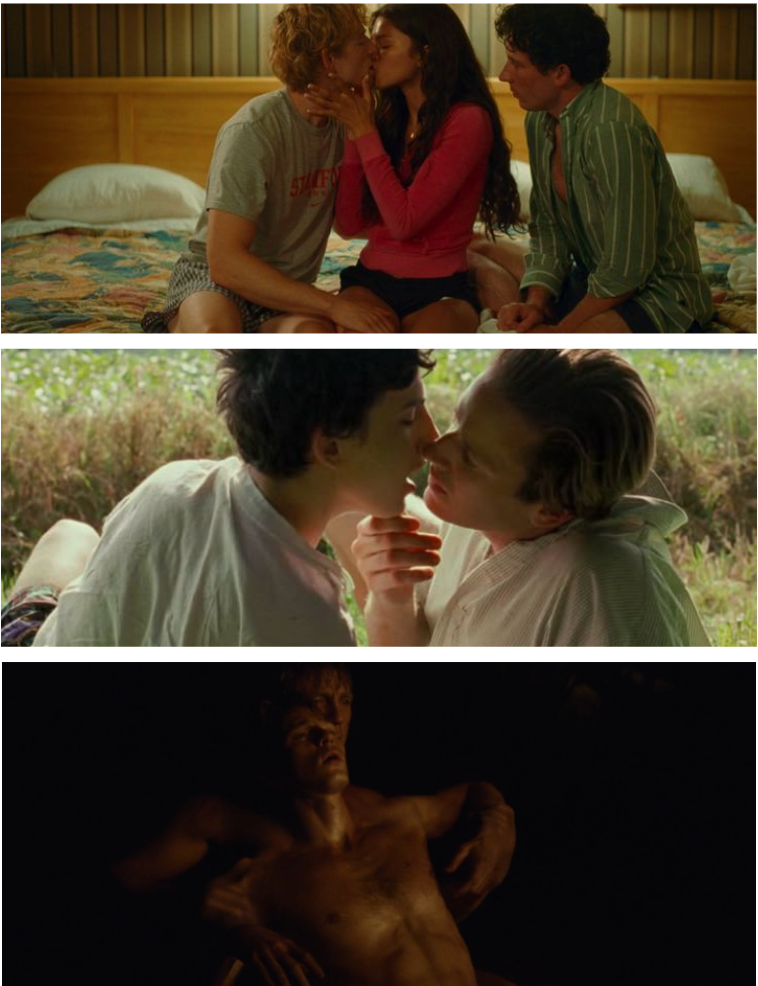
Extracts from Challenger, Call Me By Your Name and Queer by Luca Guadagnino
Luca Guadagnino’s triptych—Call Me By Your Name, Challengers, and Queer—offers, through three distinct aesthetics, an ongoing dialogue about desire: irrepressible, revitalizing, destructive, and ultimately futile. Through a reversal of the gaze that sexualizes the male body, the director aims not only to depict homosexual desire on screen but also to open up the space for female spectators to desire openly. This overarching theme, which runs through Guadagnino’s entire body of work, is expressed through staging that is at times naturalistic and raw (as in Call Me By Your Name), and at other times vibrant and pop-infused, as executed in Challengers.
What remains particularly striking, however, is the texture he lends to the cinematic representation of sexuality. By working meticulously with image and sound to convey the sensual and corporeal dimension of desire, Guadagnino offers the spectator—just as he offers his characters—an experiential space for desiring, and more than that, for experiencing pleasure. Although his films focus predominantly on homoerotic desire, they are not films about homosexuality per se. As Fox argues in his research, the dynamics between the characters stem from “the emotional experience of the protagonists as they come to understand their homosexual or bisexual identities.” These films are not about coming out; rather, they stage an interior journey in which the protagonists attempt, often painfully, to reconcile their desires with the world around them.
Yet the conclusion of each film tends to lean toward the fatality and vanity of desire. As desire erodes with time and with the body’s weakening, what remains is the longing for a deeper, Platonic connection—one that cannot fully exist in the worlds inhabited by these characters. All of Guadagnino’s protagonists, far beyond their hunger for desire, are in search of a more profound meaning in existence. The desire they attempt to satisfy is never enough to provide what the heart demands.
What ultimately remains is the irremediable need for tenderness—a need never fulfilled by insufficient or repressed sexuality. It is this tenderness that brings the final tennis match in Challengers to a close in an embrace; the tenderness for which Elio lets winter pass and allows his first love to drift away; and the tenderness that lulls Lee into sleep in the final moments of his life, held in a dream by the legs of the lover he once had.
Works Cited
Butler, Judith. “Critically Queer.” Bodies That Matter: On the Discursive Limits of Sex, Routledge, 1993, pp. 223–42.
Dargis, Manohla. “‘Challengers’ Review: Game, Set, Love Matches Zendaya, Josh O’Connor and Mike Faist Play Friends, Lovers and Foes on and off the Tennis Court in Luca Guadagnino’s Latest.” The New York Times, 25 Apr. 2024, updated 6 Jan. 2025.
Fox, Alistair. “Visual Aestheticism and the Queer Prestige Melodrama: Call Me By Your Name (2017) and Luca Guadagnino’s Desire Trilogy.” Melodrama, Masculinity and International Art Cinema, Anthem Press, 2022.
Gazalé, Olivia. I Love You in Philosophy: When Philosophers Talk About Love and Sex. Robert Laffont, 2012.
Gleiberman, Owen. “‘Queer’ Review: Daniel Craig Shows a Whole New Side in Luca Guadagnino’s Bold and Trippy Adaptation of William S. Burroughs’ Ahead-of-Its-Time Novel.” Variety, 3 Sept. 2024.
Hudak, Justin. “A Review of Call Me By Your Name, Courtesy of Philology.” Arion: A Journal of Humanities and the Classics, vol. 26, no. 2, Trustees of Boston University, Fall 2018, pp. 151–60.
The Bible. Genesis 3:6–7. Louis Segond Translation.
Naselli, Adrien. “Luca Guadagnino Talks Call Me By Your Name: ‘Elio is Me.’” Têtu, 27 Feb. 2018.
Plato. Laws. Complete Works, vol. 2, Gallimard, 1943.
Sedgwick, Eve Kosofsky. Between Men: English Literature and Male Homosocial Desire. Columbia University Press, 1985.
Smith, Paul Julian. “La ley del deseo.” Desire Unlimited: The Cinema of Pedro Almodóvar, Verso, 2014, pp. 82–83.
Tinkcom, Matthew. “Scandalous! Kenneth Anger and the Prohibition of Hollywood History.” Out Takes: Essays on Queer Theory and Film, edited by Ellis Hanson, Duke University Press, 1999, pp. 69–90.
Winklinson, Alissa, and Wesley Morris. “‘Challengers’ and That Ending: Our Critics Have Thoughts. The Tennis Movie Comes to an Abrupt Stop Midmatch, So We Don’t Know Who Won. Does That Matter?” The New York Times, 7 May 2024.

Alexandra TOUCHARD
Redactor and Writer