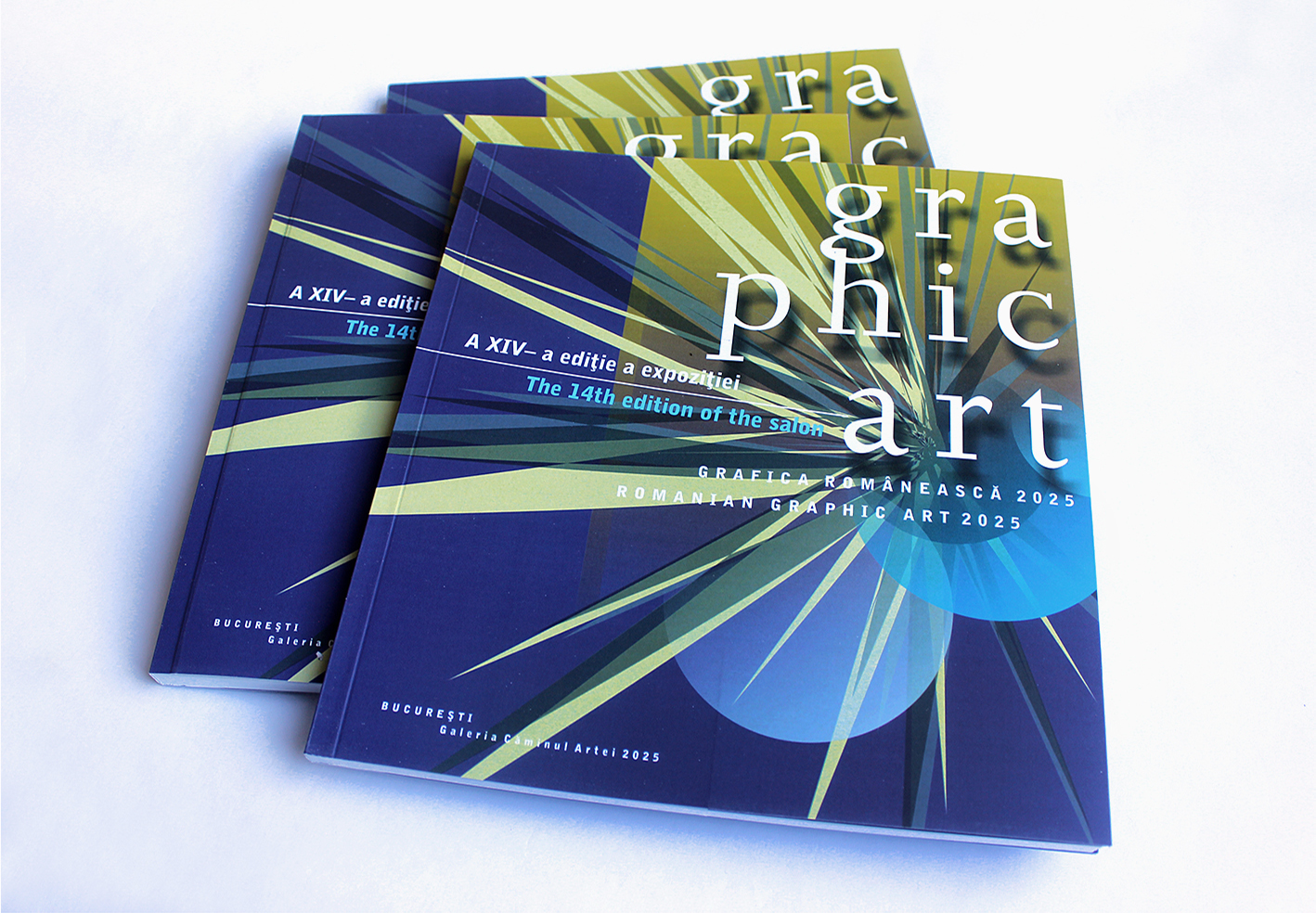
“One Hundred and Twelve Sparkling Drops”
The 14th Edition of the Romanian Graphic Arts Annual Show
Căminul Artei Gallery, Bucharest
by Alexandra M. Ivancenco
There are exhibitions that gather artists, and there are exhibitions that become statements. The 14th edition of Grafica Românească (The Romanian Graphic Arts Annual Show), held at the historic Căminul Artei Gallery in central Bucharest and supported by the Union of Plastic Artists (UAP), falls decidedly into the latter. This is not only the largest gathering of printmakers and graphic artists in Romania, but also one of the most refined, in execution, in technique, in spirit.
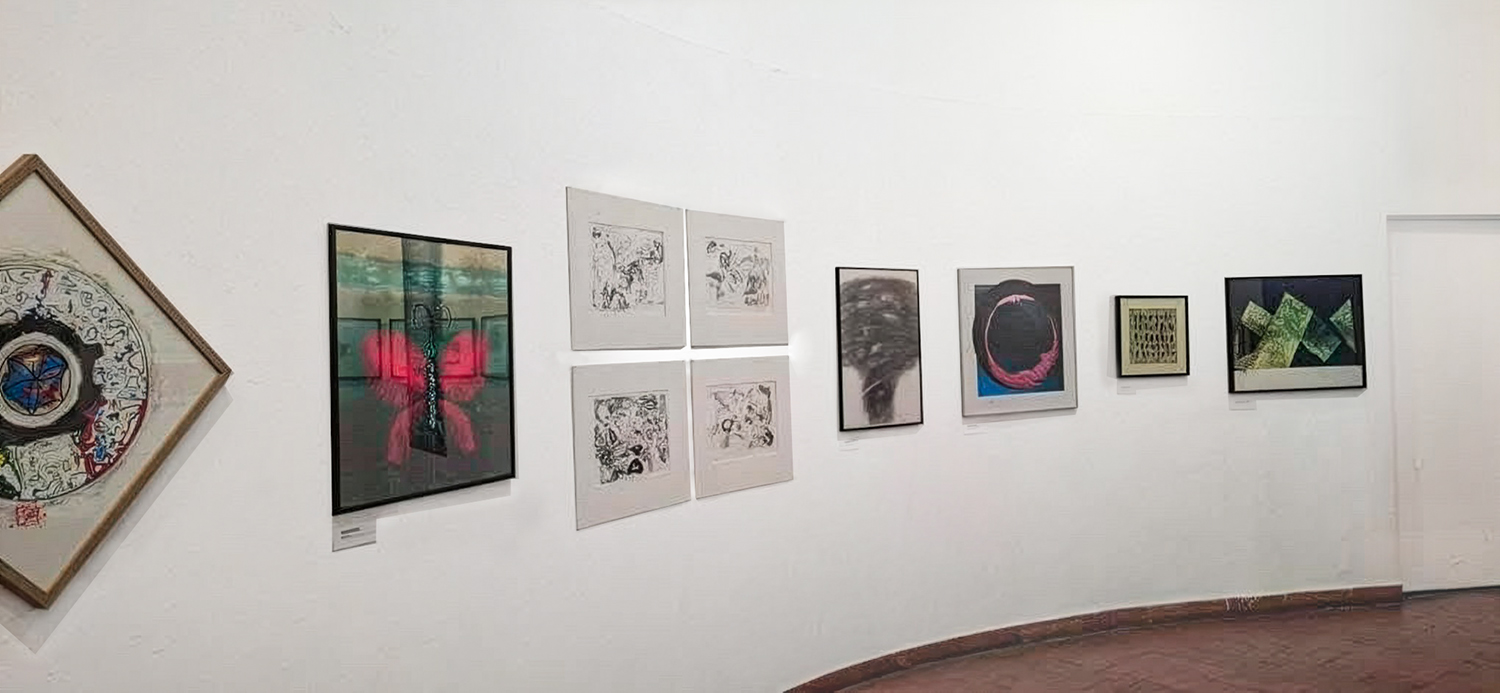
From left to right: mixed media by Vasile Pop-Negreșteanu, art print by Ioana Andrei, ink drawings by Alexandra Mas, charcoal and pastel on paper by Marcela Rădulescu, digital drawing by Andrei Adriana, drawing by Vică Tilă Adorian, and a mixed etching (raised aquaforte) by Atena Elena Simionescu.
Rotonda view from the Căminul Artei Gallery, Bucharest – 14th edition of the Romanian Annual Graphic Arts Exhibition, photo Ioana Andrei
This year’s edition could indeed be titled “O sută douăsprezece picături strălucitoare” (One Hundred and Twelve Sparkling Drops) a metaphorical evocation of the precision and brilliance found in each exhibited work. The curators extended an open invitation to artists across the country and abroad, allowing them to choose their own technique, subject, and dimensions. The result is a stunningly diverse and rich body of work that spans classical and contemporary modes: from drypoint and linocut to aquaforte and digital techniques; from whisper-fine pencil drawings to bold, experimental approaches in installation. The visual languages shift, but the integrity remains.
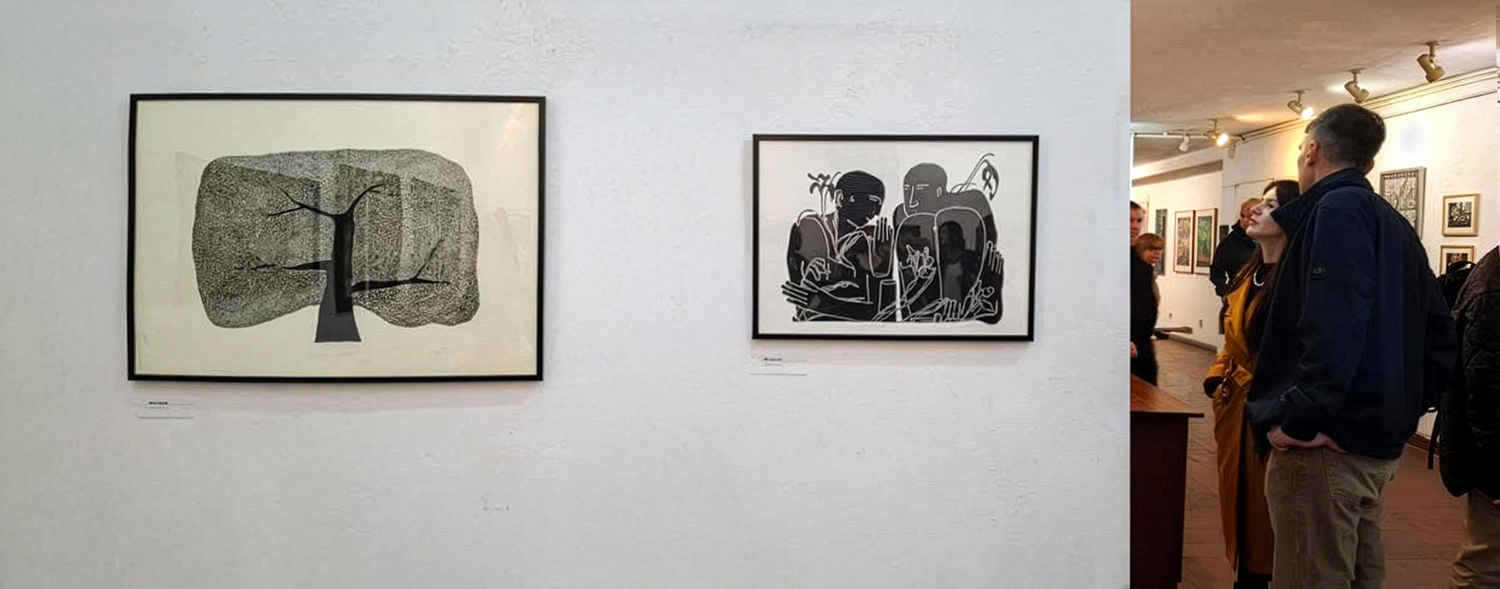
Katalin Pop, linocut works, 2025
Many of the pieces come from young, first-time participants, with this edition welcoming 23 new artists, a clear sign of the vitality and continuity of the genre.
The exhibition’s importance lies not only in its scale or technical range but also in the careful curation by artist and cultural figure Ioan Cuciurcă, who for over a decade has guided the visual identity of Grafica Românească. Each edition is accompanied by a beautifully printed bilingual catalogue – Romanian and English – with cover artwork by the curator himself. This year’s main essay, titled “One Hundred and Twelve Sparkling Drops”, was penned by Dr Silvia Suciu(Tribuna magazine, Cluj-Napoca), whose refined and coherent analysis frames the exhibition within a wider contemporary discourse.

Ioan Cuciurca – Window 2,3 and 4, digital print
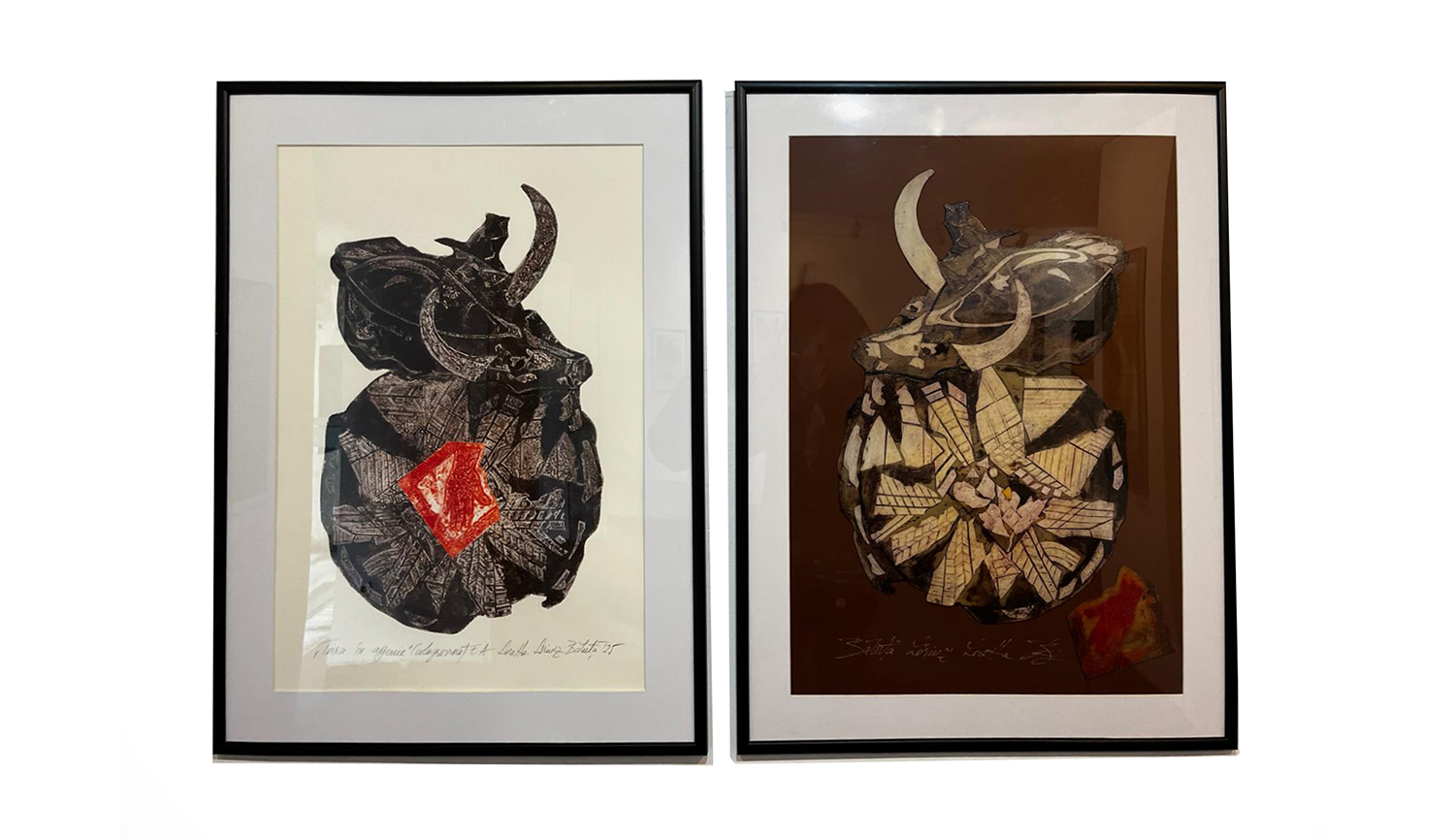
Loretta Bǎluțǎ Lorincz, “Earth in Agony I & II” (2025), collogravure on paper, 82 × 62 cm each
In this striking diptych, Loretta Bǎluțǎ Lorincz invokes the ruptured core of our planet as both a literal and metaphysical wound. Earth in Agony I & II are shaped by a circular, almost anatomical abstraction, a hybrid form that hovers between fossil and machine, scar tissue and celestial relic.
The layered collogravure technique intensifies the textural density, drawing from traditions of post-war expressionist printmaking, a lineage that recalls Antoni Tàpies or Lee Bontecou in its use of matter as metaphor. Cracked, bandaged, sutured with maps or script-like motifs, the forms pulse with the tension between permanence and fracture. The vivid red in Part I cuts like a warning, the heart of a wound, perhaps a forgotten flag. These are not works of radical witnessing. A planetary portrait intimate and epic. The viewer is not spared; the earth, in agony, is also our mirror.
This year’s jury included distinguished figures such as Professor Ioan Doru Vlădoiu, Professor Marcela Rădulescu, and Doru Cristian Deliu. Their careful selection ensured a nuanced yet coherent exhibition. “As in previous editions, Grafica Românească maintains an international dimension, a testament to its expanding cultural relevance,” tells us curator Ioan Cuciurca. “The 14th edition is also a commemoration. With sorrow, we mark the passing of several key figures in Romanian printmaking who, for many years, honoured this exhibition with their presence and talent,” he concludes.
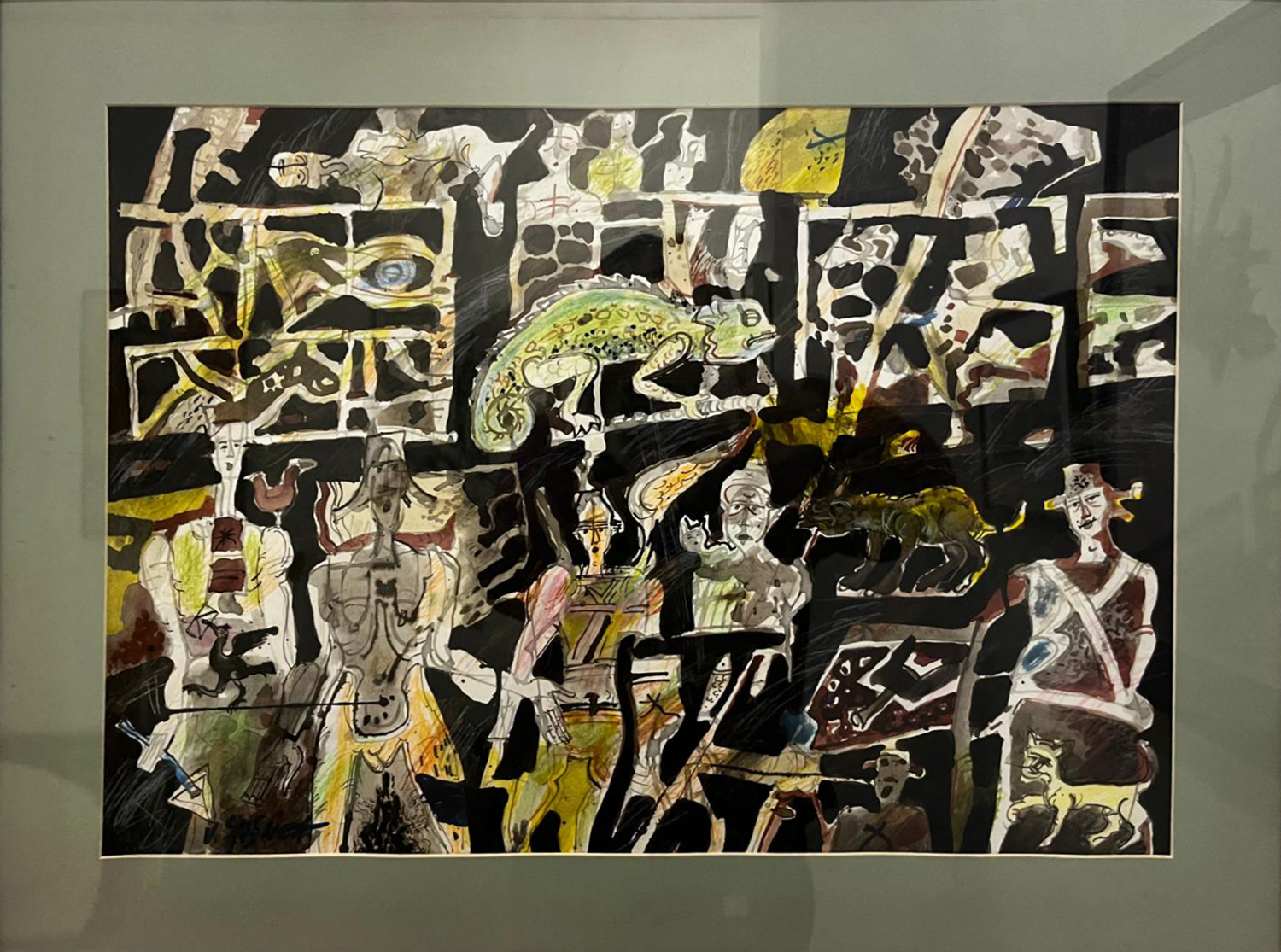
Valeriu Susnea, Story, mixed media on paper, 43 x 60 cm
In Story, Valeriu Susnea orchestrates a phantasmagorical theatre of myth, memory, and political subconscious. The composition is dense, erratic, a palimpsest of figures, symbols, and bestiaries scattered across a fractured pictorial field. One is struck immediately by the chameleon at the centre, its adaptive skin resting uneasily above fragmented human silhouettes, ancient warriors, hybrid beasts, and spectral onlookers. These forms are suspended between the archaic and the futuristic, the tribal and the bureaucratic.
Susnea’s visual language echoes the intensity of Jean Dubuffet’s Art Brut, raw, layered, and unafraid of the grotesque, while the structure and mythic layering recall Anselm Kiefer, particularly in his evocations of cultural trauma and decay. Yet unlike Kiefer’s monumental gloom, Susnea’s palette holds sparks of mischief, irony, and alchemy: ocres punctuate the chaos, and faces seem to mock as much as they mourn. The work invites the viewer into a destabilised story-world, where power, belief, and violence are fragmented and refracted, locked in a battle over time, and truth. As with Paul Klee’s Twittering Machine or Leonora Carrington’s dreamscapes, Story resists interpretation while making clear that what is at stake is real: our capacity to read the signs of collapse, or perhaps transformation, etched into the margins of civilisation.
photos by Ara Ivancenco & Ioana Andrei