
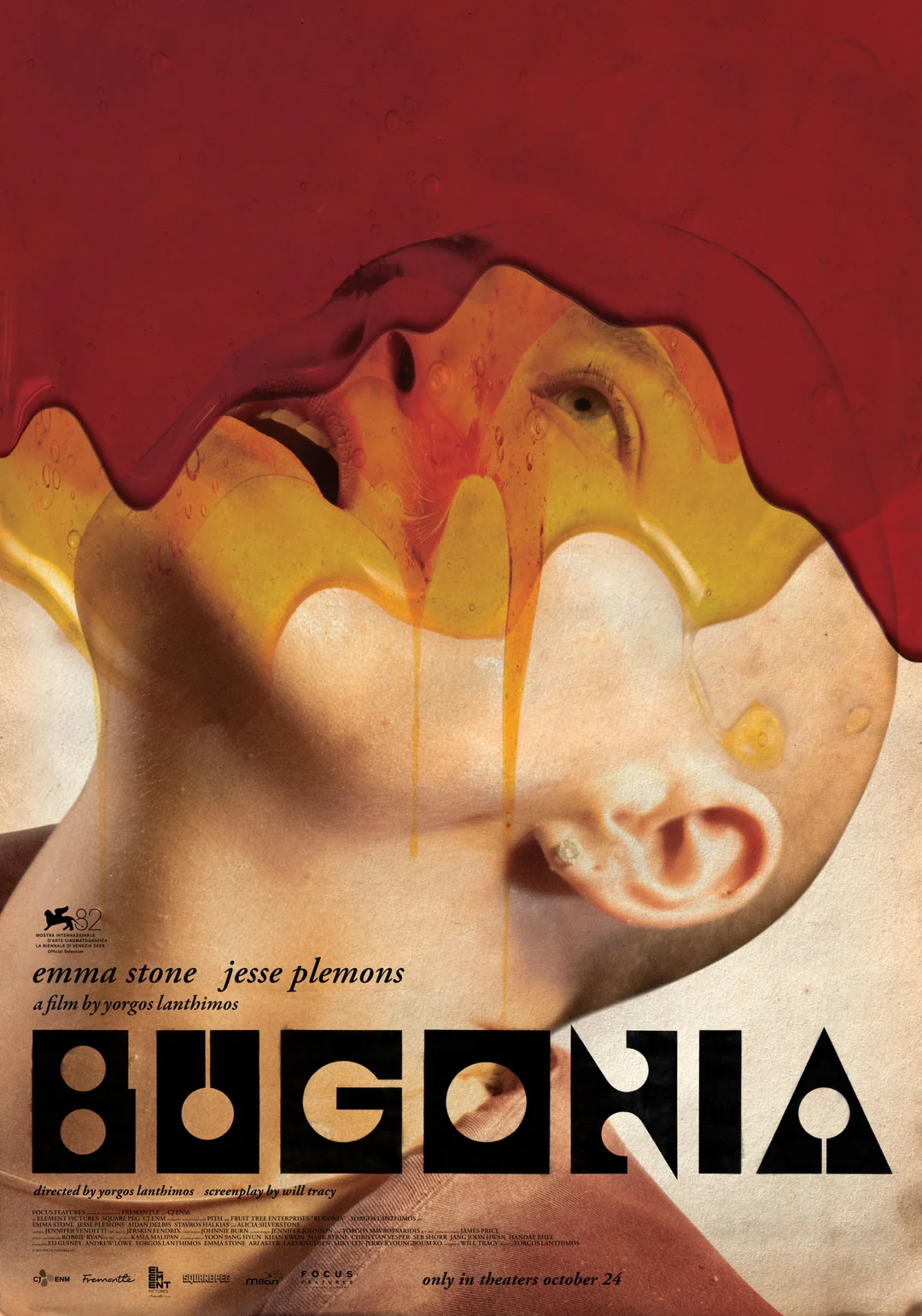
A joke, a manifesto, and perhaps the joke was always on us.
With Bugonia, unveiled at the Mostra di Venezia, 2025, Yórgos Lánthimos once again forces us to laugh where we should cry, and to cry precisely when laughter seems most inappropriate. He drags us into our very own actuality: the villains are us, everyday egocentric humanoids, incapable of inhabiting a universe that – against astronomical odds – was fine-tuned to harbor life. This earth, a miracle, and yet treated by many as hell, a chronic consumption, pollution and vandalized into something worse than our most gothic folklore.
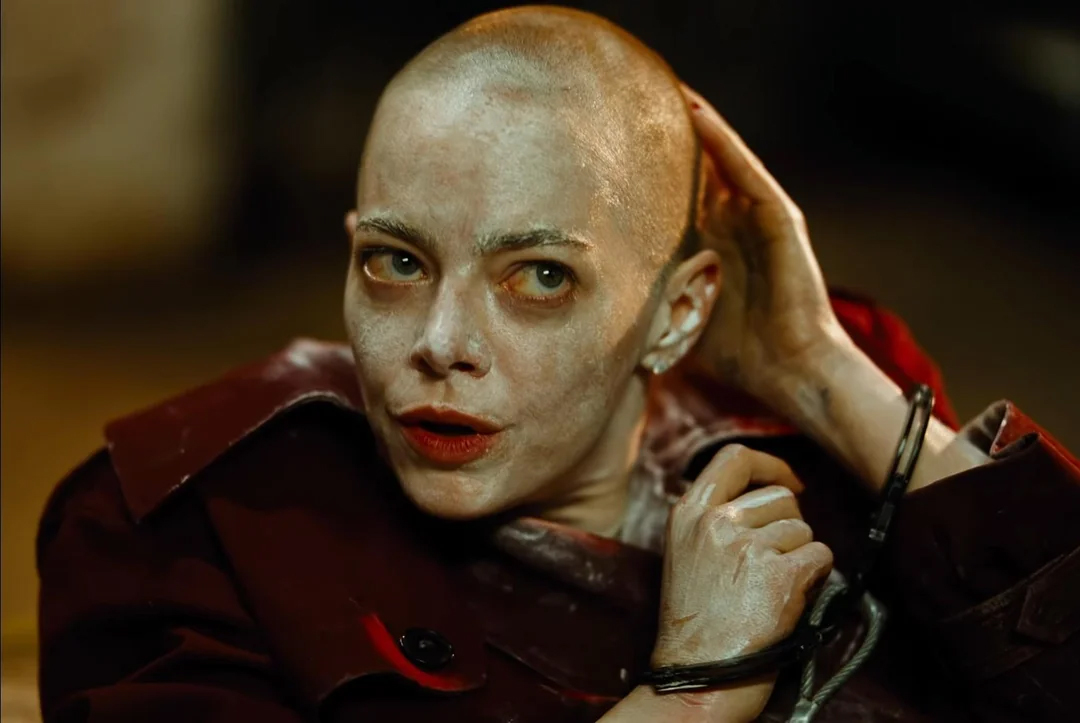
We live in an era where redemption is already past its “twelfth hour.” Lánthimos responds with a film that is both jewel and detonator. At its center, a character poor thing in every sense, bearing the weight of our collective sins: fatherless, raped as a child, manipulated by a mother enslaved to obsessive conspiracy theories and an endless consumption of fake news. Yet he is clever enough to turn himself into a human time-bomb. His journey is painted in wit, sorrow, desperation, and that uniquely Lanthimosian humor, the humor of cruelty and exposure.
If All Kinds of Kindness was a triptych of human absurdities, Bugonia feels like the inevitable conclusion: Eden regained, but only to be vandalized again, and again, until …
Flowers, bees, and other omens
The film is concluded with Marlene Dietrich’s voice, singing Where Have All the Flowers Gone, that post-war hymn of mourning and memory. It works here as a refrain, a reminder that cycles of violence and waste repeat endlessly, even as we disguise them with irony.
The film begins and ends with the bees, not just a symbol, but a frame. The protagonist is an apicultor. In the face of our current ecological hecatomb, Yórgos Lánthimos makes bees into both mirror and prophecy. These fragile guardians, without whom our ecosystems collapse, without whom our very chain of nourishment breaks down, remind us that we are living at the cliff edge of a self-inflicted void.
And so comes Bugonia: a new Eden. Ours is poisoned, tended by a damaged gardener. It is Lánthimos at his sharpest, a filmmaker who stages cruelty not for spectacle, but to reveal the comedy of our hubris. He is indulging in some iconic splatter beauty to keep it a tiny bit far from our day to day reality but we are left asking whether we mutated this garden into a trap…the cruelest of jokes?
Alexandra I. Mas, 2025