
by Alexandra I. Mas
We are made of water, light, hope, and love, and we shall become dust.
At the beginning, we are entrusted with the key to Sirāt : in Islamic tradition, the celestial bridge between heaven and hell, where souls are weighed and confronted by their truth.
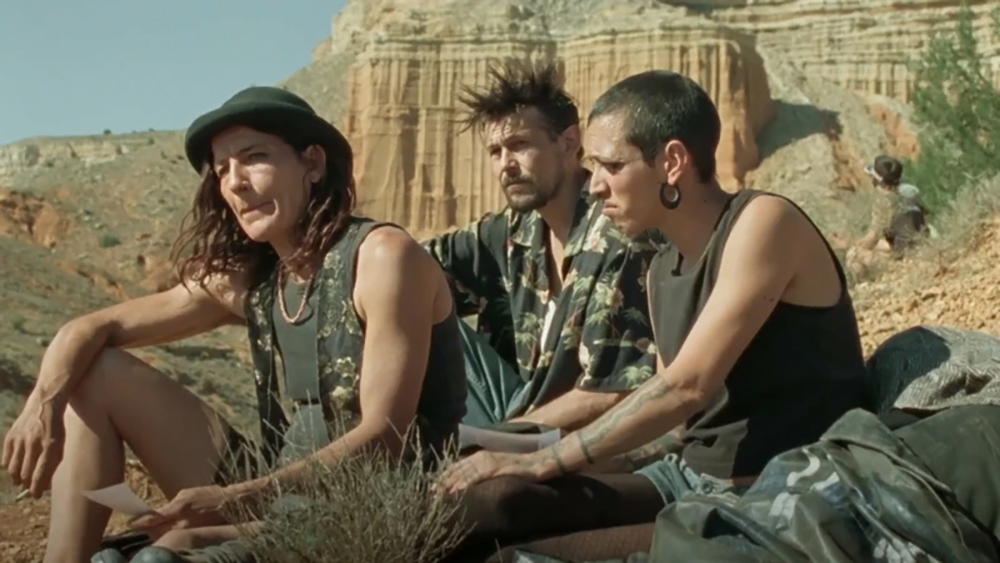
Olivier Laxe, the French-Spanish filmmaker, takes us on a cinematic pilgrimage, a spiritual road movie somewhere between Mad Max and The Wages of Fear, where humanity collides with pain, fear, wonder, and desolation.
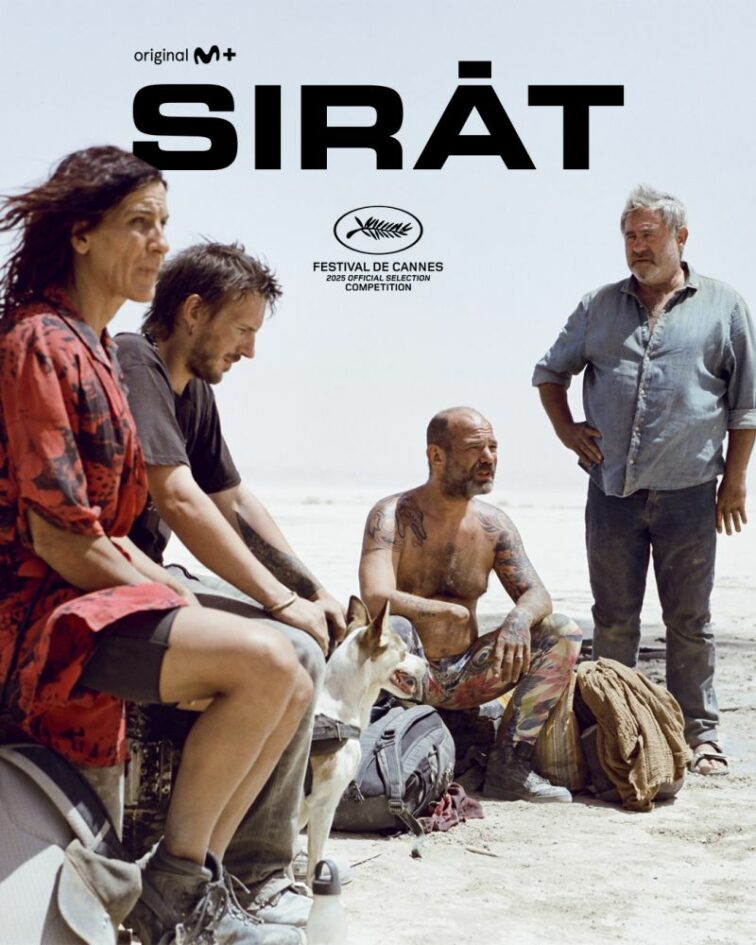
His camera embraces imperfection, like a Mad Max spiraling into the realm of realist poetry. Not dystopia, but raw, luminous, humanist realism. I came expecting vistas and instead I found myself plunged into the very marrow of the human condition, dazzling in its flaws. A chase not only for liberty, but for eternal childhood, and the breath of life itself. Every detail pulses — beautiful, wretched, alive — unfolding at the tempo of a giant, yearning heartbeat, hoping to make the whole Earth tremble.
We follow Luis, portrayed with gravity and tenderness by Sergi López, the archetypal father, willing to cross the ends of the Earth to find his missing daughter, who vanished into the throes of a rave in the Moroccan desert. Throughout this odyssey, symbols and signs guide us, each frame a whisper, each gesture a cipher.
Here, the most precious cargo isn’t any explosive, it is Hope, that rarest and most fragile of elements. A band of idealists hurtle forward, desperate to forge a path far from any civilization, from which we hear only sparse echoes of a looming Third World War. All that remains is rhythm, the rhythm of a mad, psychedelic heart, escaping into an unknown horizon filled with gentle smiles and the untamed spirits of eternal children, through a barren expanse where light and water become punctuation marks in the sentence of life.
Shot on 16mm, the screen becomes a Tarkovskian canvas — grainy, sacred, polarized — a tapestry of the ethereal. And from this spiritual mirage, a question emerges:
“Is this what it feels like, the end of the world?”
“I don’t know… but it’s been the end of the world for a long time.”
This universal fatalism pulls us into a vortex. Hell offers no pardon. And no, the end is not some distant war. The apocalypse is intimate, immediate: the death of a child. Darkness floods the screen, the blackness of a soul extinguished. The day can no longer rise. Death devours everything, even the oldest of children, a warped survivor of a collapsed civilization. Boom “blow it all up.” Pain. Fire. Dust. A veiled sun. A cruel curvature where hope no longer finds its place.
And yet, spirituality endures. Shamanic strikes to the chest. A pulse, a throbbing vein, carries us forward, driven by the visceral, haunting sound of Kangding Ray. We are no longer spectators, we are fugitives in this race for life.
When death surrounds us and nothing is left to lose, perhaps that is when something new begins.
Too much fatalism, or the shimmer of immortal hope? What is there to choose? Perhaps nothing. Just keep walking. Maybe this is the key to life itself, to any life.
We leave behind the desert of our desolation and fear to glimpse a future more verdant, more alive.
Laxe’s meticulous, almost anatomical camera closes in, finally, not on landscapes or bodies, but on faces. All the faces. The most beautiful of all horizons. Moving forward, along the thin, trembling line of life.
Sublime.
You may already know Olivier Laxe from Fire Will Come (O Que Arde), which earned the Un Certain Regard Jury Prize in 2019, or from You All Are Captains (Todos vós sodes capitáns, 2010), a hybrid documentary that revealed him as a deeply humanist filmmaker.
It’s no wonder Sirat is produced by none other than Pedro Almodóvar’s El Deseo, alongside Movistar Plus+, Filmes Da Ermida, Uri Films, and 4A4 Productions.