
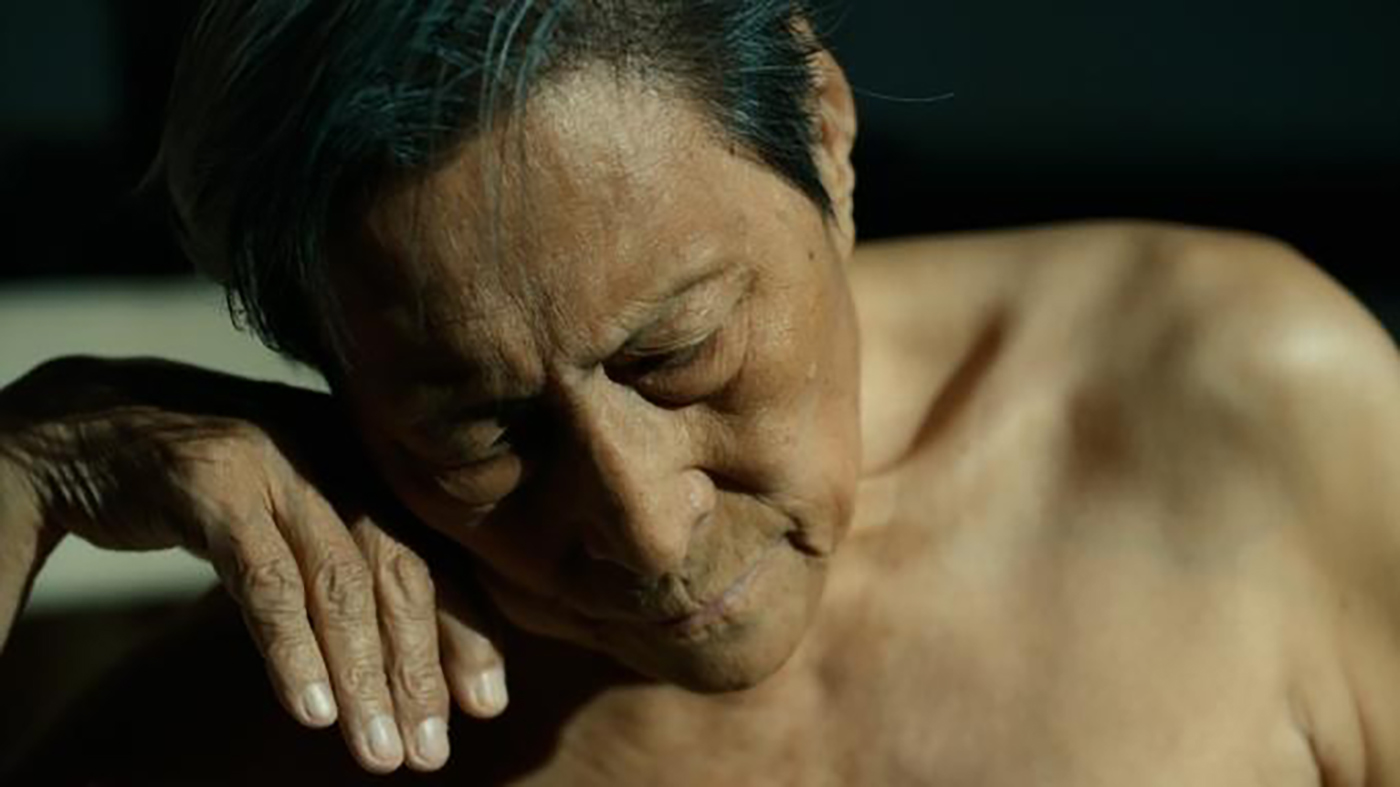
There are certain films that deeply touch your soul, eliciting tears of both joy or sadness. “Man In Black” is one such powerful movie that moved me to tears from start to finish, encompassing a sense of despair.
It serves as both a political manifesto and an innovative narrative, where the human body becomes a sculptural vessel of memory. It captures the painful recollection of physical and mental anguish, commonly known as torture. Perhaps my own upbringing in a communist regime allows me to resonate with these themes, and due to the unfortunate experiences of some family members. I implore you to watch this film, engaging with your emotional core, in order to comprehend this deeply poetic representation of pain.
Wang Xilin‘s aged body becomes a profound statement, as he, at 86 years old, offers a silent testimony throughout the initial part of the movie. The absence of words proves more unsettling than any dialogue, surpassing even his genius symphonic works. The weight and manner in which the camera captures his body, abused by the communist system, leading him towards madness, is truly impactful. The isolation of the theater, filmed in Paris under the masterful direction of Caroline Champetier, becomes a visual representation of his seclusion, a prison and a parallel universe to his art. When he finally speaks, his voice resonates as a blessing.
Filming the most significant of Chinese modern composers as a monument, while comprehending the struggles he endured, provides insights into his realm of sound.
The narrative unfolds on three layers: Wang Xilin‘s tormented Body, subjected to beatings, dragging, shame, and the brutality of forced labor; his Mind, pushed to the brink of self-destruction and dehumanization by a manipulative political system; and his Music, which served as both his salvation and his diary. His symphonies act as illustrations of these experiences, as well as those of his brothers and mentors.
Wang Bing delivers a truly memorable film with this masterpiece. He has accustomed us to his profound stylistic approach in his documentary subjects, infusing his movies with meaning and emotional depth.
Alexandra Mas
- Co-production : Gladys Glover
- Foreign production companies : Wil Productions, Louverture Films
- Film exports/foreign sales : Asian Shadows
- Director of photography : Caroline Champetier