Written by Alexandra Touchard
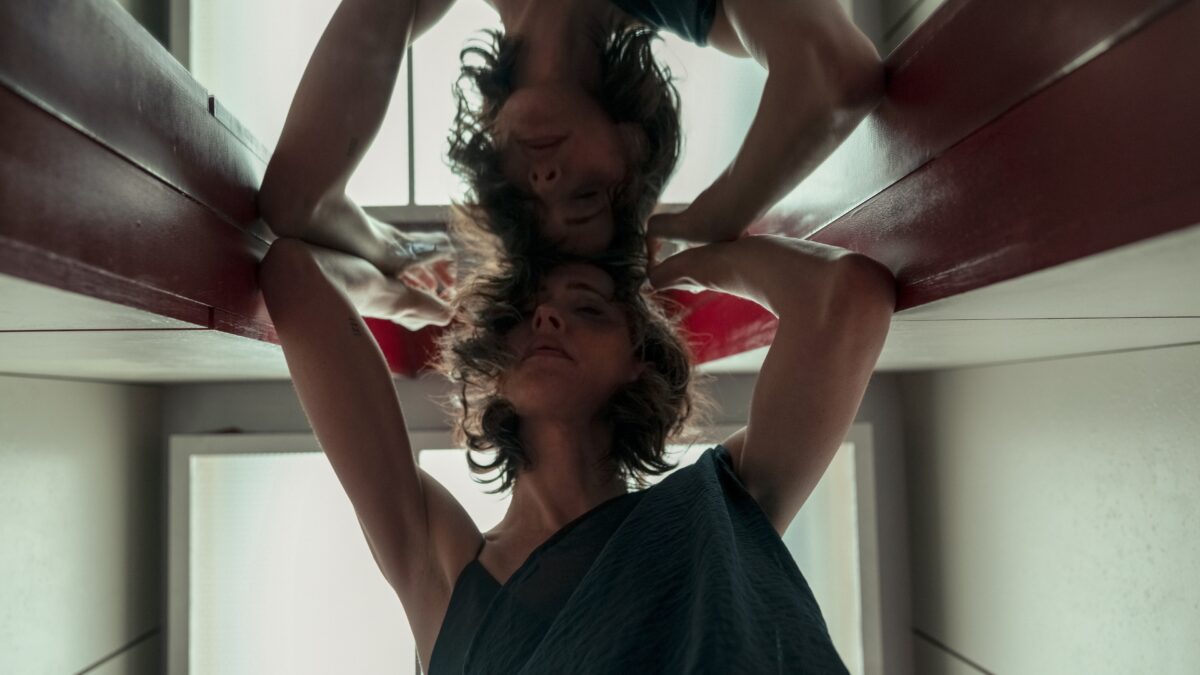
Presented in the Cannes Première section on Thursday, May 21, 2026, The End of It, the debut feature by director Maria Martínez Bayona, certainly did not leave the audience indifferent. I have to admit, the synopsis had intrigued me long before I even entered the screening room. The promise was a dystopian future in which death is no longer inevitable, where it is possible to live forever so long as one undergoes a specific medical treatment. The story follows Claire — a magnificent performance by Rebecca Hall — an outsider who, after 250 years on earth, decides to put an end to her life. In this world, death has become synonymous with madness, evil, irrationality, ugliness, monstrosity — something society has collectively condemned.
Martínez Bayona’s artistic stance is fully embraced from beginning to end, with a remarkable coherence in the universe she constructs, its limitations, and its possibilities. One of the most compelling questions raised is that of children: how can the Earth avoid overpopulation if death no longer exists — or barely does? In this world, reproduction functions through a transactional system. By relinquishing their life, the future deceased may grant the right to have a child to someone else through a series of legal documents. Demography is therefore rigorously controlled, and women have become infertile.
The film ultimately becomes a magnificent memento mori, almost in the spirit of a poem by Charles Baudelaire, particularly in the haunting scene where Claire, having left her own body, contemplates her skeleton lying beside her. The director deliberately restores a sense of nobility to death, transforming it from something grotesque into something sublime. Claire’s death itself becomes an irreversible and unprecedented performance artwork, in which she adorns herself in a chainmail dress referencing Joan of Arc, the French martyr and saint who famously declared at the stake: “I am not afraid, I was born for this.” Like the saint, Claire chooses to confront fear in order to return to the natural state of aging and death.
After stripping herself bare before the audience, she leaps into liquid amber, drowning within a substance that will solidify and preserve her body, her movement, and her expression at the exact moment of death. One of the film’s most fascinating paradoxes lies precisely there: while the director advocates a return to aging and nature, she simultaneously grants her protagonist a death frozen forever in eternal youth.
Throughout the film, Martínez Bayona repeatedly employs Christian iconography evoking courage in the face of death, while also deploying imagery rooted in nature — mud, water, blood, light — textures she constantly places in dialogue with the futuristic world she envisions. Can humanity truly claim to dominate nature through technology? Can death itself be defeated? These are increasingly common ambitions within contemporary social discourse, and the film offers a compelling space for reflection.
If there is one thing that remains untamable in the film, it is art. Art alone still provokes genuine emotion within the characters, in a world where life itself has become a source of exhaustion and boredom. Art is free, tied to the divine, and capable of sublimating human finitude. It is a beautiful thesis proposed by the director in a debut feature that commands genuine admiration.