Time layers experience without resolving its deeper equations. The artist often moves in the same way, through gesture and research, seeking what remains of our humanity.
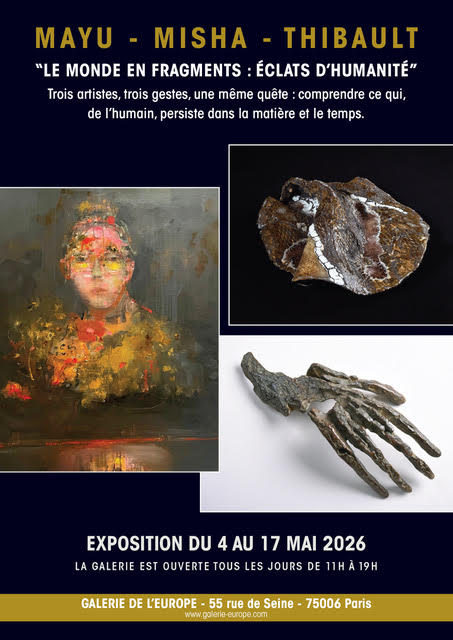
At Galerie de l’Europe, rue de Seine, Paris, three artists converge around a shared question: how do we inhabit the world, and what do we leave within it? The World in Fragments: Shards of Humanity does not construct a narrative but defines a field whee three practices, each grounded in material, are confronting what persists when continuity breaks.
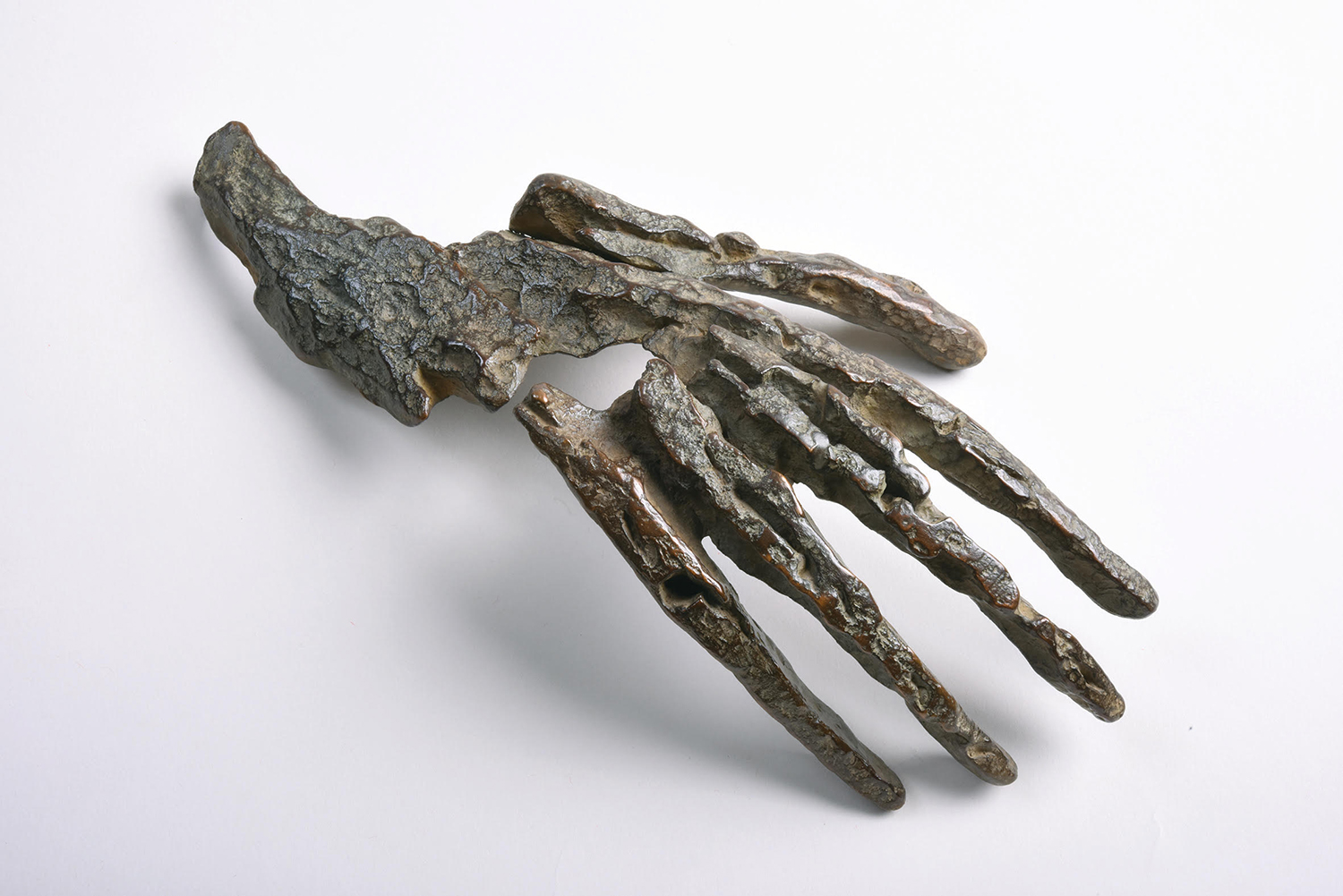
François Mayu ( on the cover ) works through retrieval. The Chemin des Dames is not approached as a historic site, but as an intimate space that continues to produce matter. Shrapnel becomes in the sculptor’s hands an active residue. The gesture remains minimal, nothing is repaired, the object retains its violence, now fixed in another state, silent and unresolved.
Misha turns inward. The face becomes unstable ground. Painted from memory, her portraits resist fixation. They hold a presence that does not settle. Identity appears as fluctuation, never fully given, never fully withdrawn. What is seen is not likeness, but a condition of being. Who are we, after all?
Isabelle Thibault dissolves orientation. Her ceramic planispheres refuse the authority of mapped space. Continents shift, borders lose function. The earth returns to matter, modeled, fired, altered. Geography becomes tactile so the world is no longer measured; it is felt.
There is no attempt here to restore coherence. This is not rupture, but fragmentation as acceptance, an articulation of beauty drawn from the earth and from our own imprint upon it. Each work operates within its own logic, yet all converge toward a single position: what persists is not the whole, but the trace.
Metal, Memory, Earth, three materials, three states of resistance.
Alexandra I. Mas