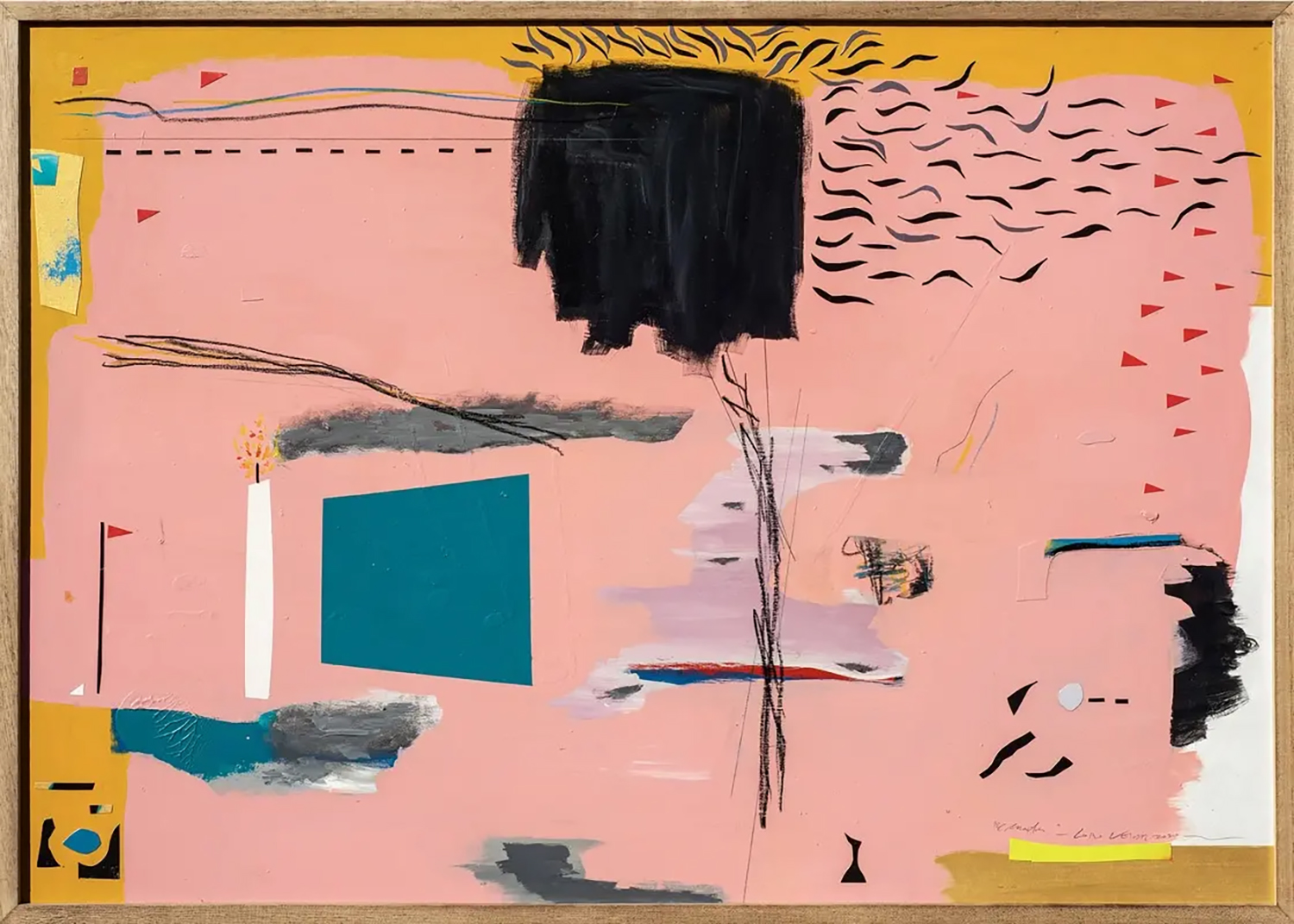
Lobo Velar de Irigoyen, El Master
Acrylic, paper and pencil on MDF.
65 × 90 cm, 2020.
by Sophie Vesperini
There are painters who construct worlds; there are others who dissolve them. The works of Lobo Velar de Irigoyen belong to the latter order. They lead us somewhere we had not intended to go, much like Baudelaire’s stranger who confesses, almost absently:
“Eh! qu’aimes-tu donc, extraordinaire étranger?
J’aime les nuages… les nuages qui passent… là-bas… là-bas… les merveilleux nuages!”
“Then what do you love, extraordinary stranger?
I love the clouds… the passing clouds… over there… over there… the marvellous clouds!”
The comparison is not merely rhetorical; it is structural. Lobo’s canvases are not anchored landscapes but ephemeral thresholds, breathing spaces suspended between presence and disappearance.
Born in Argentina in 1978, Velar de Irigoyen began his career in 1998 as a photographer, swiftly earning recognition in fashion and editorial realms. Yet even at that early stage he resisted the neutrality of the lens. Intervention was instinctive: surfaces altered, images disrupted, photographic certainty unsettled. The image, for him, was never a document; it was already a site of becoming.
This transition, from photography to painting, should be understood as deepening. One is reminded of Gerhard Richter’s oscillation between photographic source and painterly ambiguity, a continual questioning of representation. Yet Lobo’s approach is less analytical, more atmospheric. If Richter interrogates memory through blur, Lobo allows it to hover, to breathe.
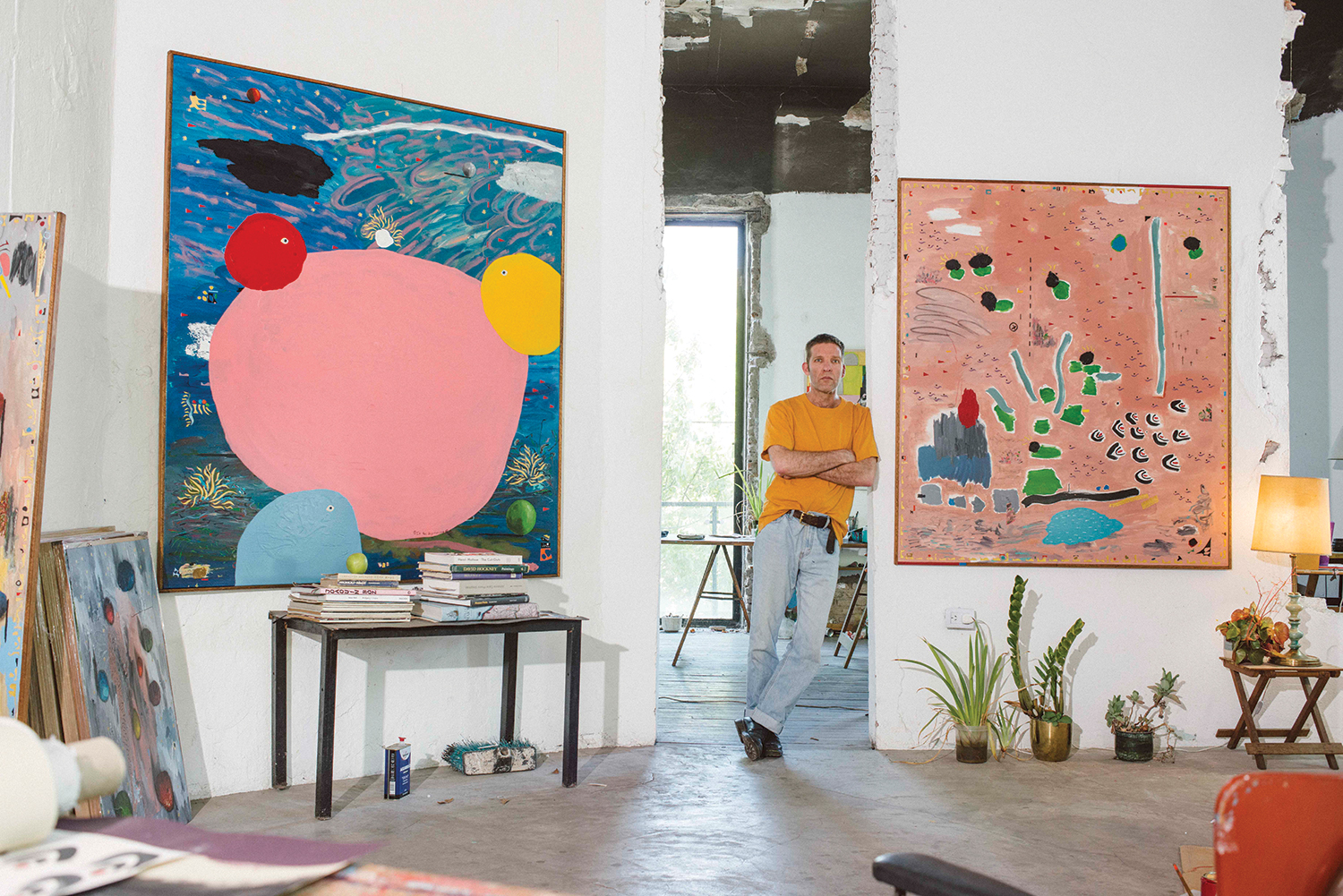
His canvases possess an unusual tenderness. Lines curve softly, as though reassurance were embedded in their gesture. But suspended within these gentle fields are forms that resist easy naming, eggs, stones, fragments, floating masses that seem both embryonic and elemental. They evoke origin and fossil, presence and absence, memory and becoming. There is a metaphysical suspension here that recalls Giorgio de Chirico, though Lobo’s space is diffused rather than deserted.
Colour operates as atmosphere and argument. A recurring rose, vibrant, measured, meets a pool-like blue that verges on the immaterial. This chromatic pairing does not indulge sentimentality, nor does it dissolve into abstraction. It resembles more the ethos of Mark Rothko, where colour becomes a breathing field rather than a decorative choice, yet Lobo’s palette remains anchored in a remembered world: sky, water, fleeting light.
His childhood, shaped by art books and the presence of horses, surfaces obliquely in the work. The equine element is kinetic rather than literal: a sense of contained movement, a musculature of line beneath calm surfaces. The horizon in his paintings rarely asserts itself; instead, it trembles, dissolves, suggests distance without mapping it. Here one might think of Luc Tuymans, whose muted visual syntax speaks of memory’s erosion. Yet unlike Tuymans’s weighty political reverberations, Lobo’s invocation of memory is more intimate, more existential.
What distinguishes Lobo Velar de Irigoyen is restraint. His image invites, it permits ambiguity. In this, his practice aligns with a modern tradition that understands painting as condition: the canvas, a temporal field; the act of looking, a suspension between comprehension and sensation.
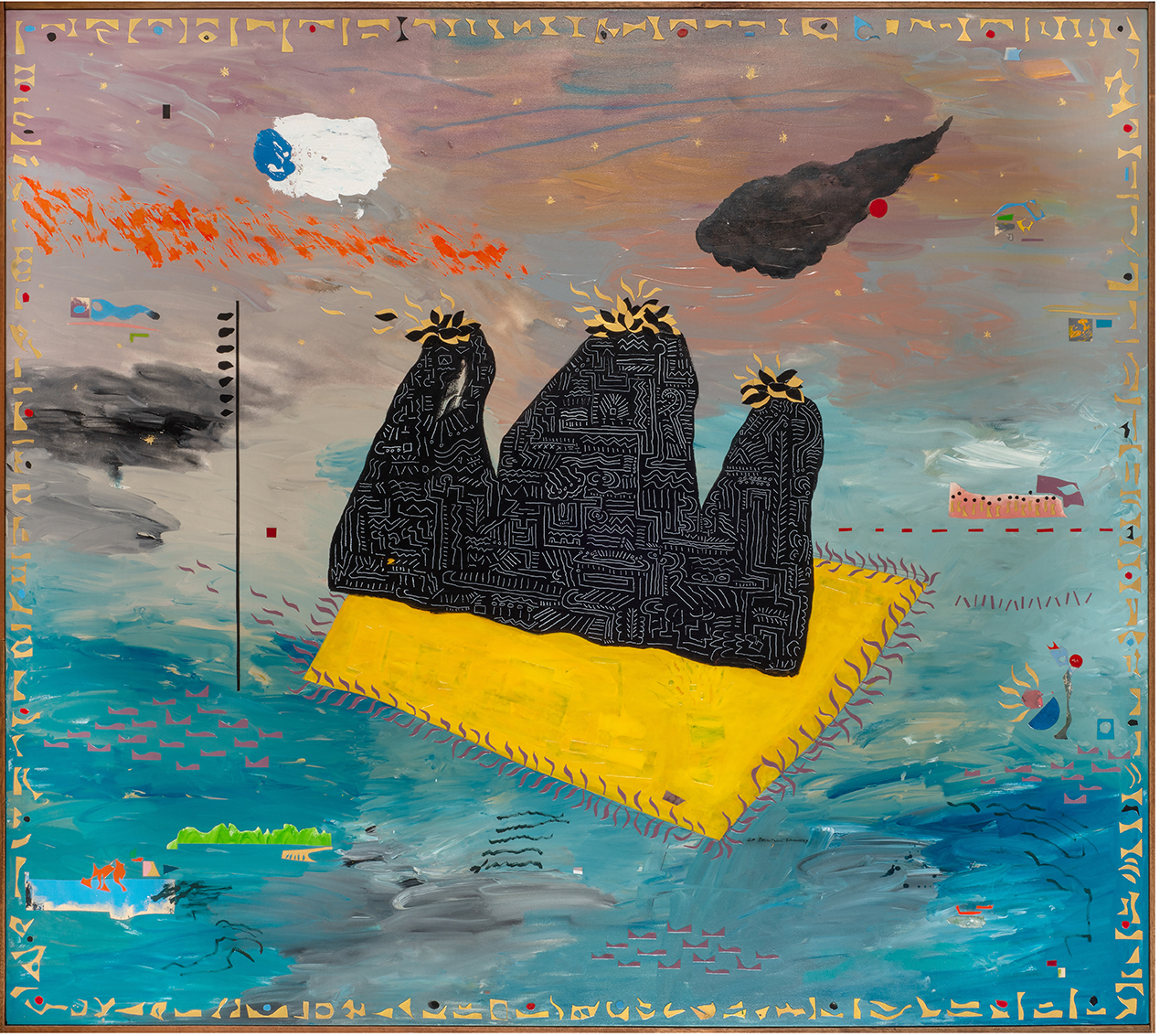
Lobo Velar de Irigoyen, Familia fantasma
Acrylic and collage on paper. Mixed media on canvas.
160 × 180 cm, 2024.
Lobo Velar de Irigoyen’s path remains poetic, enigmatic, sometimes disquieting, yet the destination is luminous. There is joy here, not brash, an affirmation issued from the still centre of uncertainty.
Nothing is imposed. Horizons are not borders but invitations. We hesitate between comprehension and sensation. And, like Baudelaire’s clouds, everything moves on, yet nothing ever truly vanishes.