
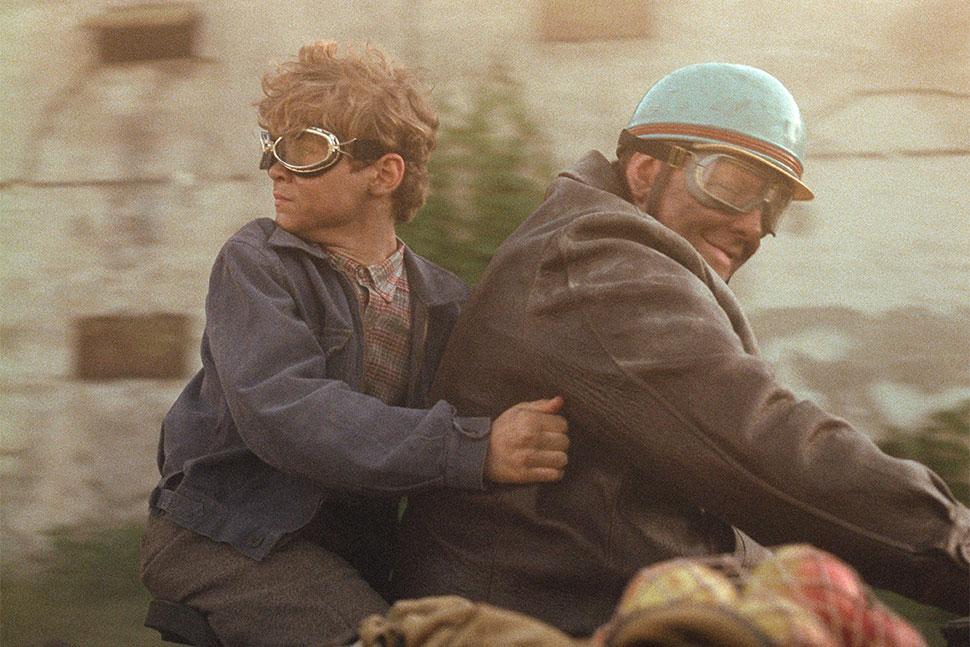
The camera lingers low, at the height of a child. We see the world as he does — vast, broken, threatening. Andor, a small Jewish boy, returns to his mother in a Budapest still in ruins, caught between the ashes of war and the grey dawn of communist rule. He belongs to a generation of orphans: some without parents, others bereft of truth, all marked by a century that tore apart families and faith.
László Nemes, who stunned the world with Son of Saul, continues his exploration of history’s scars with Orphan. Once again, he roots the epic in the intimate, placing the burden of Europe’s violence on the shoulders of a child. Nemes, himself shaped by his family’s stories of the Holocaust and communist repression, forges a cinema of proximity — close frames, grainy textures, sepia tones — where history presses against skin.
Orphan is not a conventional drama but a meditation. Through Andor’s gaze, the viewer inhabits a boyhood built on fragments: a father mythologised into heroism, a mother crushed by silence, a city riddled with suspicion. The 1956 uprising has failed; bullet-ridden walls and hushed neighbours whisper of betrayal. Into this fragile domestic sphere storms Berend, a coarse butcher who claims to be the father the boy has long imagined. The revelation collapses Andor’s inner sanctuary: the heroic ghost is replaced by a bruising, fallible man. The conflict is not only between child and intruder, but between memory and truth, reverence and reality.
Nemes tells this with a language of claustrophobia and revelation. The square frame encloses Andor in dim spaces and hollow streets, while the soundtrack favours silence, creaks, and whispers over orchestration. This aesthetic draws comparisons to Truffaut’s The 400 Blows in its immersion in a child’s solitude, yet Nemes infuses it with the heaviness of Hungarian history, a climate where antisemitism survives beneath new ideology, and where faith itself becomes a quiet act of resistance.
At its core, Orphan asks if innocence can endure compromise. Andor’s rituals, his prayers, and his stubborn sense of right and wrong stand against a world accustomed to bending. The yellow star lingering, impossible to erase from our minds, encapsulates the film’s haunting: the past never vanishes, it seeps into every gesture of the present.
The performances root this poetry in flesh: Bojtorján Barábas embodies the boy with a mixture of rage and tenderness, while Andrea Waskovics gives the mother’s silence a weary dignity. Grégory Gadebois turns Berend into both ogre and tragic man, hated and needed at once.
If Son of Saul was a cry from the abyss, Orphan is its echo, softer, slower, but perhaps more intimate. It is Nemes’ most sincere take on the post-war condition: a study of fractured families within a fractured nation, told with visual austerity and a belief that cinema, like faith, can preserve the fragile flame of humanity. Orphan affirms the possibility of retaining one’s soul even when innocence is lost.
Alexandra I. Mas , 2025