
by Alexandra I. Mas
In an era of fleeting noise and algorithm-fed playlists, Gadi Sassoon invites us to listen differently, not just with our ears, but with the whole body, and the spaces we inhabit. With Modes of Vibration, his third full-length release and most expansive project to date, Sassoon shifts the paradigm of how sound can be conceived, performed, and perceived. It is not merely music—it is sculpture, software, performance, and above all, poetry of vibration.
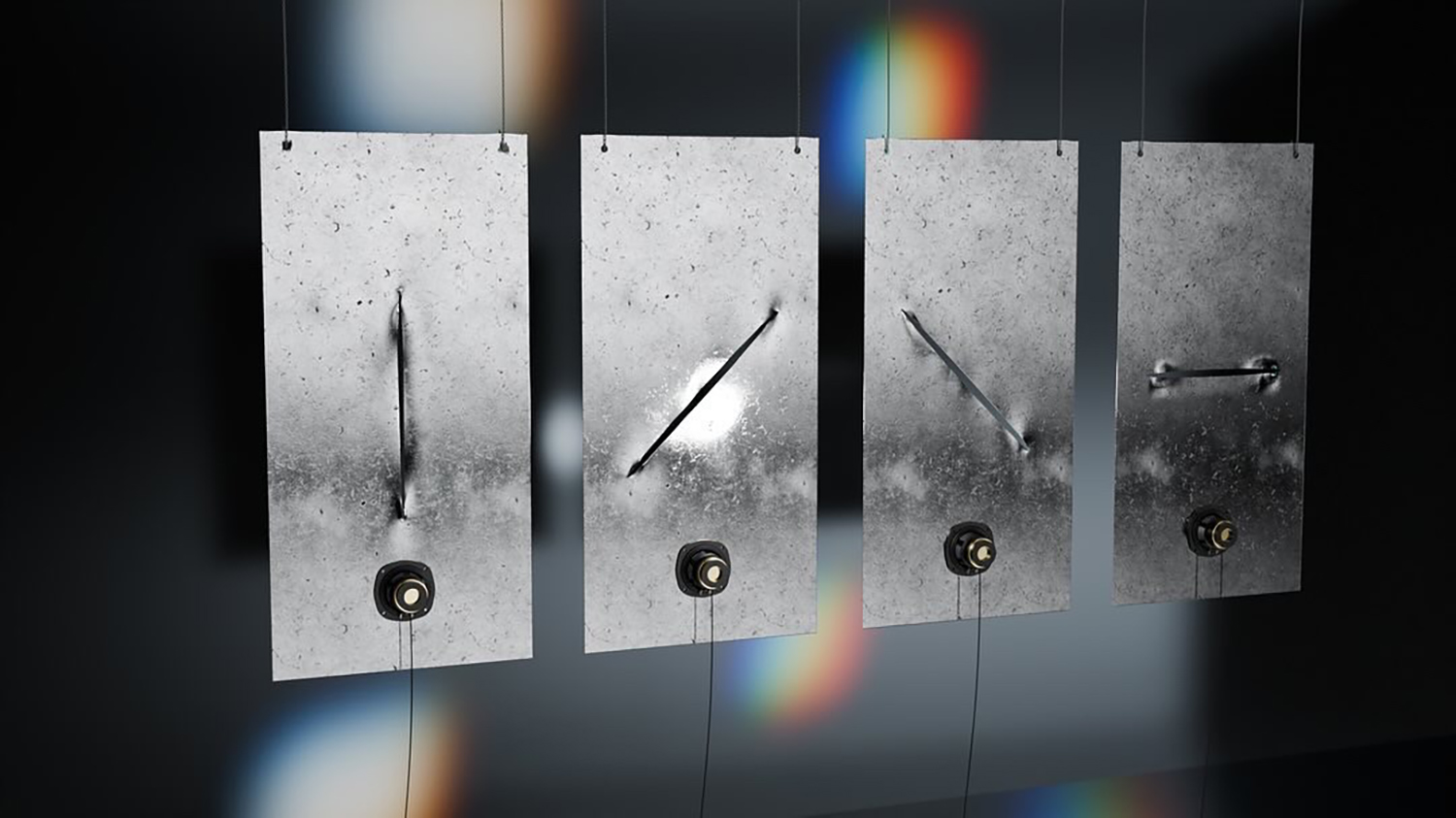
Four suspended plates act as the sonic heart of Sassoon’s installation. Each is cut, etched, and tuned to resonate with distinct sonic signatures, visible scars through which sound escapes.
“People are fascinated by seeing the vibrations in these plates… A piano vibrates too, but this is displayed as an ‘object d’art.’”
Gadi Sassoon
The Material as Ritual Instrument
The visual and sonic heart of the project is a monumental sound sculpture: a fusion of metal plates, electronics, and meticulous craftsmanship, built to resonate like a living organism. Originally developed at EMPAC (Experimental Media and Performing Arts Center) in New York, and later refined by a blacksmith in Italy, the structure was born from the artist’s fascination with the visible behavior of vibrating surfaces.
This installation is not simply the backdrop for Sassoon’s album—it is the instrument. Each plate, incised with unique scars, responds to transducers mounted below, transforming itself into a giant sculpture-based synth. “People are fascinated by seeing the vibrations in these plates,” Sassoon notes. “A piano vibrates too, but this is displayed as an ‘object d’art.’ A bigger conversation is why people perceive this as art compared to a piano or guitar that also vibrates. People are intrigued by why this makes sounds, and why it makes sounds they like.”
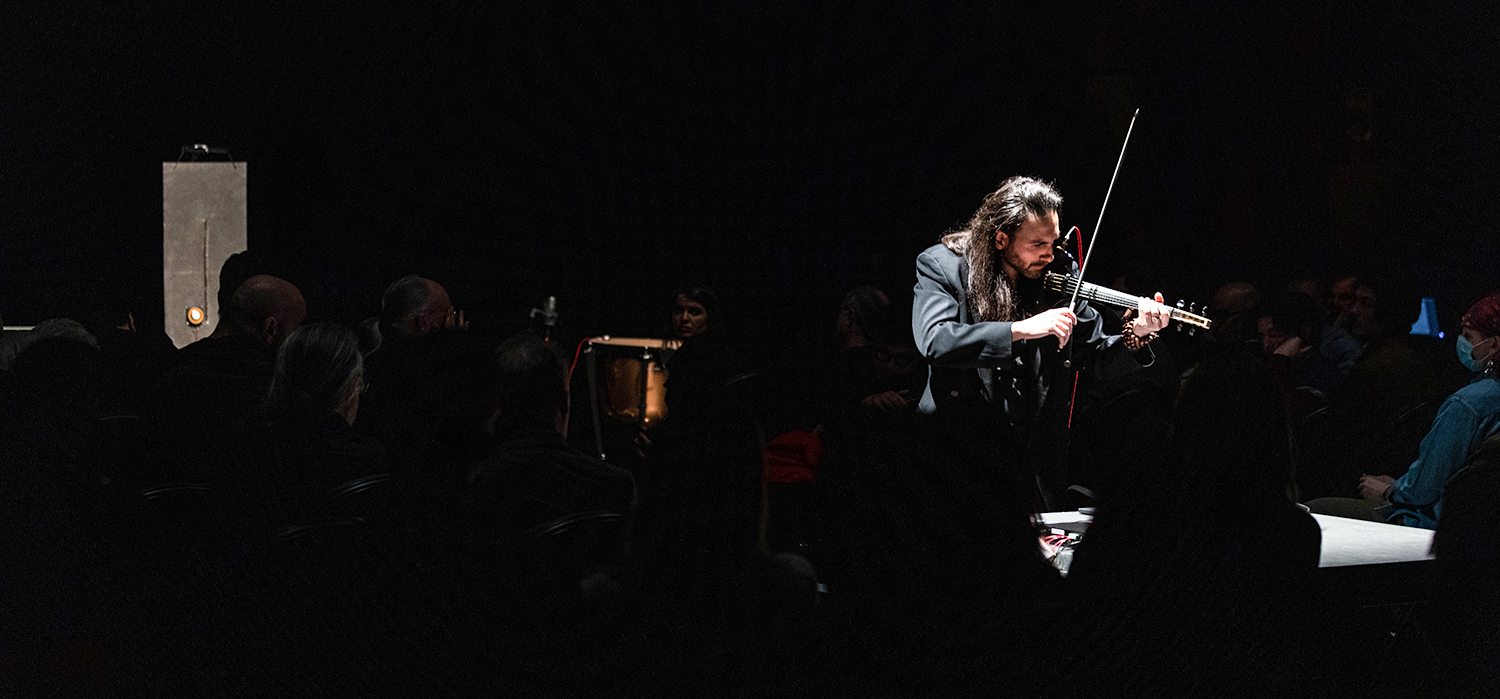
Gadi Sassoon, mid-performance, drawing resonance from his electronic violin while activating the sculpture.
“Silence is not absence, it’s potential.”
Gadi Sassoon
On stage, Sassoon becomes part of the sculpture. His electronic violin feeds into the system, each note activating sympathetic resonances in the plates. It’s not a duet but an entanglement: the instrument becomes the architecture, the music becomes sculpture, and the performer becomes a conductor of space itself.
These performances, often staged in darkened rooms or galleries, resist traditional concert expectations. The audience is immersed in a deep listening experience, where vibration is felt, through air, through metal, through skin. Silence is not absence, space listens back.
At the core of Modes of Vibration is a poetic inquiry: what does it mean for sound to inhabit space rather than simply pass through it? The installation does not impose itself on the room, it responds to it. Every venue becomes a collaborator. The plates shimmer under light, creating a visual echo of their acoustic lives.
Sassoon’s attention to detail, through software developed in collaboration with NEMUS and Physical Audio, and his background in classical composition, allows him to sculpt sound with scientific precision and emotional depth. What emerges is a presence: the invisible made visible, the audible made architectural.

A Triptych of Media
Modes of Vibration exists in three formats: a studio album, a live installation performance, and a virtual instrument titled Tetrad, which allows musicians and producers to engage with the unique acoustic behavior of the plates in a digital studio setting. Each mode is a different facet of the same conceptual gem: music as environment, music as matter.
This July, the installation will be performed at the United Nations’ AI for Good Summit, underscoring its role not only in the art world but in broader dialogues around technology, creativity, and embodied knowledge.
Sassoon’s path to this moment is as multidisciplinary as the work itself. His earlier collaborations include acclaimed albums Multiverse and Chaos & Order, born from research with physicists and mathematicians, and a recent co-creation with Reeps One for the Leipzig International Ballet and Opera, hailed for its innovation and emotional power.
In Modes of Vibration, Sassoon offers a map for a future where music is inhabited. Where sculpture breathes, sound shapes space, and technology becomes a medium of intimacy rather than alienation. He invites us to experience music not as a time-based art, but as architecture in motion, a presence vibrating at the edge of silence, somewhere between the physical and the poetic.