
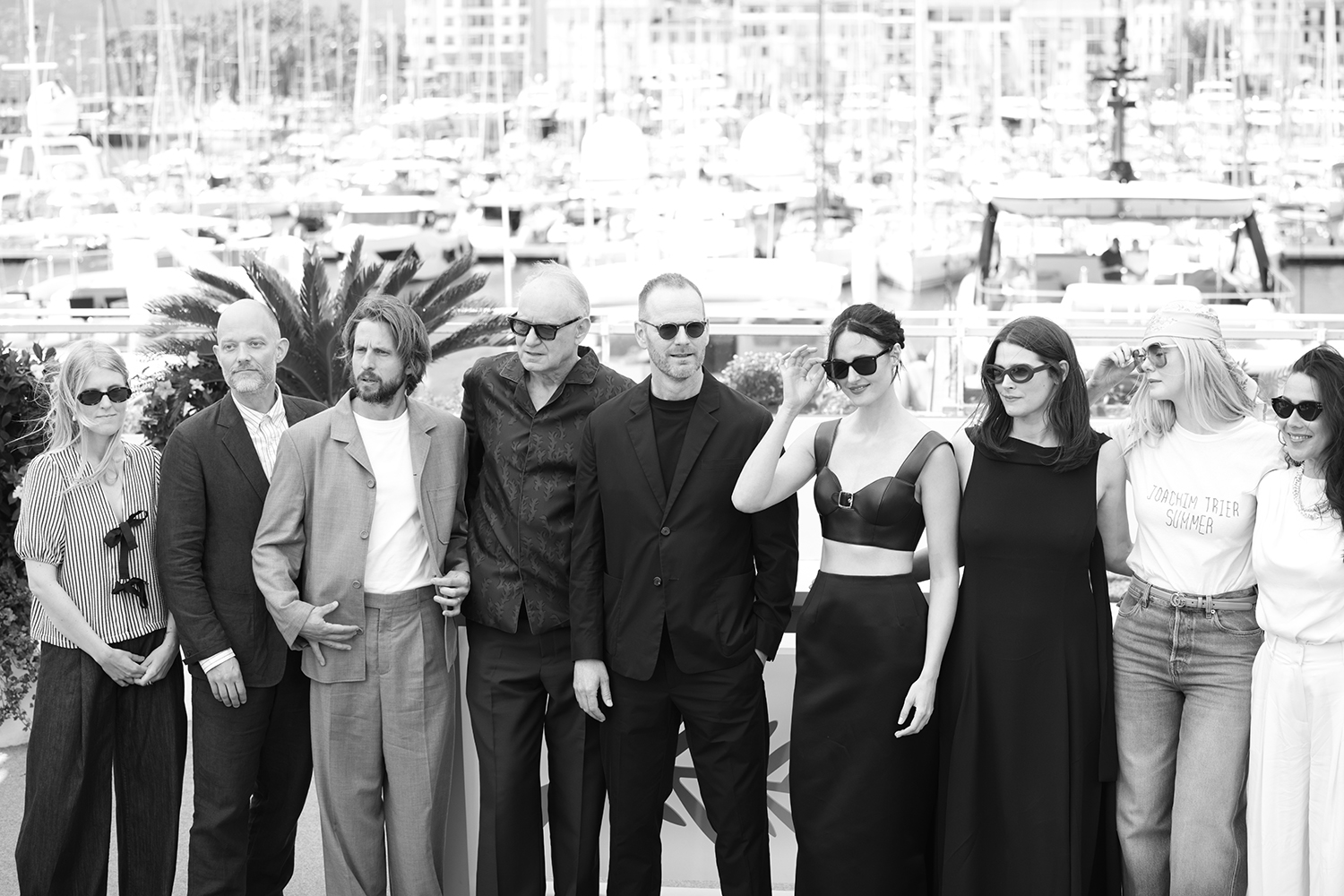
producer Andrea Berentsen Ottmar, Eskil Vogt, Andreas Danielsen Lie, Stellan Skarsgård, director Joachim Trier, Inga Ibsdotter Lilleaas, Renate Reinsve, Elle Fanning and producer Maria Ekerhovd
by Alexandra Touchard
The film opens with a sweeping cinematic sequence. Over the protagonist’s voice, the camera brings to life the family home where she has always lived with her sister and their warring parents. The house is both a sanctuary and a barrier. The story begins with the death of the mother, which prompts the return of the father — now the legal owner — to the family home.
This is where the narrative truly begins. A complex, taciturn man and misunderstood artist, he was never present for his family. Yet, he makes a strange proposal to his eldest daughter: to play the lead role in his next film.
The story tries by all means to immerse us in the heart of this conflicted relationship — between father and daughter, between two depressions, two artists, two forms of madness. While the film is full of ideas and heavy, resonant themes, it remains curiously devoid of emotion, often leaving the viewer detached from the subject. Depicting depression on screen is no easy feat. Few have dared, and even fewer have succeeded with the brilliance of Lars Von Trier in his masterpiece Melancholia.
Here, the pathology is never treated as such. Beyond the tears, little is done to truly portray the illness. One eventually wonders what, exactly, afflicts these characters. Can we believe in their despair? Can we feel for them? That remains uncertain.
The characterization of the protagonists often remains superficial, never truly delving into the depths of their psyche. As the film progresses, it loses its initial allure; the magic begins to fade. The characters ultimately lose credibility, as the script has already laid everything bare in the opening minutes. By the final scenes, nothing remains of their soul, their essence.
Still, the performance of the lead actress deserves praise — Renate Reinsve had already captivated us last year at Cannes in The Summons (La convocation).
The film’s most powerful element, however, remains the singular symbol with which it opens and closes: the house. It is these walls that carry the sentimental value each family member projects onto them. The house is the most tragic character of all — the stage for every drama, a sorrowful witness to lost freedoms, and the keeper of all memories.