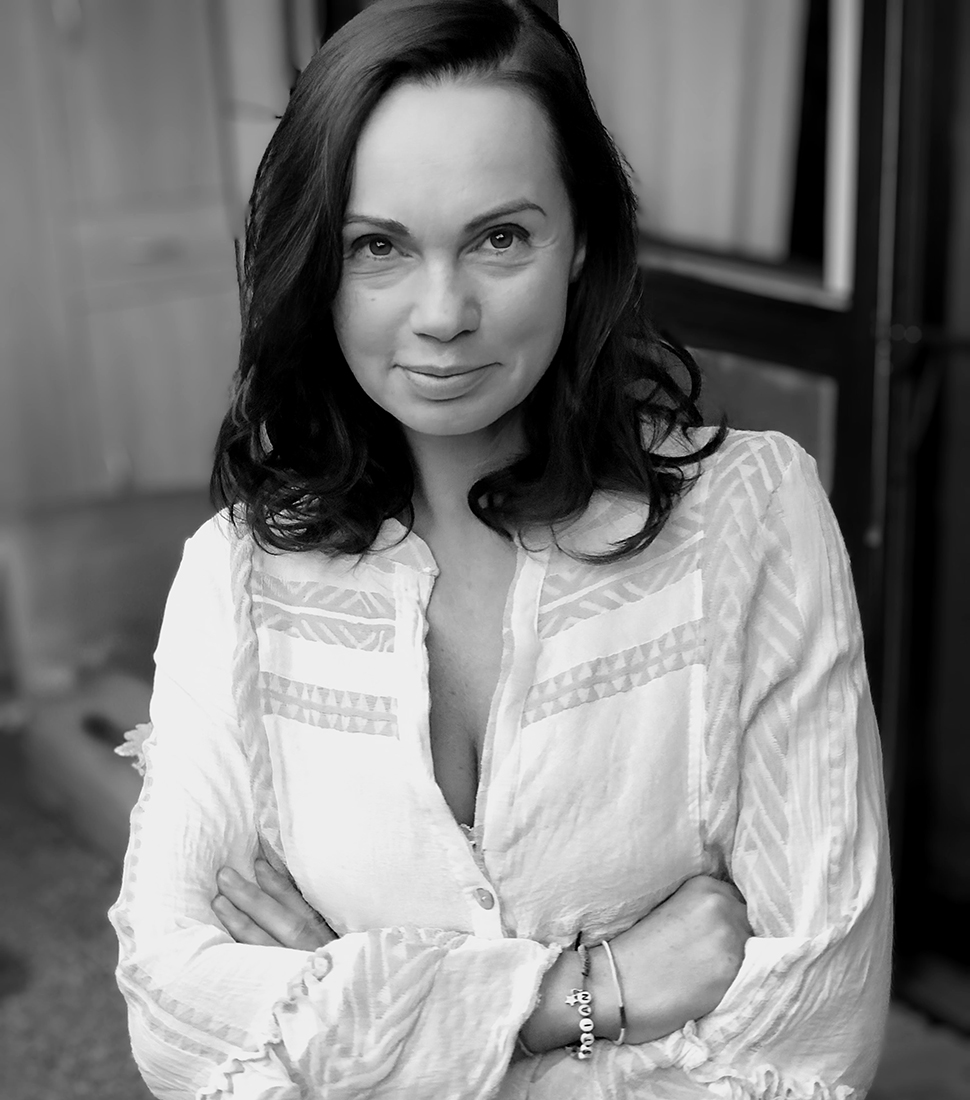
Born in Romania and now living in Frankfurt am Main, Marlene Schanz arrived at painting by an unconventional path. She first studied sports science at the University of Bucharest, graduating in 2002, before gradually turning toward art in her mid-twenties.
A decisive moment came with her encounter with the Romanian painter Ștefan Câlția. His poetic universe, populated by suspended figures, animals and silent rural landscapes, revealed a form of painting where narrative and dream coexist without explanation. From that moment onward, Schanz began shaping her own pictorial language, one in which gravity loosens and meaning remains deliberately open. Boats, animals and solitary houses recur in her compositions as quiet presences within a contemplative landscape.
Entirely self-taught, Schanz developed her practice outside academic structures. This independence places her within a lineage of artists who forged their language through intuition rather than institutional training. One may think of Henri Rousseau, whose imaginative worlds reshaped modern painting. Like Rousseau, Schanz constructs images with clarity and conviction, trusting the authority of vision over theory. Today she works as a full-time artist while raising three children, building a body of work rooted in persistence and lived experience.
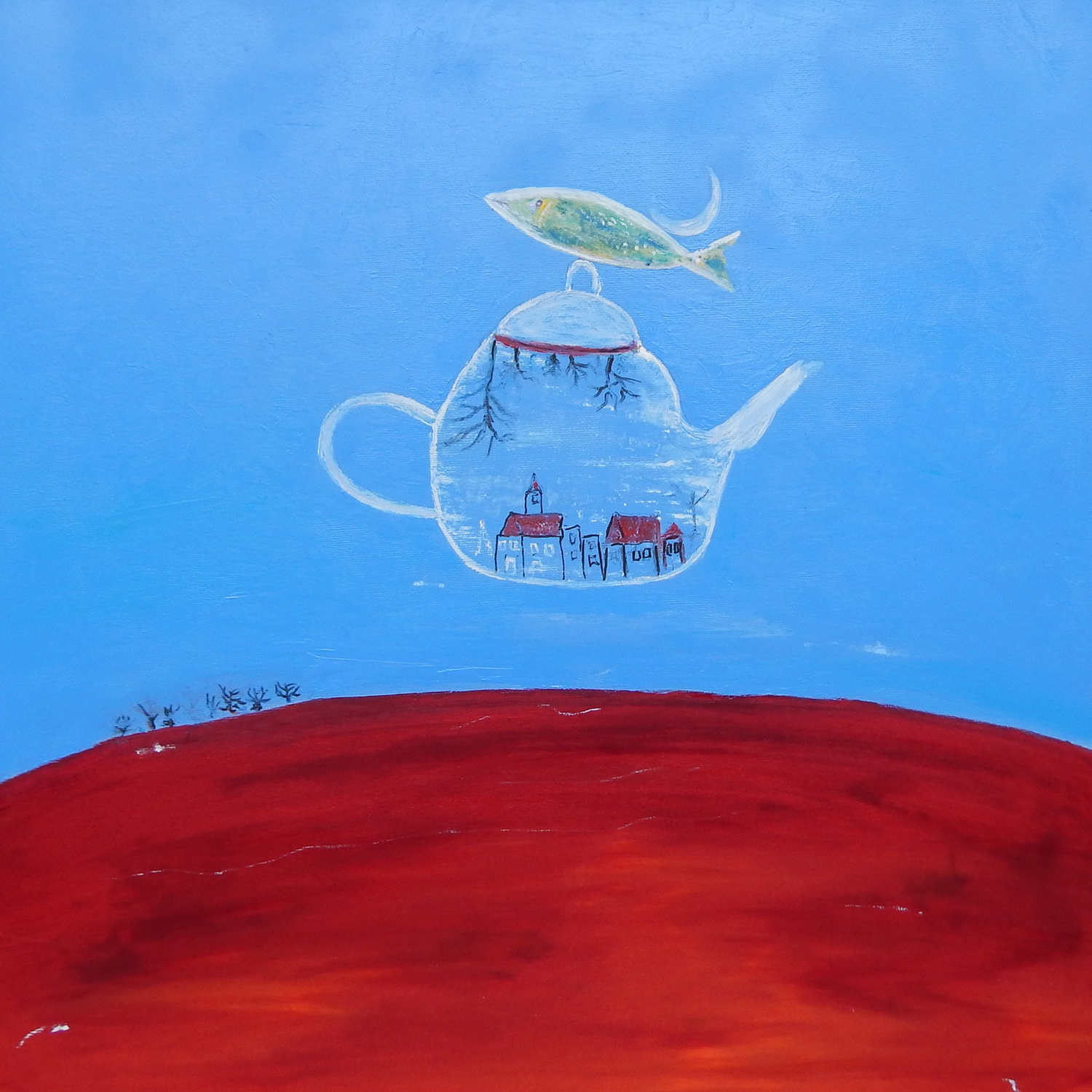
er paintings unfold in a space where narrative dissolves into dream. Fish drift across the sky, houses appear within translucent vessels, horizons glow in improbable colours. The imagery is simple yet charged with suggestion. In their treatment of colour and space, these luminous terrains recall the emotional landscapes of Milton Avery, where forms are reduced to essentials and colour becomes the primary structure of feeling. The symbolic dimension of Schanz’s work finds an echo in the reflections of Gaston Bachelard, who described houses, shells and containers as spaces capable of holding entire worlds of memory and imagination. The teapots and vessels that appear in her paintings function in a similar way: modest objects transformed into interior landscapes, places where personal memory and dream converge. In recent works, Schanz’s landscapes move increasingly toward abstraction. The horizon remains, but the terrain dissolves into fields of colour where space becomes more atmospheric than descriptive. These compositions approach the language of abstract landscape, where the image no longer represents a place but evokes a state of perception. The simplified forms and luminous colour planes reinforce the affinity with Milton Avery, whose paintings transformed landscape into a quiet equilibrium of colour and sensation.
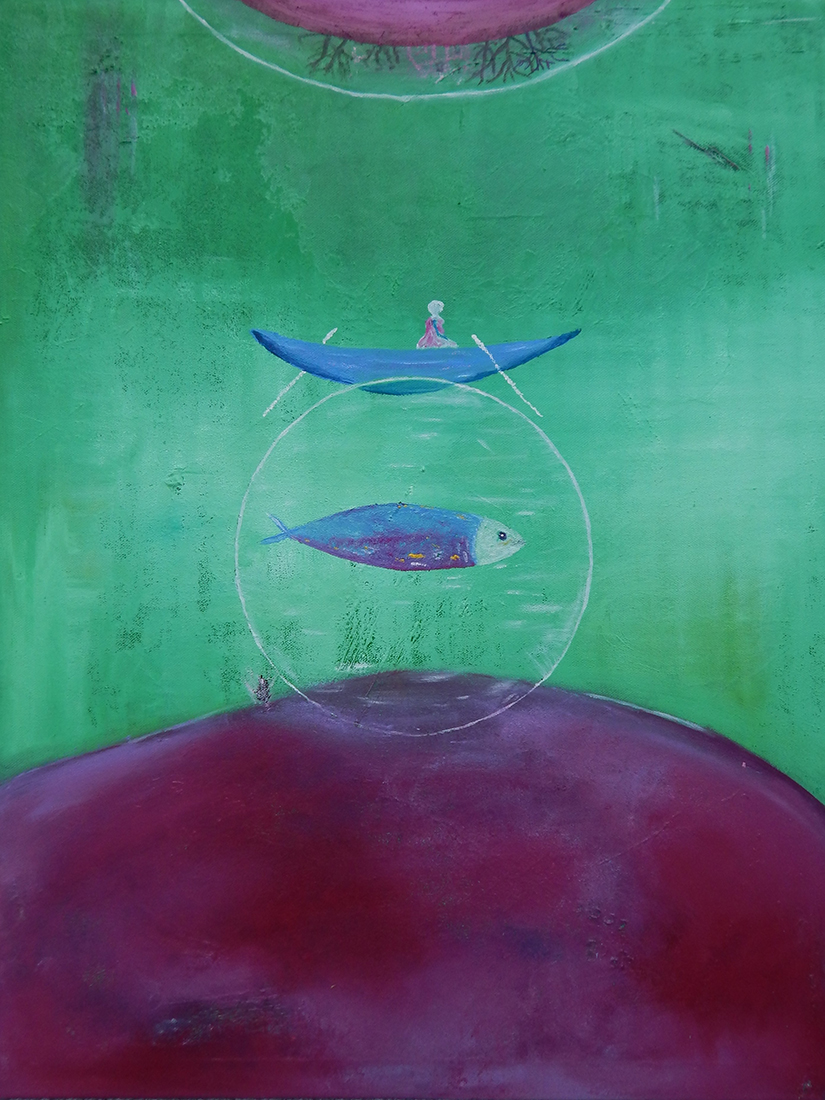
Schanz approaches painting first as a tactile act. The gesture is simple but radical: pigment meets canvas through touch. The image emerges from contact rather than distance.
“I consciously avoid the traditional brush and apply the paint with my hands in order to feel the canvas directly and to create an immediate, physical connection between sensation and image.”
This gesture gives her surfaces their distinctive atmosphere. Colours blend softly, edges dissolve and forms seem to hover rather than settle. The landscapes appear less constructed than revealed, as if the canvas were a place where fragments of inner life slowly surface.
At the same time, the quiet strangeness of her imagery resonates with the poetic surrealism of Remedios Varo. Both artists transform everyday objects into symbolic architectures of the inner life. Their trajectories also share a deeper resonance: each experienced the displacement of leaving one cultural landscape for another. In this sense, the solitary houses and drifting figures in Schanz’s work may also evoke the subtle condition of exile, the distance between memory and the place one inhabits.
What holds these paintings together is their oneiric logic. They do not describe reality so much as translate states of mind. Objects detach from their ordinary function and enter another order of meaning: a fish becomes a messenger, a vessel becomes a world, a landscape becomes a threshold. In Marlene Schanz’s work, the dream is not an escape from reality. It is a method of approaching it, through the fragile but persistent language of daily objects.

Interview
Your paintings place familiar elements—fish, houses, vessels—within suspended worlds. Are these symbols or something more personal?
Marlene Schanz — Many of these elements come from a very personal place. Some small houses, vessels, quiet villages, are connected to childhood memories, almost like fragments of a lost world. At the same time, they reflect how I perceive the present: a kind of upside-down world, where the natural balance of life sometimes feels disturbed.
These motifs are not fixed symbols. They function more like fragments of an inner mythology that develops slowly through the work. The fish, for example, often represents freedom, but also a form of inner belief, not religious, but a personal point of trust or orientation in life.
You are self-taught. Was this independence freedom, or something you had to structure yourself?
MS — It was both. Without an academic framework, I had to listen closely to my intuition and develop my language through practice and observation. Over time, I understood that independence does not mean the absence of discipline. It means creating your own structure, your own rhythm of work and reflection. That allowed my visual language to grow in a very organic way.
You paint directly with your hands. What does this change in the act of painting?
MS — It creates a direct connection between the body, the material and the image. When the hand touches the paint, the distance between intention and gesture becomes very small. The movement of the body becomes part of the painting itself. This contact allows the work to develop intuitively.
Your landscapes feel more like atmospheres than places. How do you think about space?
MS — They are not geographical places. They are emotional spaces. I think of them as inner fields rather than physical environments. Colour and silence create a space the viewer can enter, a certain state of mind.
What did your encounter with Ștefan Câlția reveal to you?
MS — It showed me that dreamlike elements can exist very naturally in painting. His work made me understand that poetic imagery does not need explanation. Narrative and dream can coexist quietly, creating a world that feels both familiar and mysterious.
Your images balance innocence and estrangement. Is this tension intentional?
MS — Yes. The small houses and simple forms often evoke something familiar, almost like memories. But when they appear in unexpected contexts, another layer emerges. It reflects a feeling that the world has lost a certain balance. Placing these elements in unusual situations allows me to explore that sense of displacement.
Dream logic seems central to your work. Do you see painting as a translation of dreams?
MS — In many ways, yes. In dreams, different images can coexist naturally, even if they would never meet in everyday life. I try to translate that freedom into painting. It is not about illustrating a dream, but about creating a space where the viewer can experience a similar atmosphere.
Your paintings often contain enclosed worlds—villages within vessels, landscapes inside fragile forms. What draws you to this idea?
MS — It appears very naturally in my work. A vessel can hold a village, a fragile shape can contain an entire landscape. For me, this is connected to memory, but also to protection. These spaces feel intimate, like small inner universes where something fragile can still exist.
When did you begin exhibiting your work?
MS — My first exhibition took place in Frankfurt am Main, at the St. Wendel Community House Library, in October 2012. It came about roughly a year after a deeply emotional moment that marked the beginning of my development as an artist. My work emerged from a strong inner impulse, and that intensity was clearly visible in the paintings from that period.
Since then, I have exhibited regularly, one or two exhibitions each year, in cities such as Hamburg, Munich and other locations in Germany.
Tell us about your most recent exhibition.
MS — My most recent exhibition grew out of the desire of the gallerist Tiberius Vermann to bring me back to the public after this long pause.
The exhibition, titled Farbenprächtig (“Colorful,” “Vibrant”), was created in just three months: two months of intense, almost continuous painting, followed by one month dedicated to the organisation, posters, invitations, catalogue.
More than forty works were produced, all created in a deeply emotional and instinctive way. I moved quickly from an initial moment of doubt, questioning whether I could still paint after such a long break, to the realization that all the emotional intensity accumulated during those years could be expressed naturally on canvas.
The exhibition, originally planned for four weeks, was extended by two more due to the strong interest and very positive response. For me, the feedback was deeply meaningful, a true culmination of my work.
It was the audience that made the exhibition resonate. People found in the colours something that seems increasingly absent from the world today: warmth, emotion, a space where one can still dream with open eyes.
What does painting offer today, in contrast to the constant flow of digital images?
MS — Painting offers time, presence and material reality. The slow process creates space for contemplation. You can sense the gestures, the layers of colour, the physical presence of the work. In a world of fast images, painting invites us to slow down and to look more attentively.