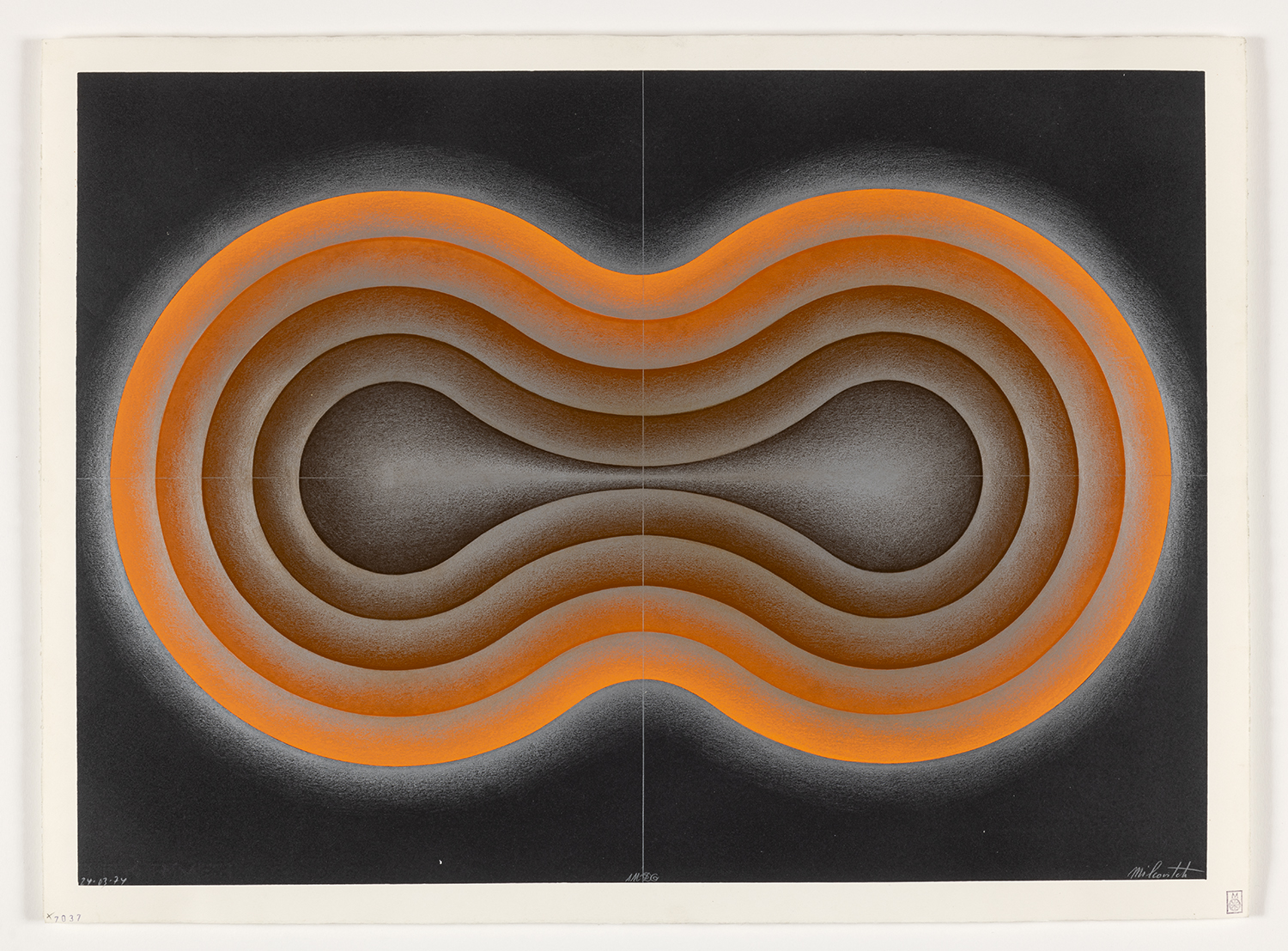
Méditation, Mircea Milcovitch
silkscreen, 1974, 55,5 x 76 cm, donated by Francois Paul-Cavallier to the Beaux Arts Museum of Nancy, France
by Alexandra I. Mas
A sign is never innocent. It stands where silence condenses into form. A line, a curve, a mark, each holds within it a compression of time, gesture, belief. The sign is not an ornament of thought; it is its vessel. What words cannot sustain alone settles into it. Before speech, there was tracing. Before tracing, there was vision. The sign belongs to that first accord between the human gaze and the world, a pact older than memory. Across millennia, it persists. Carved into stone, painted on skin, woven into cloth, cast in metal, inscribed into architecture. It travels without passport, without translation. A spiral answers another spiral across continents. A cross, a circle, a hand, a triangle — forms return where no exchange can be proven. Not imitation, but recognition.
This is not history. It is recurrence. The sign does not explain; it discloses. It gathers fear and hope, imposes measure upon disorder. To draw a sign is to contain the infinite within a boundary the hand can hold. Yet the more reduced the form, the more it escapes definition. It endures because it speaks where language fails. Because it outlives tongues and names. A mark carved five thousand years ago stands intact, not asking to be deciphered, but to be faced. And in that encounter, something shifts. If the same forms arise again and again, beyond all contact, then they do not belong to culture alone. They precede it. They exceed it. They suggest an order beneath fragmentation, not invented, but revealed.
Call it archetype. Call it memory. Or call it, without precaution: the divine; not above, not elsewhere, within. The sign is the trace of that presence, a mark at the surface of the visible, indicating inward. It does not demonstrate; it insists. Across centuries, quietly: you have seen this before.
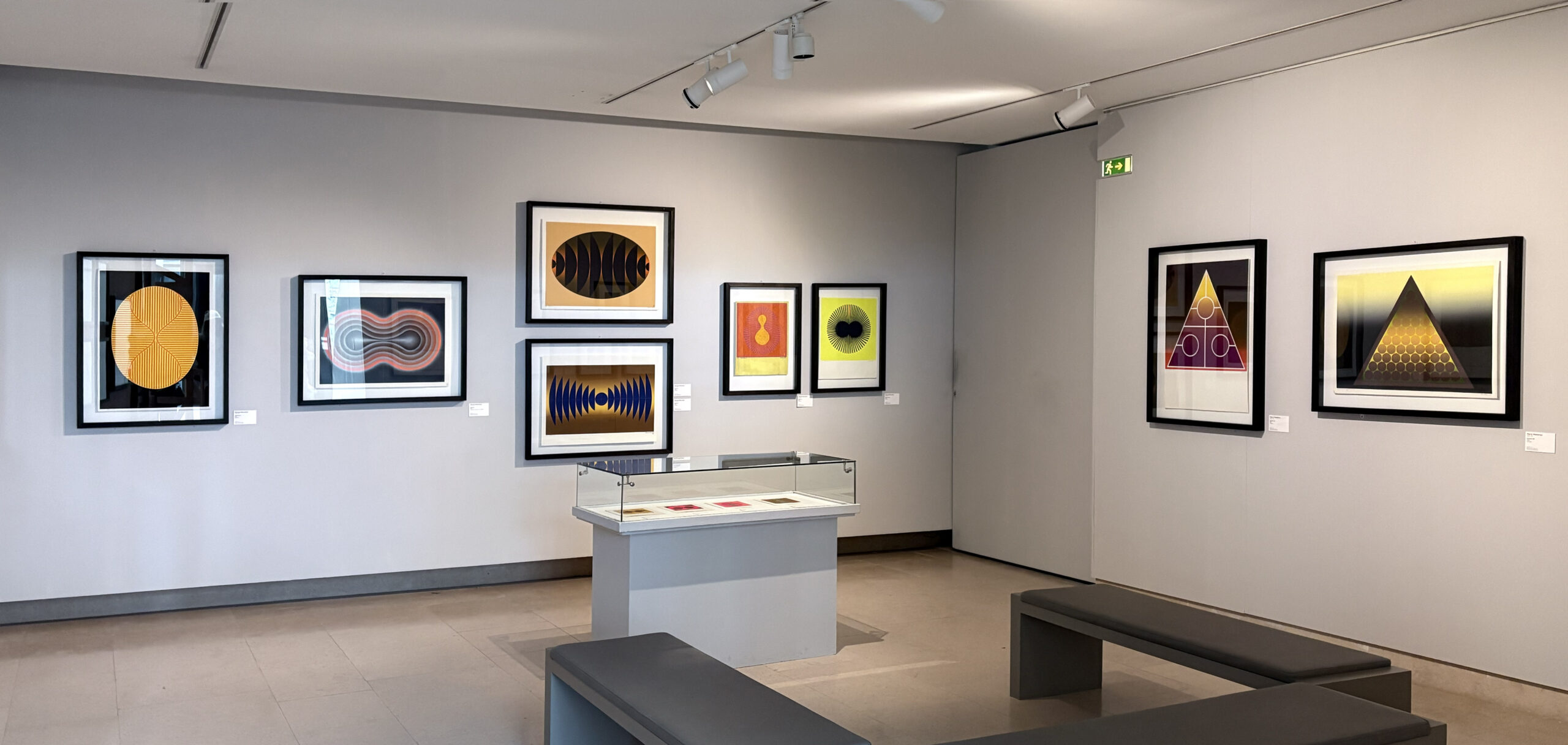
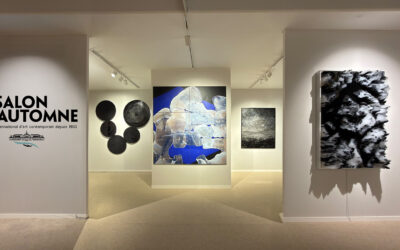
view from the Maria Mesterou and Mircea Milcovitch exhibition at the Beaux Arts Museum of Nancy, France, 2026
I had always known my mother’s cousin — whom I have always called my uncle — was a sculptor. It was, to me, a distant knowledge, held at a remove. The Iron Curtain severed intimacies, yet it did not uproot them. What runs beneath resists division. On my grandmother’s side, the language of the image — and of the sign — was never incidental. It was transmitted. We share an ancestor who served the Orthodox Church as an arkhierei, an archbishop in the original sense: one who safeguards and passes on. He was also active in the school of liturgical chant in Moldavia, where voice, sign, and devotion formed a single discipline. Among the oldest of their kind, this school opened early to those without means, a decision traced to the time of Stephen the Great. Through them, knowledge circulated where borders could not contain it, between what we now call Russia, Ukraine, and Moldavia, carried not by force, but by study and continuity.
Distance marked the surface. The roots held. I came to my uncle’s work — and to his wife’s — late. I was already twenty-two. Mircea had reached a point of mastery. Maria painted icons with a discipline that felt less like practice than devotion. Entering their home and atelier, close to Paris, revealed matter in its full demand: the accumulation of years, the exactness of technique. He works Carrara marble and black schist with equal authority; she brings light forward through paint with a rare exactitude.
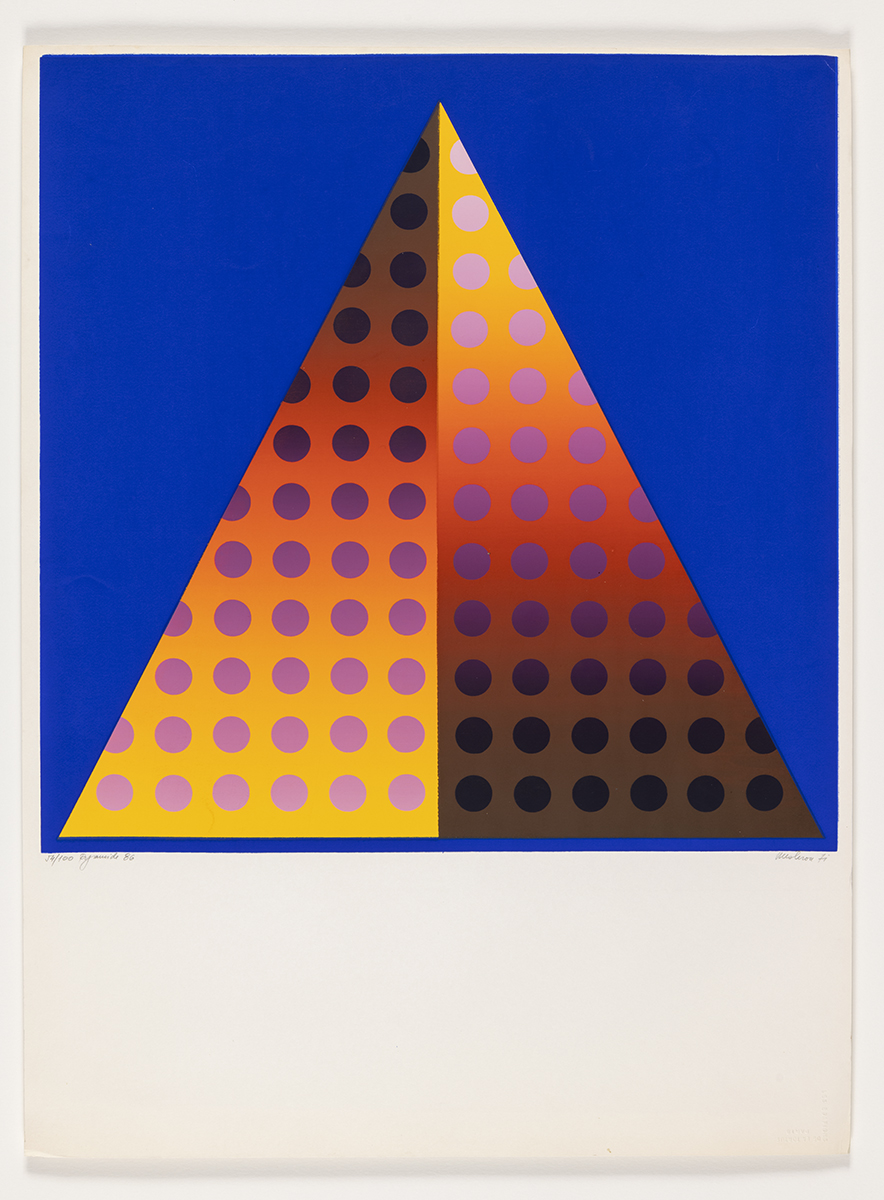
Pyramide 86, Maria Mesterou
silkscreen, 76,5 x 57,2 cm, 1971, donated by Francois Paul-Cavallier to the Beaux Arts Museum of Nancy, France
During my student years in Paris, I would meet him occasionally, most often at gallery openings on rue de Seine. These encounters were brief, marked by a certain reserve, almost ritual in their tone, yet they were enough to sense an underlying continuity. My years in California pulled me away once more. But upon returning to France, that separation receded. In 2013, at the Salon d’Automne in Paris, we found ourselves exhibiting together, each in separate sections.
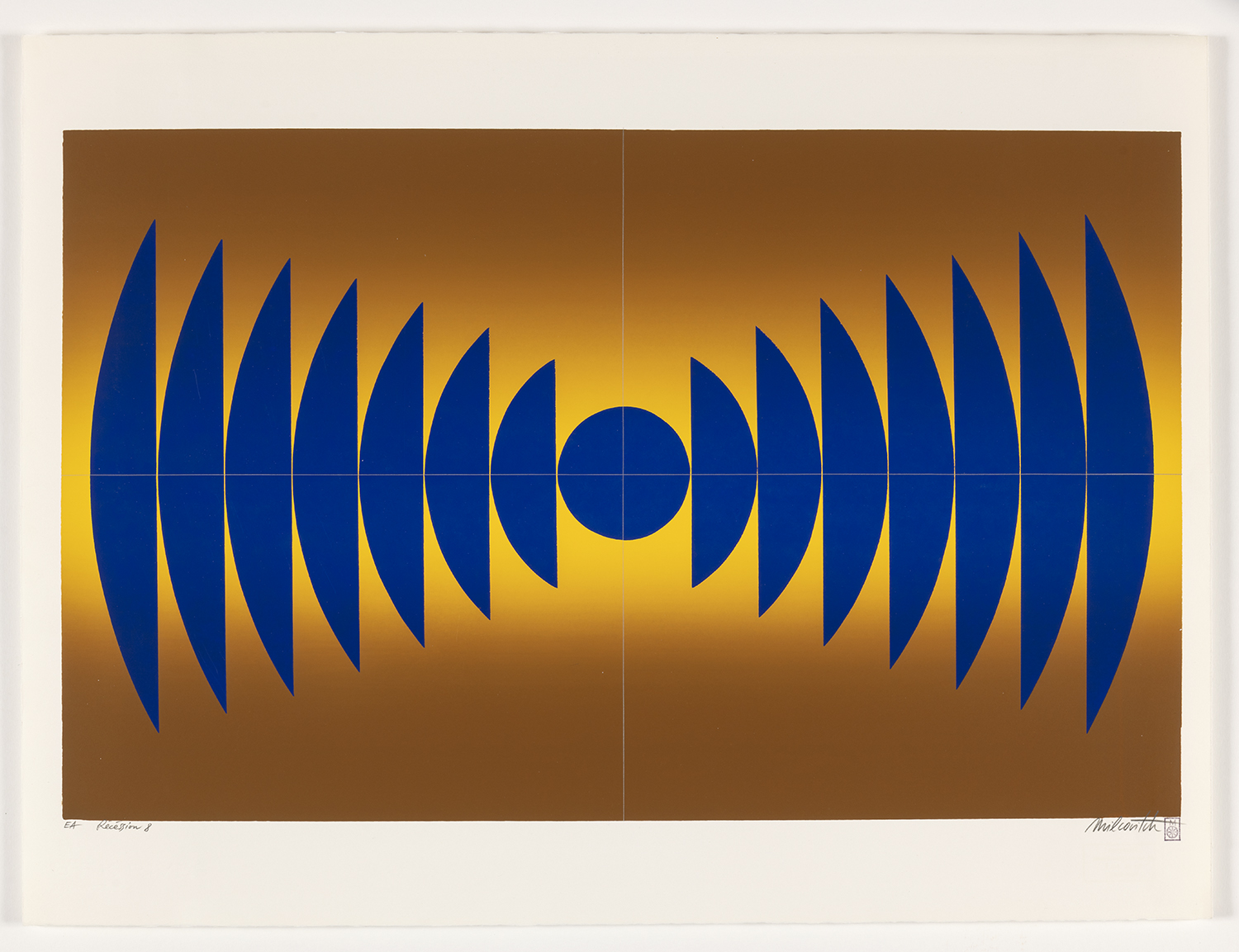
Récéssion 8, Mircea Milcovitch
silkscreen, 1974, 56,2 x 75,5 cm, donated by Francois Paul-Cavallier to the Beaux Arts Museum of Nancy, France
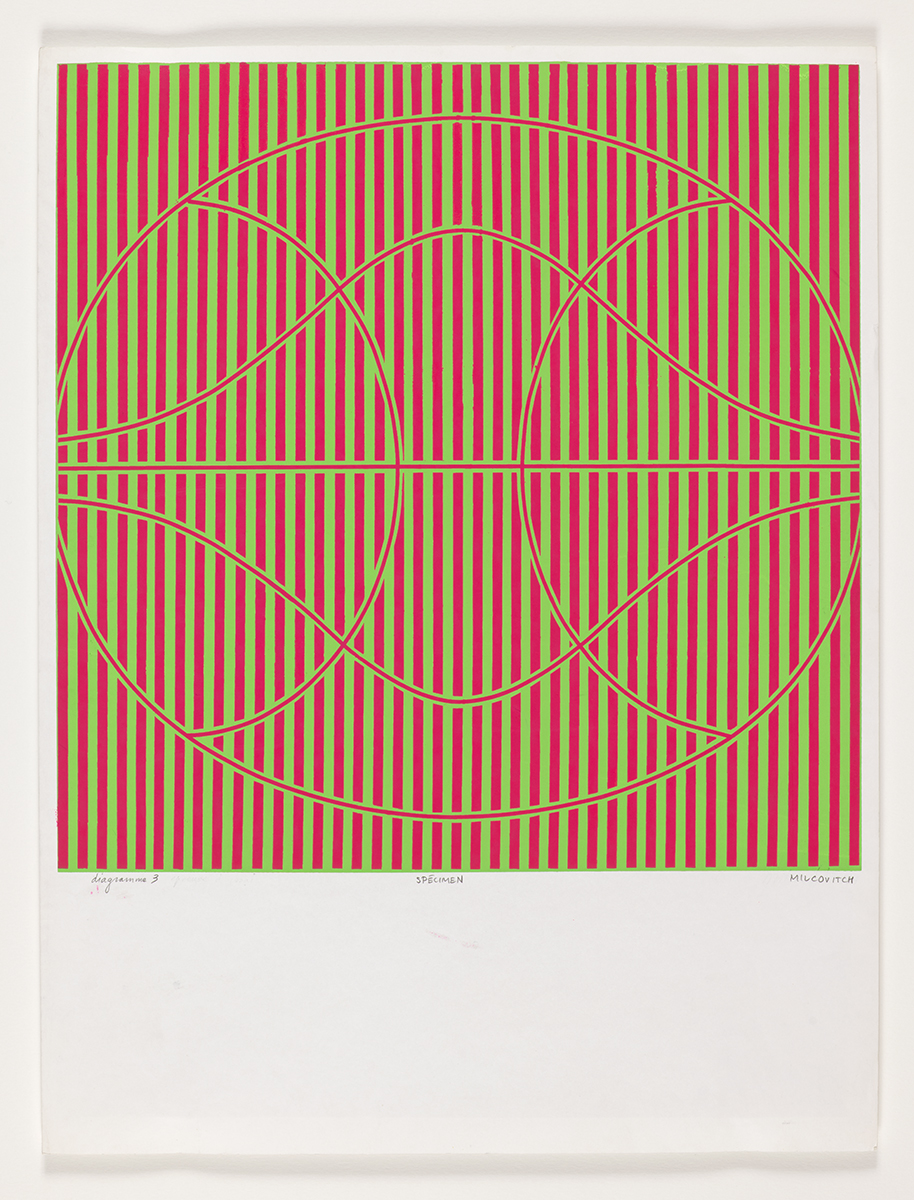
Diagramme 3, Mircea Milcovitch
silkscreen, 1970, 67,2 x 50,8 cm, donated by Francois Paul-Cavallier to the Beaux Arts Museum of Nancy, France
I went, with emotion, to the exhibition at the Musée des Beaux-Arts de Nancy, which will remain on view through July, drawn from the donation of François Paul-Cavallier. It brings into view a body of works by Maria Mesterou and Mircea Milcovitch within the context of kinetic and optical art.
The historical framing is exact. The decades of the 1960s and 1970s were marked by a refusal of academic constraint. Artistic creation sought new grounds, new modes of diffusion. Art had to be everywhere, even within the domestic sphere through television. May 1968 revealed the force of posters and printed matter, not only as vehicles of protest, but as visual forms capable of immediate impact. Lithography and silkscreen opened new technical fields. Publishers and artists worked together to produce works at modest cost, accessible to a wider public. The Éditions de la Tortue emerged in this context, founded by François Paul-Cavallier, first an artist, then a publisher and dealer, committed to promoting the artists he supported through salons and biennials.
Kinetic and optical art asserted themselves. They brought forward works structured by color, by vibration, by the activation of perception. In contrast to Pop Art, they did not claim a social program. They extended the research of Mondrian and Yves Klein on form and color, while drawing from scientific thought, the atom, galaxies, magnetic fields. Science had established that matter is composed of elements in perpetual motion. Artists translated this into visual pulsation.
Maria Mesterou and Mircea Milcovitch found in these vibrations a means to articulate a spiritual orientation. Born in 1941, trained at the Institute of Plastic Arts in Bucharest, they left communist Romania in the 1970s and settled in France. Their collaboration with Éditions de la Tortue began then. Their silkscreens, marked by precision, carry a spiritual charge through the controlled use of vibrating color. Forms drawn from Orthodox tradition introduce a dimension that is contemplative.
“If one wishes to appreciate them as more than mere decoration, the viewer must be willing to concentrate on them for an extended period.”
(Op Art Paintings: “Metaphenomena” Milcovitch, Leonardo, vol. 4, 1971, pp. 267–268.)
Yet what appears here is not limited to a movement. These forms read as a system, a grammar. In these prints, one already perceives the discipline that will later take form in sculpture. Repetition, symmetry, calibrated tension, all prepare the gesture. The work on paper is not an end; it is a passage. A necessary ordering before the irrevocable act of carving.
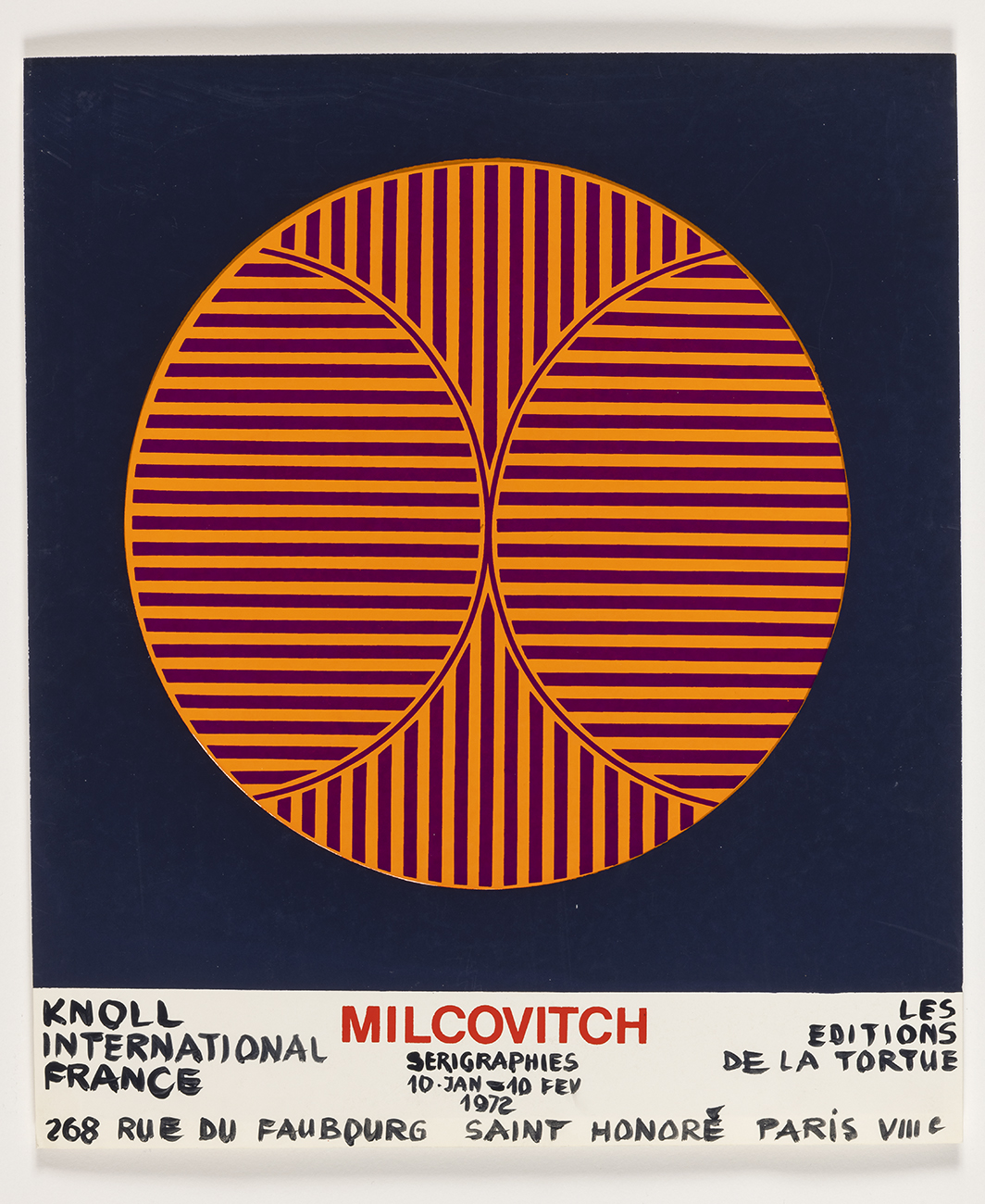
Poster for the Knoll Gallery exhibition, Mircea Milcovitch
silkscreen and artist’s handwriting, 1972, project proof, 50,7 x 42,8 cm, donated by Francois Paul-Cavallier to the Beaux Arts Museum of Nancy, France
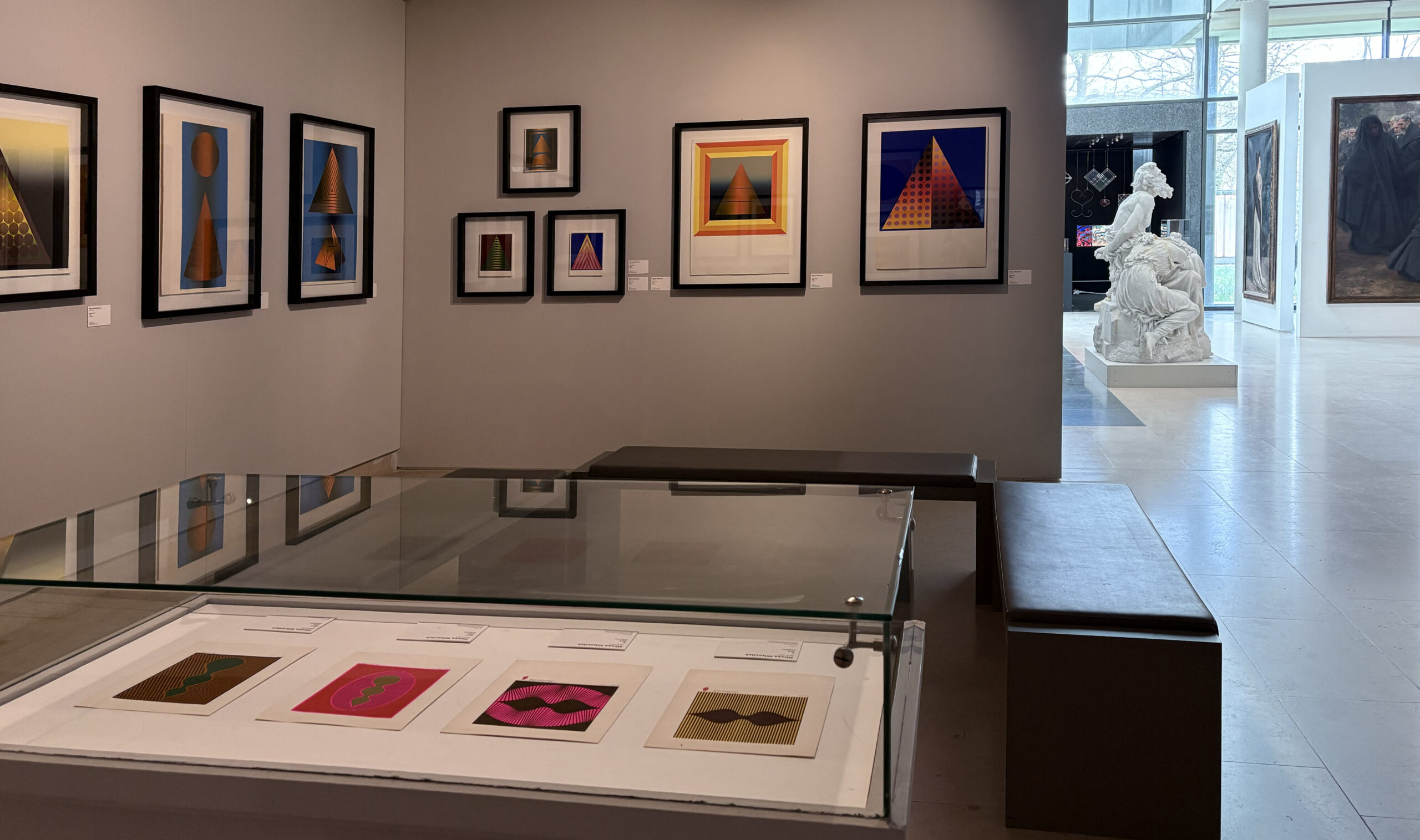
Exhibition view, Maria Mesterou & Mircea Milcovitch, Beaux Arts Museum, Nancy, France 2026
This process would later be formalized in what Mircea calls his Mutus Liber — a “silent book,” in reference to the alchemical tradition — where forms and symbols are gathered, identified, and structured as a language intended to transmit a message that exceeds the individual. Sculpture admits no correction. His carved forms bear that constraint. In Carrara marble, light is held with clarity. In schist, a harder, more resistant stone, fractured, dense, the work reaches another register. There, resistance meets intention without concession.
Vibration becomes incision. Optical effect becomes structure. Nothing is abandoned. The same signs persist, translated from surface to depth. What changes is not the language, but its weight.
This exhibition matters because it reveals that foundation.
François Paul-Cavallier writes:
“What marks the beginning of things always shapes what follows. For Maria and Mircea, we do not go back further than their first names, yet their origins reach much deeper. Mircea is a Romanian name whose root, ‘Mirce,’ signifies peace, but it has often been associated with Michael, the Archangel who casts the demon down to earth, patron of those who descend from the sky. At Mont-Saint-Michel, he fixes the river Couesnon like a serpent at the foot of the mount. Mircea spent time within that community, then entrusted to the Benedictines of Le Bec-Hellouin, where he led a workshop on Christian symbolism in which I took part, alongside a small group that included a young man who would later become known, Frédéric Lenoir, editor of Le Monde des religions.
Maria is the name of the woman who devoted her life to the service of God, offering her body to bear the Messiah, and who, at the moment of the Annunciation, said: ‘I am the servant of the Lord.’
By placing thus the beginning of their destiny, I wish to show that each is invested with a mission that surpasses them, to which they consent. Both fled the imposture of communism and a world that denied spirituality, not to seek enrichment in the West, but to make possible that for which they had come into the world.
I bear witness to what I have shared with them, moments of work, of spiritual depth. Each, in a distinct role, has come to reveal a vision of the hidden signs of divine Creation.
Let me step aside to speak of art, a word into which one places everything and anything. Art is not meant to be pleasing; it is meant to be true. Beauty comes as a consequence, when all is in its right place. To say that art must be true is to say that it reflects the truth of human life, its grace, but also its violence and its baseness. Art reveals inwardly; it orders as much as it unsettles. In a place such as this, filled with works from all periods, no two viewers see the same image. The ‘painting’ does not exist in itself; only the image formed within the viewer exists. It is the encounter between what one might call an ‘ordinary’ image and the resonance it produces within one’s own history that generates the true image.
Do not forget that the word image is an anagram of magic. This is the alchemy: between a tangible reality, canvas, wood, pigments, and the conscious and unconscious layers of one’s past that it awakens, there emerges what we call reality, that is, what one experiences before the work.
Returning to Maria and Mircea: with discretion, even humility, each lifts a corner of the veil, without display, so that one may access, from where one stands, a fragment of divine Creation.”
I may add a note about Maria Mesterou. In Romanian, her name carries within it mester, the master, the one who knows through making, who unites knowledge and execution. In Maria’s work, this mastery does not assert itself. It withdraws. It is held in restraint, in precision, in the refusal of excess. She stands as a ground sustained, where image making, discipline, and silence forge together.
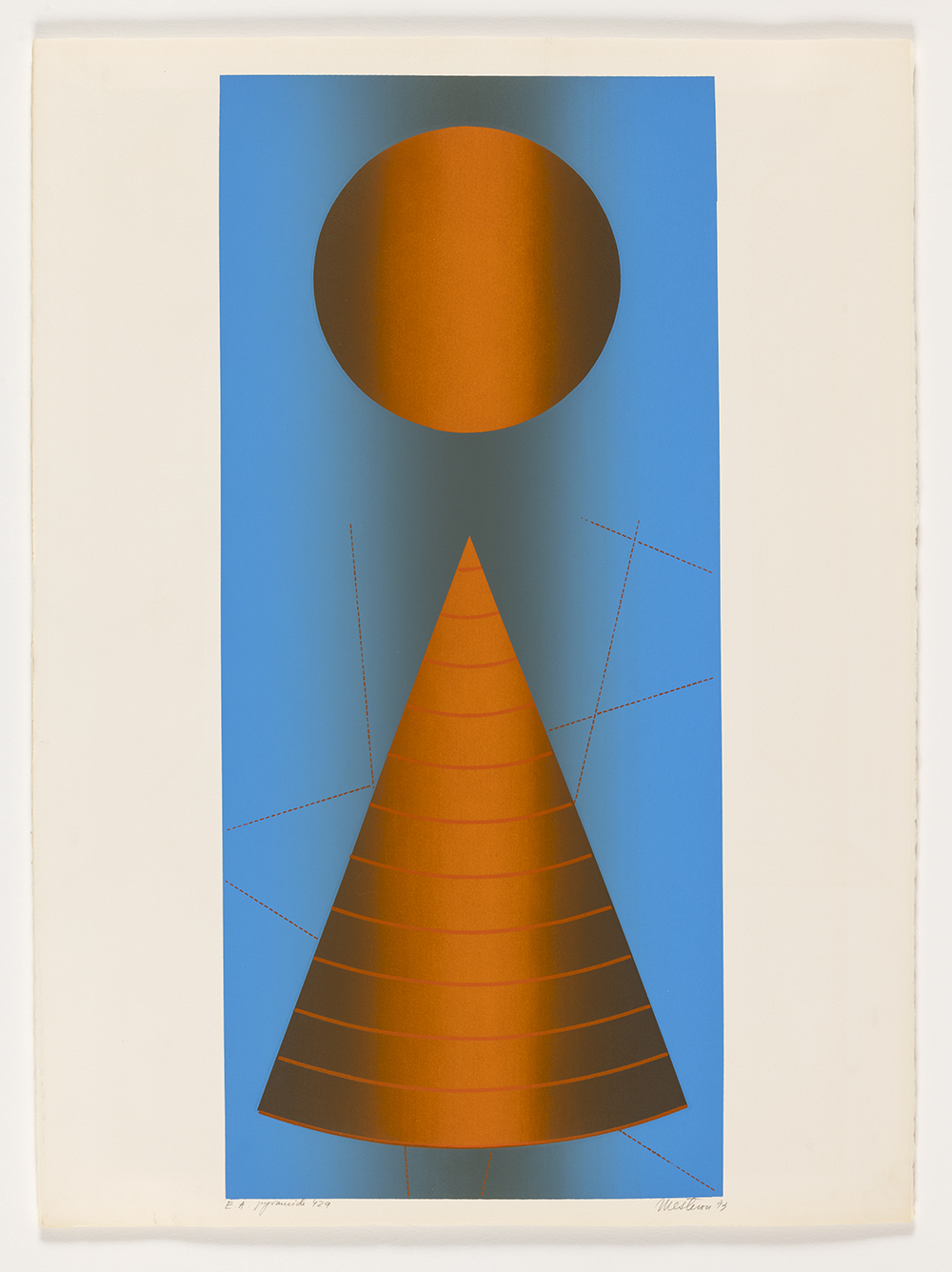
Pyramide 429, Maria Mesterou
1973, silkscreen, 76 x 56,4 cm, donated by Francois Paul-Cavallier to the Beaux Arts Museum of Nancy, France
To master, in her work, is not to dominate, but to serve with exactness, like an ascetic. And in this quiet position, something essential is secured: the conditions through which form can carry meaning without dispersion. What appears in Mircea’s work, the structure, the articulation, the unfolding of a symbolic language, finds, beside it, a necessary counterpoint. Not secondary, not supportive, but parallel.
Two trajectories, held in tension. One does not precede the other; both answer to the same demand. Their work often takes the form of complex geometries, structures long studied by mathematicians. Each configuration operates as an allegory, at times as praise: an acknowledgment that geometry is not an invention, but a discovery, a law embedded in matter, granted to human intelligence so that it may recognize order and build from it.
Mircea’s work unfolds as a sustained search for truth. He has approached both sacred and secular texts with rigor, from the Talmud to the Zohar, from Kabbalistic structures to the arcana of the Tarot, seeking to identify the signs that underlie a Judeo-Christian gnosis. Not to accumulate knowledge, but to decipher. To approach a revelation that does not impose itself, but awaits those who seek it.
As François Paul-Cavallier writes about a specific form in Milcovitch’s lexicon:
“The drop of water descending upon the earth, which one finds echoed in the domes of Russian churches, represents divine grace coming down to earth. The symbol is the image of an idea; it is never empty. It carries the essential of a message. Here, the sender is not secondary: it is the Creator addressing His creatures — perhaps not all, but those who seek Him.”