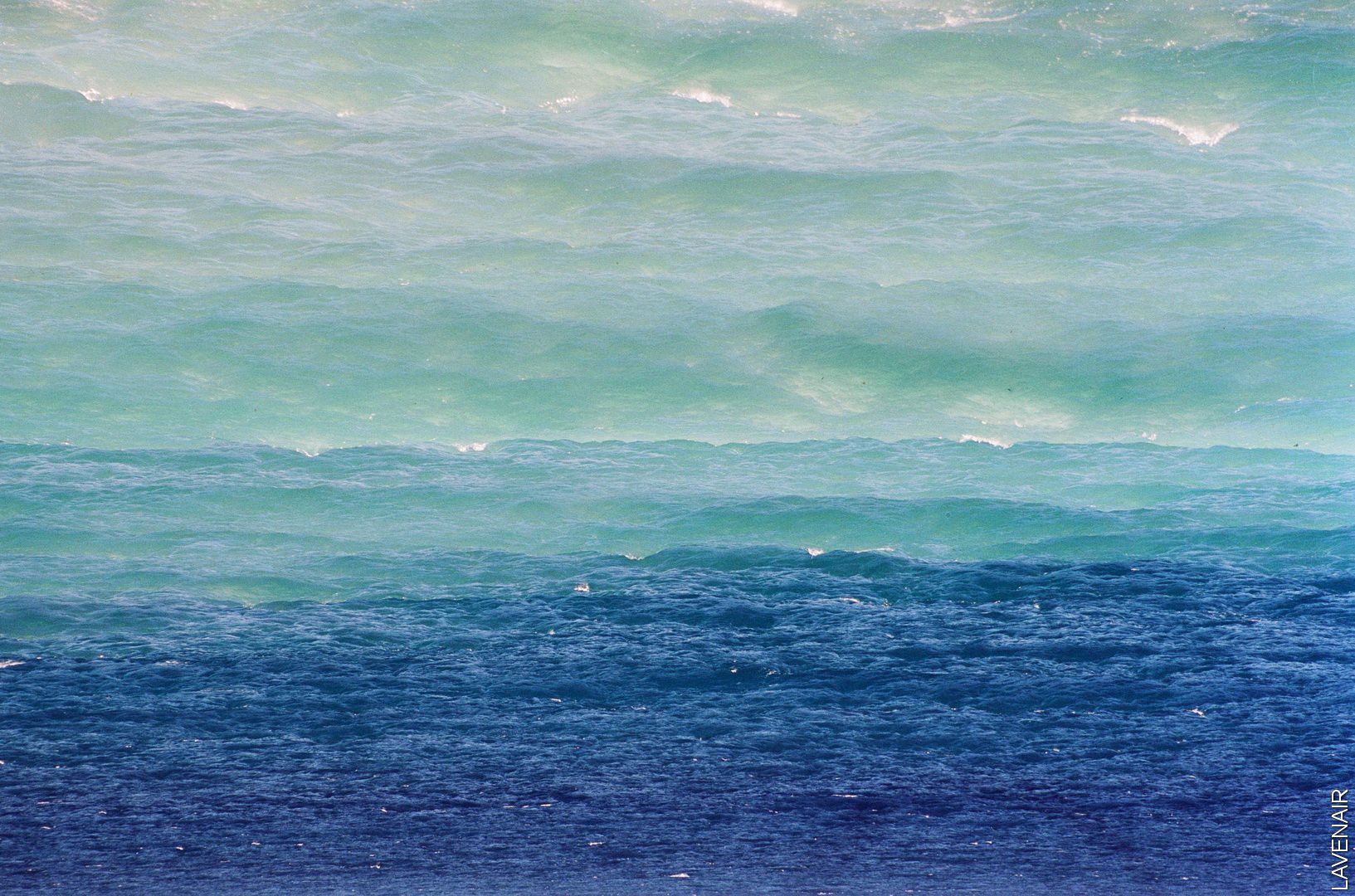
La Mer à l’envers
The Sea Upside Down (2001)
85 × 60 cm
Limited edition of 2/8
Matte fine art paper, mounted in a floating frame
by Alexandra I. Mas
There are artists who choose the sea as subject. Christopher Lavenair returns to it as origin.
Graduate of Chelsea College of Art in London, he first built his language through painting in pastel, felt pen, collage, and acrylic, a strong master of realist expressionism. Later his surfaces construct through layering, cutting, assembling. Color is not blended into submission; it is set in place. This discipline forged what has become his signature: a decisive chromatic authority revealing the inner world of his subjects.
When he turned toward photography, he did not abandon that grammar. He translated it.
Almost a decade in Nice shaped him. The Mediterranean became daily study, its turquoise, its deep ultramarine, the way storm light flattens sky and water into a single plane. Barbados reinforced the attachment: another geography of blue, another lesson in luminosity. These landscapes were not consumed as spectacle. They were observed until internalized.
After the strong reception of ‘Le Plongeoir’ at the Salon Comparaisons 2025, Lavenair returns with La Mer à l’envers, drawn from a negative made in 2001. The delay is meaningful. This is not immediacy. It is maturation. The image reveals a sea without horizon, or rather a horizon forged in our imagination.
“Le bleu turquoise et outremer foncé de la Méditerranée se confondait avec celui du ciel orageux et illimité. Un dégradé de bleu infini se manifestait devant mes yeux.”
“The turquoise and deep ultramarine blue of the Mediterranean blended with that of the stormy, boundless sky. An infinite gradient of blue unfolded before my eyes.”
What distinguishes Lavenair sharply is his refusal to retouch. No digital reconstruction. No chromatic enhancement. The gradients exist because they were present. In a field saturated with post-production, this restraint is almost austere. The photograph must hold on its own structure.
Here the dialogue with history becomes precise.
There is the late work of J. M. W. Turner, those in which sea and sky dissolve into luminous atmosphere, where form thins and light dominates. Turner allowed the horizon to tremble. Lavenair permits a similar instability, not through brush but through exposure.
And there is Hiroshi Sugimoto, whose seascapes reduce the world to elemental bands of water and air. Sugimoto removes anecdote until only time remains. Lavenair does not imitate this minimalism, yet he shares its discipline. The sea is presented without intervention, without dramatization. Presence over performance.
Between Turner’s chromatic dissolution and Sugimoto’s photographic austerity, Lavenair establishes his own ground.
The material presentation reinforces this intent. The work is printed as a fine art inkjet on art paper, mounted in a wood box without glass. The absence of glazing is deliberate. The surface must breathe. The viewer should feel proximity, as if the texture of the water were within reach.
“J’aime l’idée que l’image soit une porte ouverte à l’imaginaire, permettant au spectateur de s’y perdre. Cette mer agitée, son scintillement lui donne une texture vivante, presque palpable.”
“I like the idea that an image can be a doorway to the imagination, allowing the viewer to lose themselves within it. This restless sea, its shimmer gives it a living texture, almost palpable.”
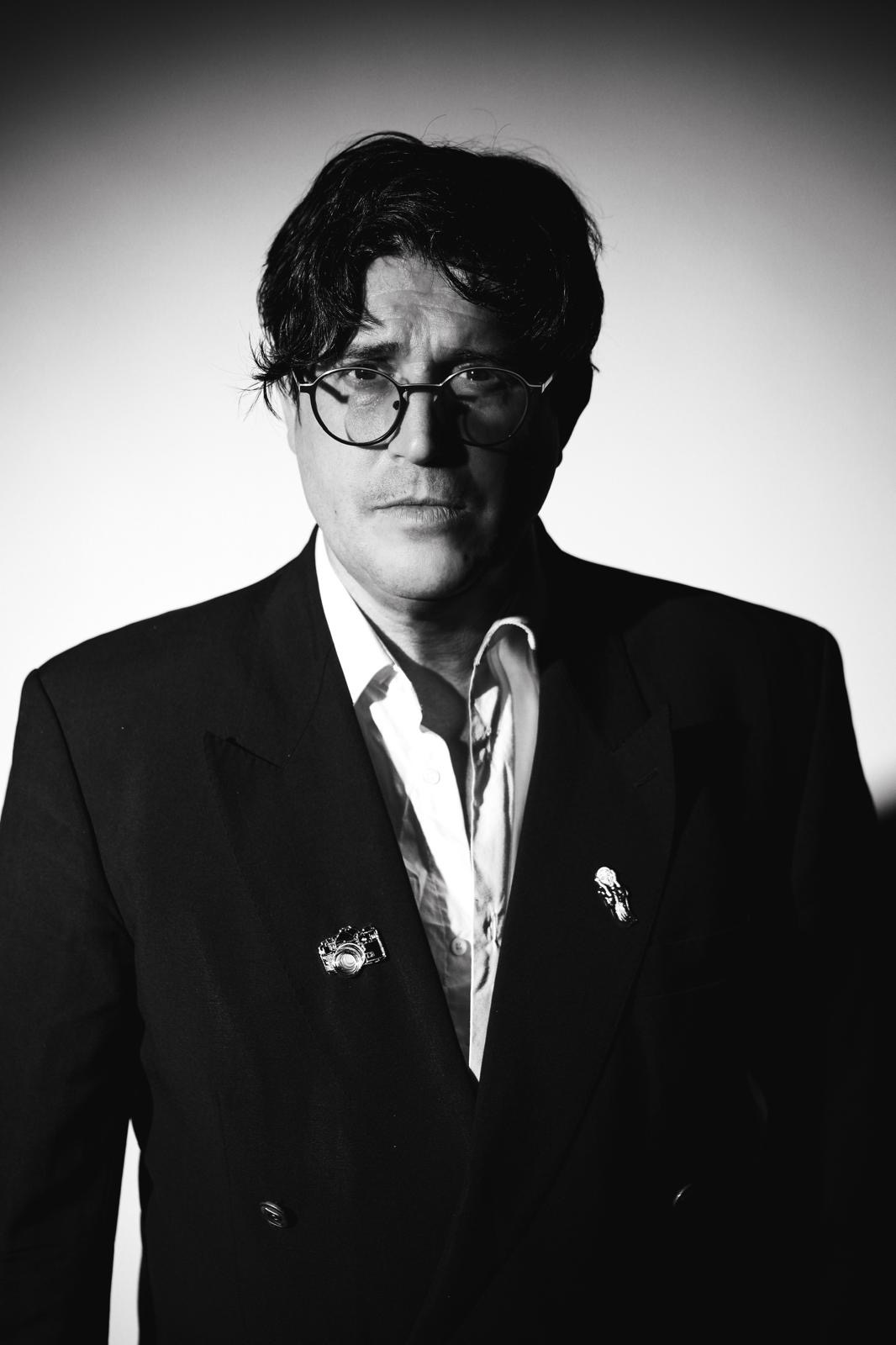
Lavenair (2026)
© Mas Tassini studio
“La mer nous régénère et murmure aux esprits ouverts.”
“The sea regenerates us and whispers to open minds.”
In La Mer à l’envers, the sea is neither backdrop nor metaphor. It is immersion. A field of blue that absorbs the eye, then steadies it. Painter and photographer converge here, not in technique, but in vision.
Alexandra I. Mas, 2026
you can follow Lavenair @chris.lavenair and find his works at La Galerie de la Cle