
Sofika, We Will Dance Again, acrylic and spray on canvas ( 150 × 150 cm )
Bathed in chromatic radiance, this painting unfolds like a promise whispered to the future. Waves of pigment and light form a symphony of resilience, echoing joy reclaimed after silence. The phrase arcs across the surface as a declaration and a benediction : art transforming hope into movement.
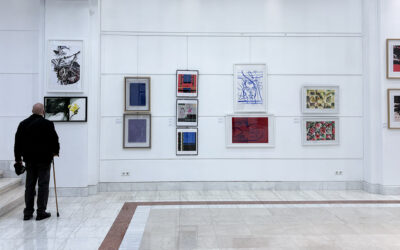
This autumn, the Salon d’Automne returns not to its habitual axis between the Grand and Petit Palais, but to the open expanse of the Place de la Concorde. Here, beneath two vast ephemeral pavilions, more than a thousand artists gathered.
Founded in 1903 by the architect and critic Frantz Jourdain, the Salon d’Automne has always stood as a living chronicle of modern art’s restless evolution. Conceived as a democratic alternative to the academic salons of spring, it offered refuge to new voices, back then, works painted under open skies, born of the long light of summer.
From its earliest editions at the Petit Palais, the Salon became a crucible of the avant-garde. In 1905, it was here that the incandescent palette of Matisse, Derain, and Vlaminck sparked the scandal of Fauvism. A few years later, Cubism and abstraction would find their first Parisian stage beneath the same roof. Over time, the Salon d’Automne transformed from exhibition into ritual, a mirror of French contemporaneity.
Now, in its 122nd edition, the Salon opens a new chapter. For the first time, its galleries rise at the heart of Place de la Concorde, a site charged with the weight of history, flanked by fountains, obelisks, and centuries of national memory. Nearly 4,000 square meters of artistic vitality pulse beneath the temporary structures, bridging heritage and experiment.
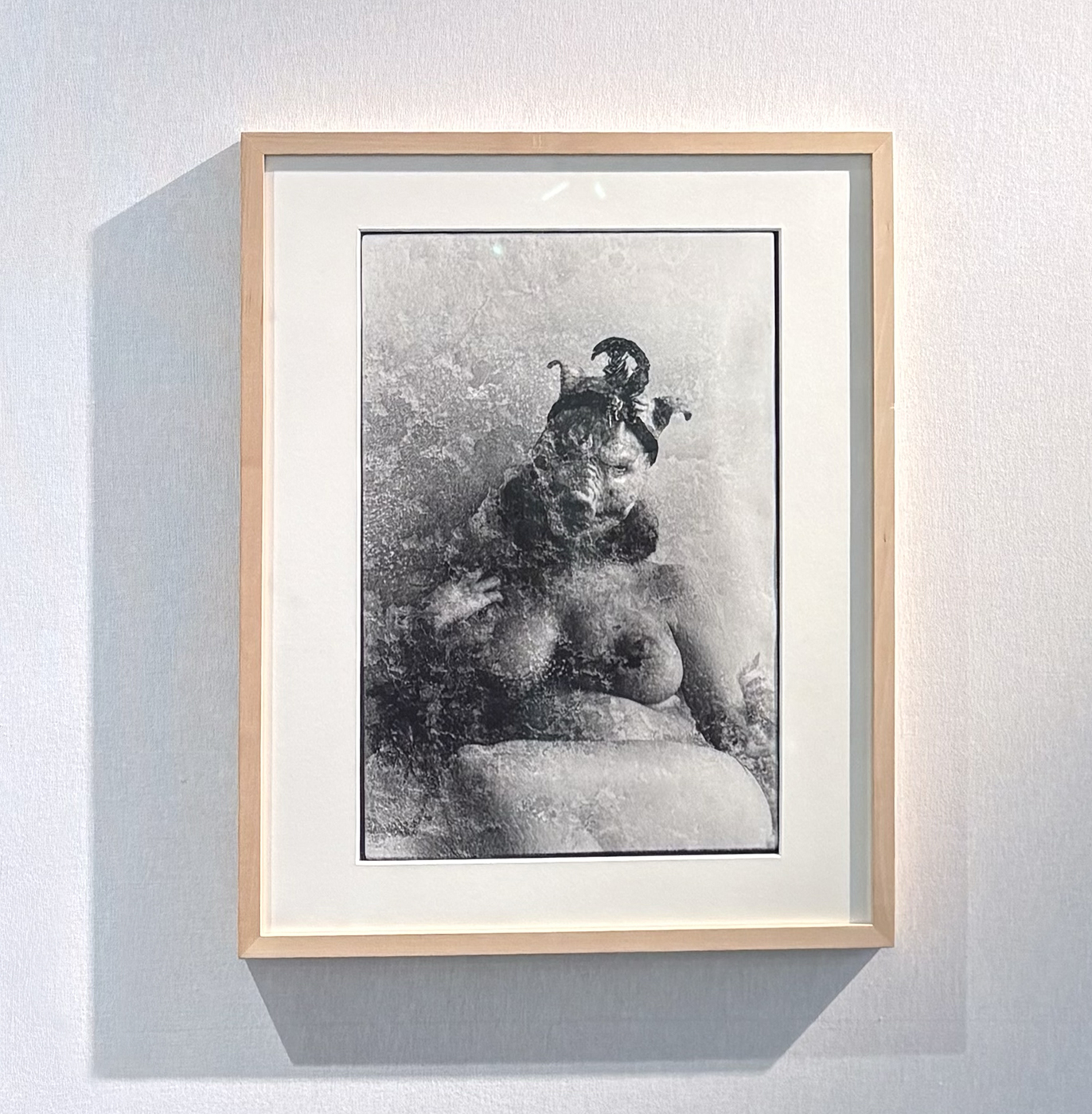
Gaia Adducchio, ‘Naked She’ , analog photography
Italian photographer Gaia Adducchio works in the fragile chemistry of analog film, a terrain of accident and intention, where the image develops like an apparition rather than a record. Her process rejects digital polish: multiple exposures converge in-camera, the print hand-developed on cotton paper, trapping time within its skin.
In this work, the body becomes a terrain. The face half-human, half-beast, her figure dissolves into a storm of texture, fur, flesh, and grain. It is a meditation on duality: the animal we carry within, the blurred edge between instinct and awareness.
Adducchio’s approach feels almost archaeological. Each print is unearthed, not produced; each layer of silver and cellulose a fragment of self, reclaimed from chance. In resisting retouching, she restores imperfection to its dignity, allowing the medium’s unpredictability to echo the instability of being itself.
Her art speaks quietly but with force. In a world oversaturated by precision, Adducchio reclaims mystery, reminding us that truth, like the photographic image, emerges only through exposure.
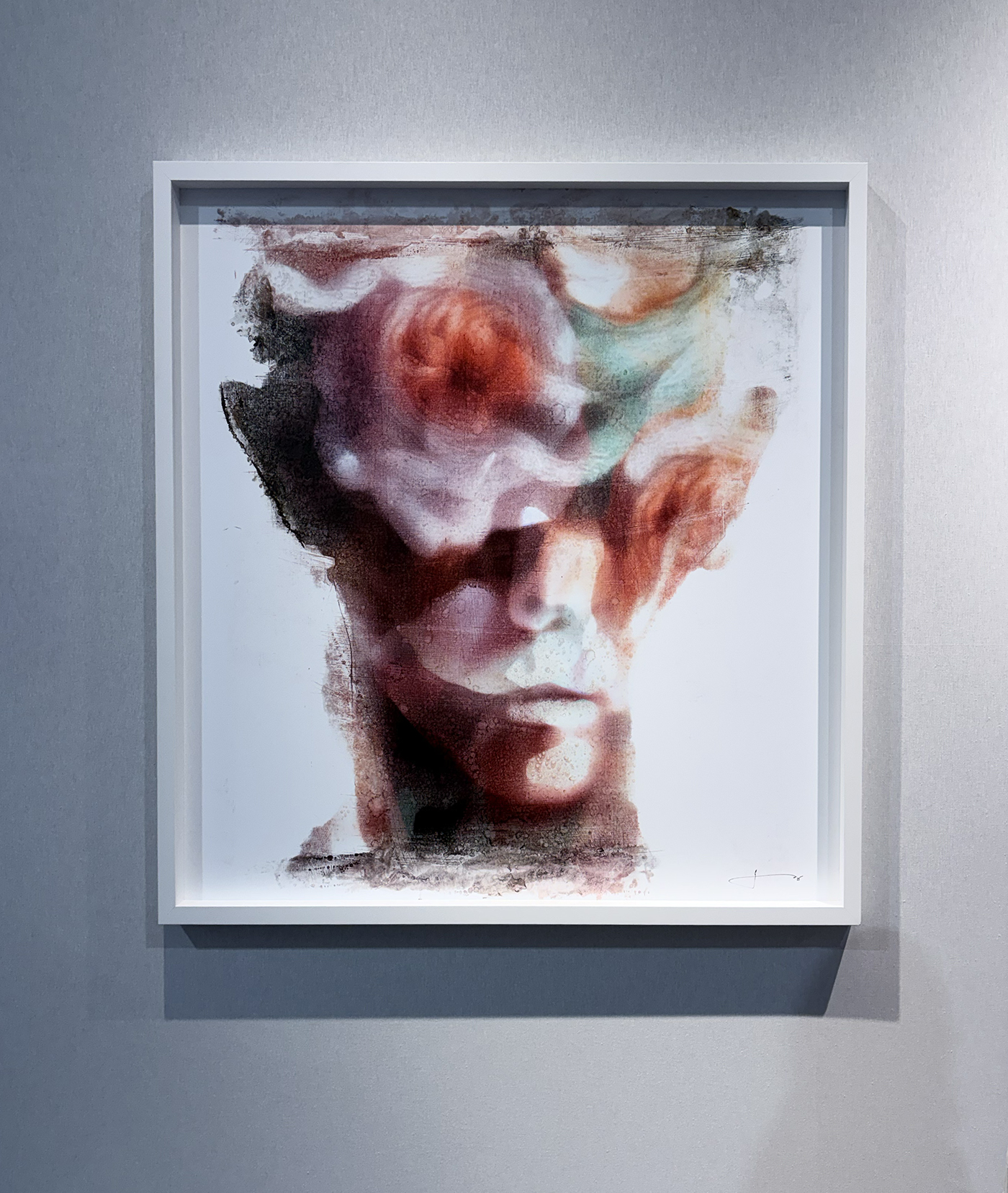
Robert Jaso, “Fragrance of Forgotten Memories”, artisanal emulsion print on fine art paper ( 100 × 100 cm )
Robert Jaso is a photographer with decades of experience in fashion and luxury imagery, now exploring a more experimental and expressive fine-art practice.
His transition toward art is grounded in a singular printing process: his photographic works are developed with selected emulsions, printed on fine art paper in ways that give the the result the texture and presence of a painting.
Rather than simply capturing, his method invites spontaneity: layered emulsions, texture, abstraction, and a poetic layering of memories.
In this self-portrait the face appears emergent from veils of color and form, as if composed of memories that are fading and resurfacing at once. His background in fashion photography gives him a refined control of composition and light; here he translates that discipline into something more vulnerable, more personal. The work evokes a scent of time passing, of identity shifting, of the past pressing its presence.
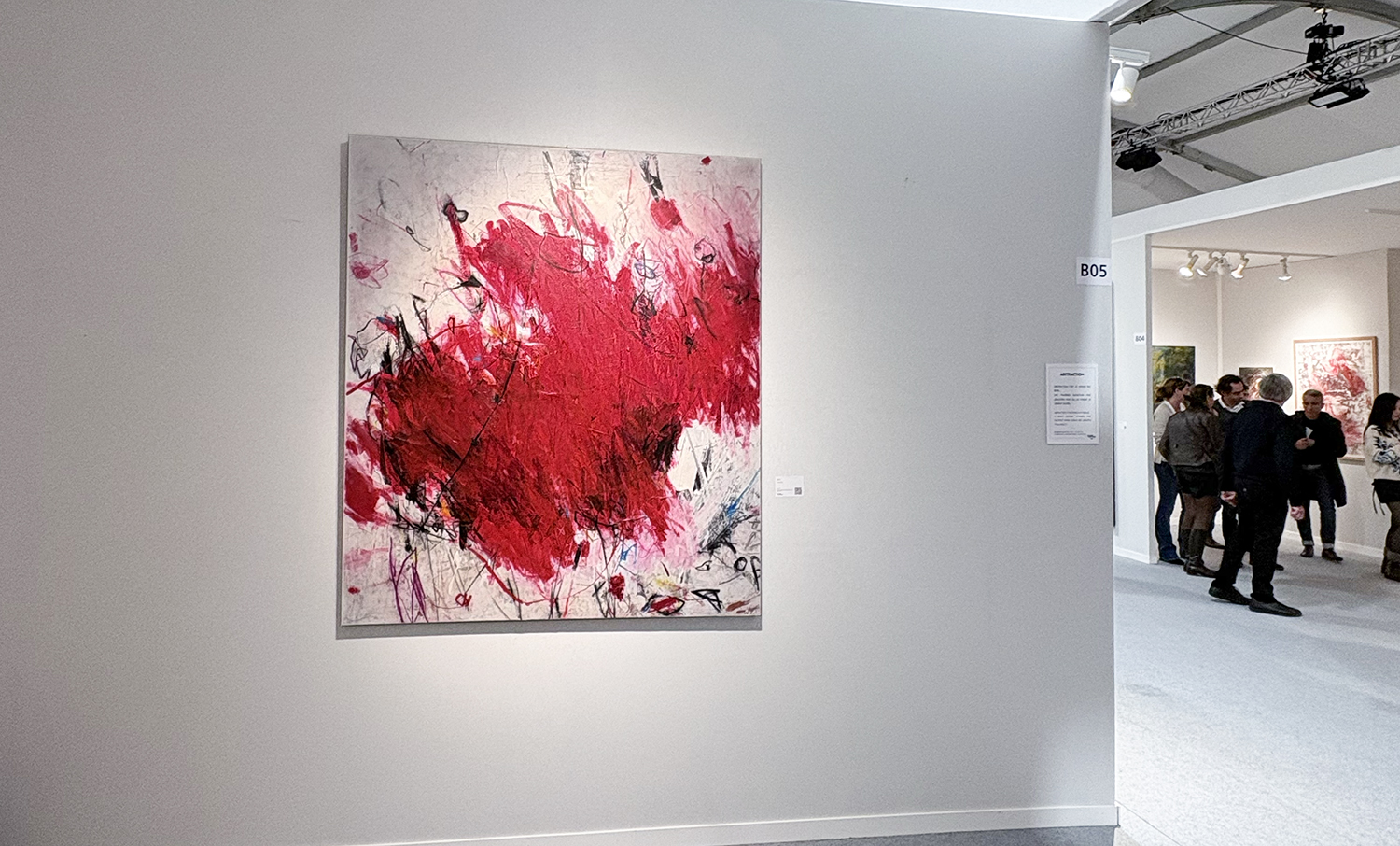
Jan K., Labyrinth, acrylic, collage, pastel, graphite, chalk on canvas ( 160 × 140 cm )
Swiss artist Jan K. works with the precision of impulse, a paradox that defines her art. Her canvases are fields of controlled chaos: collisions of saturated pigment and human energy. Labyrinthe embodies that tension between fury and grace.
Here, the color itself is force. The pigment surges across the canvas like breath or blood, layered with traces of collage and chalk, its texture almost geological. Every mark feels inevitable. You sense that nothing could have been otherwise.
Jan K.’s visual vocabulary is instantly recognizable: bold, physical, yet unpretentious. Her compositions reject the decorative in favour of confrontation, they meet the viewer where intellect falters and instinct begins. Standing before her work, one feels less the need to interpret than to withstand. In Labyrinthe, the gesture becomes architecture. The painting does not depict a maze; it is one, the eye lost in its crimson corridors, the spirit circling toward its centre. Within that spiral of pigment and graphite, Jan K. transforms emotion into form.
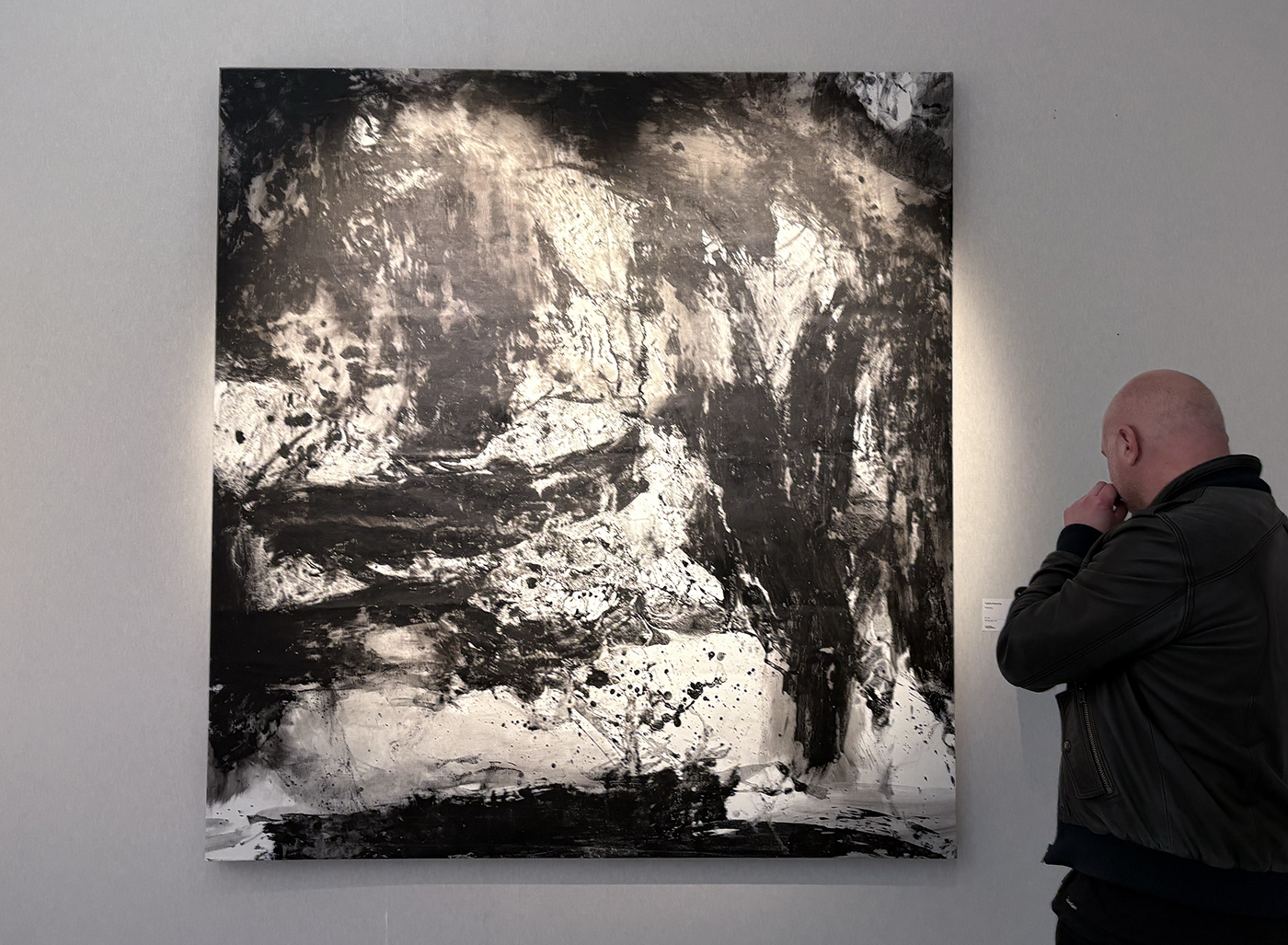
Chen Weinong, Paysage, acrylic and oil on canvas ( 170 x 160 cm )
In Paysage, Chen Weinong translates the breath of Chinese ink into the density of oil and acrylic. The canvas stands like a wall of sedimented time, layered, scarred, luminous in its darkness. His monochrome gesture fuses calligraphic discipline with the rawness of European abstraction; the brushstroke becomes both sign and substance.
Born in Zhejiang and long settled in Paris, Chen belongs to that rare lineage of painters who carry two visual languages within a single gesture. Here, black is not absence but matter, a living field of vibration. White, rather than light, behaves as silence. The result is a landscape without horizon, an interior topography where gesture and erosion coexist.
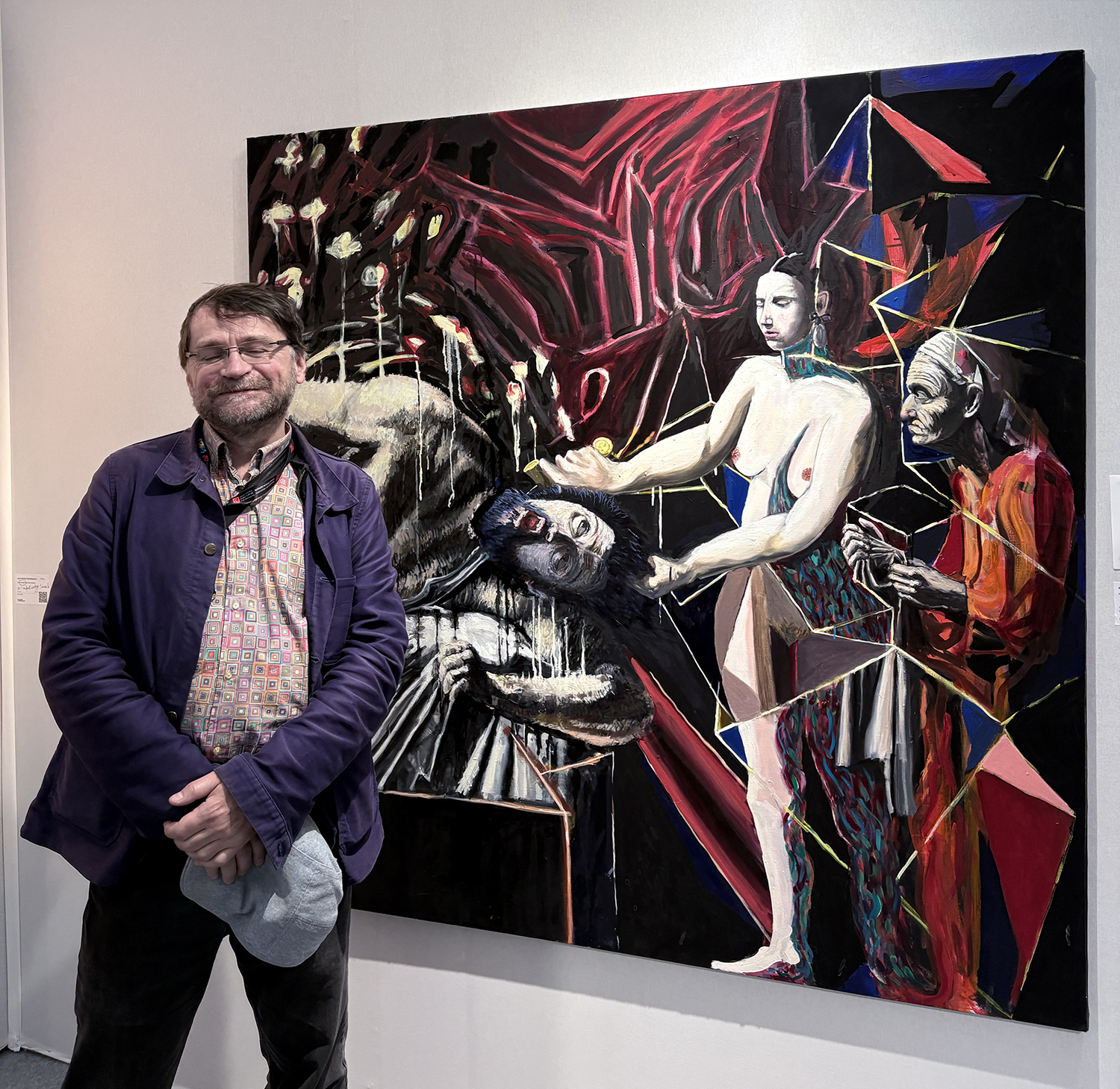
Romain Zeder, Caravane / Caravage, oil on canvas ( 170 x 160 cm )
Romain Zeder revisits the chiaroscuro of Baroque painting to confront the fractured light of the present. Executed in oil on canvas, the work bears the muscular density of traditional technique, layered pigment, assertive brushwork, a palette oscillating between carnal reds and spectral blacks. Yet beneath this mastery lies a deep unease: humanity reflected through distortion, its moral theatre collapsing into fragmentation.
Zeder builds his composition as a tension between reverence and rupture. Figures emerge from the darkness, rendered with anatomical expression and psychological disquiet. The geometrical fractures slicing through the scene break the illusion of continuity, a mirror to our fractured civilization, suspended between faith and loss, beauty and brutality, a drama of modern fragmentation, Zeder crafts a vision, an allegory of a humanity amidst the ruins of reason.
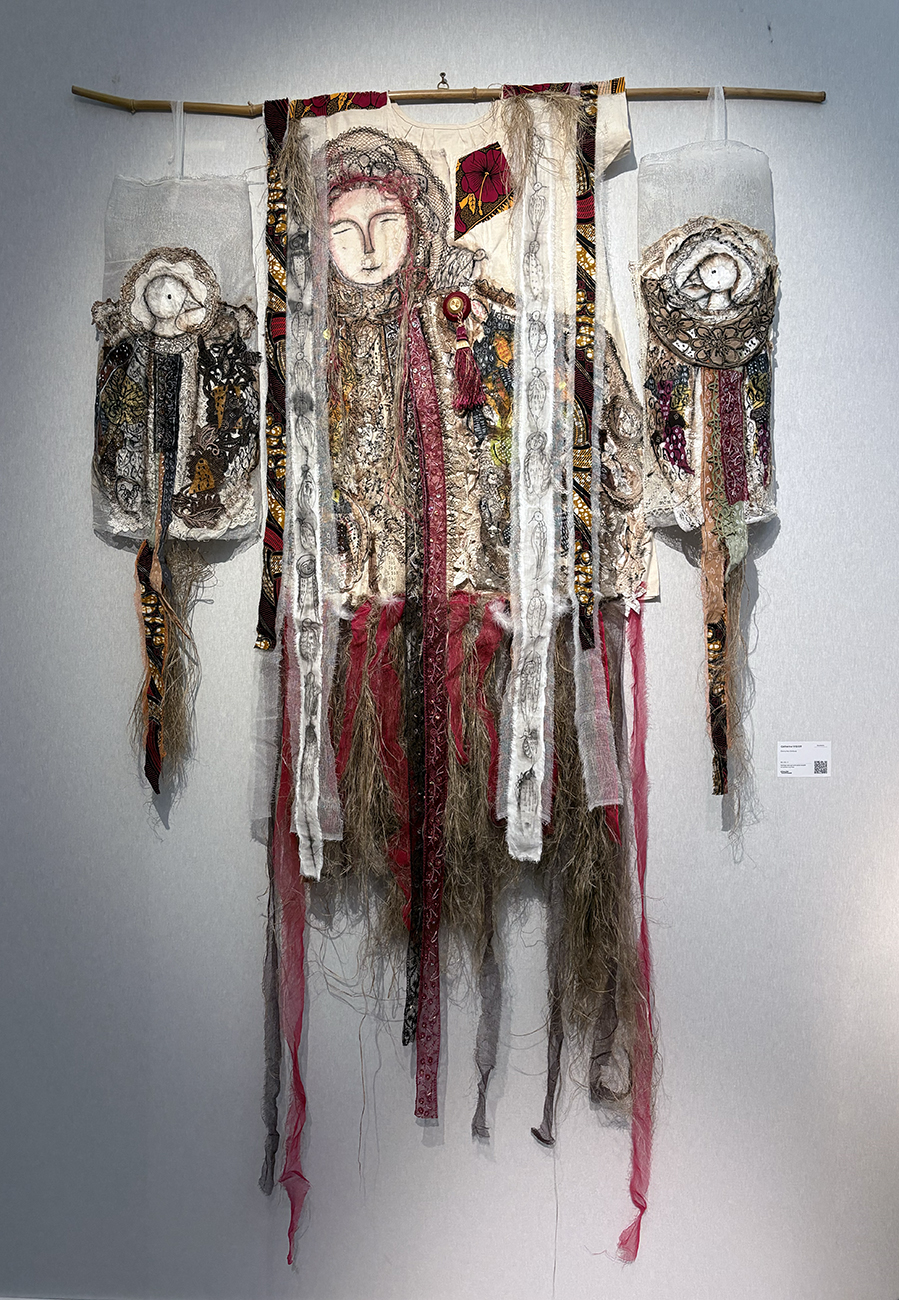
There is a liturgical calm to Catherine Vigier’s Dans les limbes. Constructed from ancient textiles, gauze, and mesh, the work hangs like a votive tapestry, fragile, suspended, and profoundly human. The materials are modest, yet their orchestration feels ceremonial. Layers of lace, thread, and hair-like fibres cascade downward, evoking both ritual garment and ancestral relic.
The central figure, softly delineated, holds the gaze in a state of quiet devotion. Neither portrait nor icon, it inhabits that borderland between the sacred and the earthly, between presence and disappearance. Vigier’s technique of marouflage on tarlatan and wire adds to the sense of transience: this is art that breathes, that trembles slightly in its own light.
Her work bridges the ethnographic and the spiritual. It recalls the tactile intelligence of traditional craft – the gestures of repair, of care – while asserting a contemporary sensibility rooted in fragility and grace.
In the vastness of the Salon d’Automne, Dans les limbes feels like a pause, a liturgical moment amid the noise of modernity. It invites contemplation, humility, and in that restraint lies its quiet power.
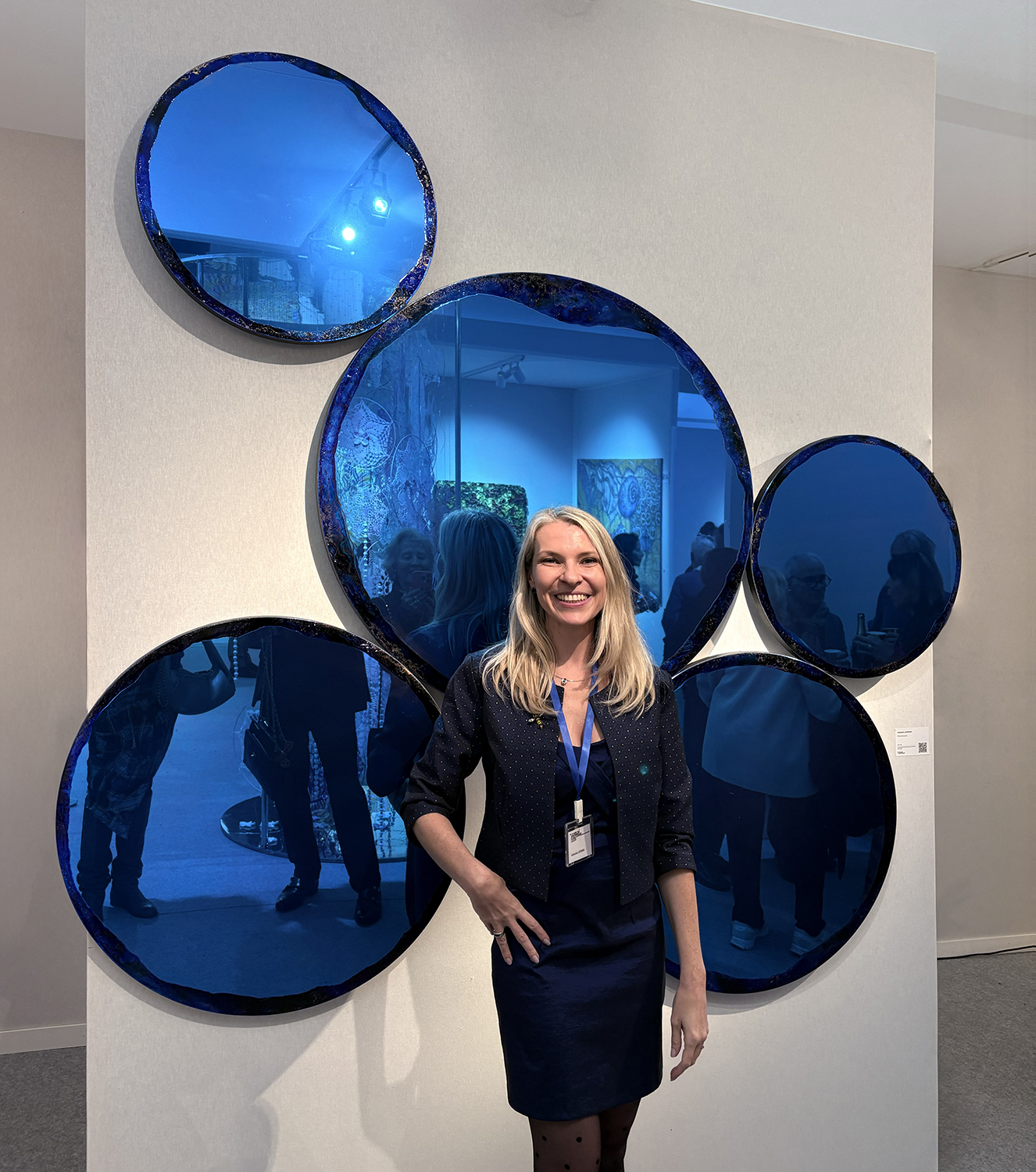
In her installation Fifth Dimension, Adélaïde Leferme transcends the traditional boundaries between object and reflection. The work, composed of five circular mirrors forged through her patented technique of heat-stretched reflective fibres, becomes a living organism, one that shifts, vibrates, and breathes with light. Within these deep blue surfaces, brushed with subtle gold pigments, the viewer encounters not merely a reflection, but a portal: an invitation to cross into perception’s inner space.
The blue recalls Blue Rhapsody, that same tonal resonance between serenity and the unknown, a hue that holds the sky’s infinite promise and the ocean’s introspective gravity. Leferme’s mirrors absorb the gaze only to return it transformed, revealing the fragility and splendour of self-awareness.
At Art Miami Fairs – Aqua Art, the artist will present new works from this same series, continuing her dialogue between technology, emotion, and light. Through her mirrors, Adélaïde Leferme offers a passage into the world’s invisible dimension.
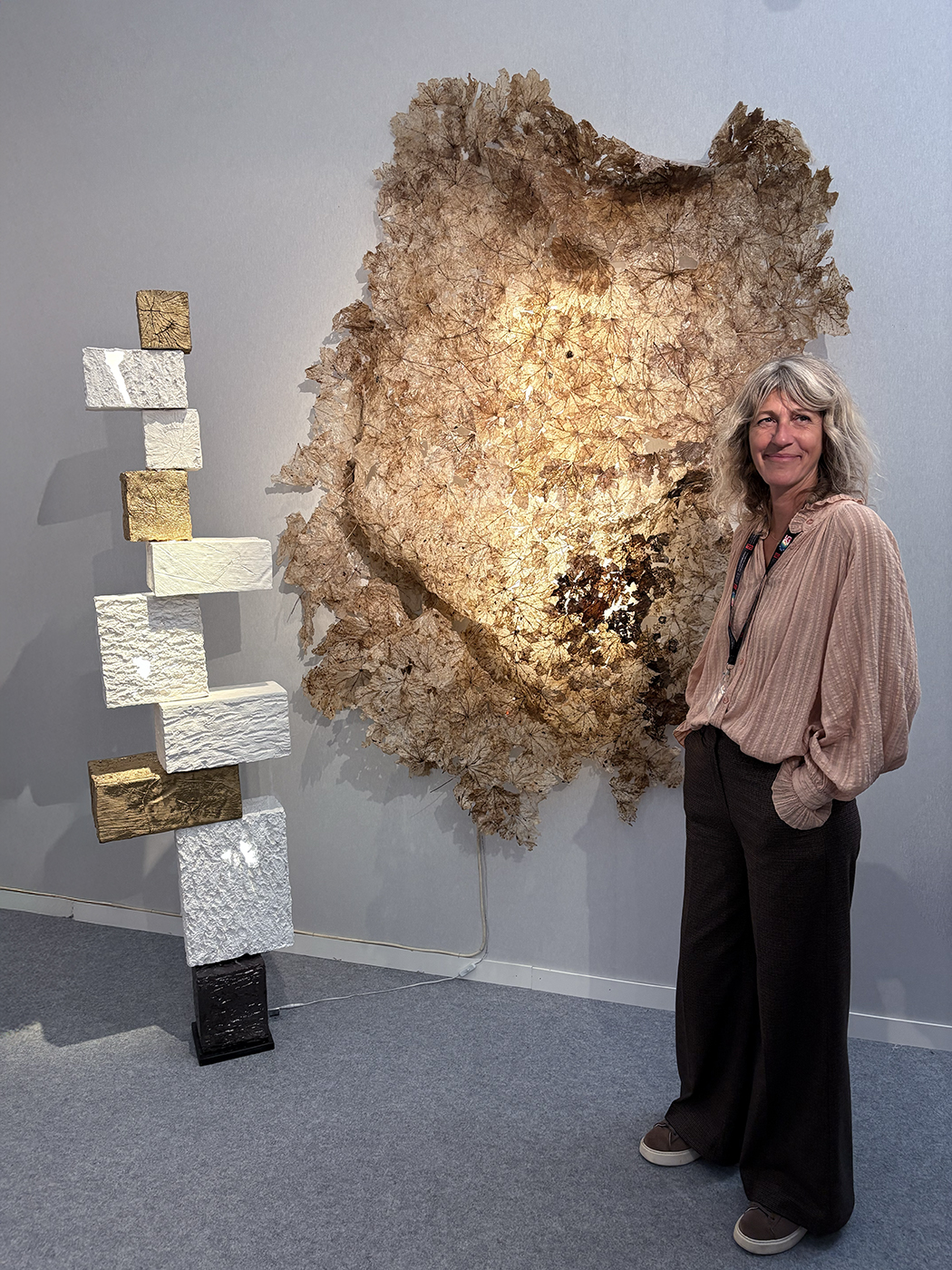
Florence Vial, Voyage, mixed-media installation
Florence Vial’s Voyage draws its strength from the paradox between fragility and permanence. Composed of layers of real leaves bound with cellulose and natural resin, the work transforms ephemeral matter into a near-sculptural membrane, a skin of nature, preserved. The installation unites organic and mineral: a totem of wood, cast concrete and pigment rising beside a glowing expanse of vegetal texture.
The dialogue it creates recalls the material poetry of Giuseppe Penone and Ana Mendieta, where human gesture merges with natural process, but Vial’s language is more intimate, rooted in empathy rather than intervention. Created in 2020, Voyage affirms nature’s capacity to adapt, to recompose itself endlessly. Its delicate surface, seemingly vulnerable, endures through its suppleness. Vial’s work reminds us that resilience often wears the face of fragility.