
Written by Alexandra Touchard
For the first time in Paris, the Palais Galliera dedicates an entire exhibition to Rick Owens, the bold figure of contemporary fashion. Fascinated by the sacred and deeply passionate about modern and contemporary art, Owens draws inspiration as much from Joris-Karl Huysmans’s writings as from 1920s Hollywood cinema. For this exhibition, he has imagined a unique journey that extends onto the museum’s façade and into its gardens.
Born in California in 1961, Rick Owens began his career in Los Angeles, founding his brand in 1992 after working as a pattern maker. His creations quickly stood out: influenced by underground cultures and 1930s glamour, they showcased daring, sophisticated lines.
In 2003, Owens left Los Angeles for Paris. His shows, always independent and provocative, became true political manifestos. Models gave way to stepping performers — an African American dance form driven by percussive rhythms. Owens questioned masculinity, celebrated female strength, and blurred gender boundaries. In response to a world in crisis, he answered with sculptural, radical, and often colorful creations.
The exhibition unveils more than 100 silhouettes, enriched with personal archives, videos, and never-before-seen installations. Works by artists like Gustave Moreau, Joseph Beuys, and Steven Parrino highlight Owens’s key influences. His wife and muse, Michèle Lamy — a central figure in his universe — is also honored, including a reconstruction of their Californian bedroom.
The journey continues outdoors, where Rick Owens wraps the museum’s façade statues in shimmering fabric. In the garden, raw cement sculptures echo his furniture designs. Even the flower beds have been reimagined, inspired by the plant varieties he loves in Los Angeles.
With Rick Owens, Temple of Love, the Palais Galliera offers a monumental and intimate dive into the designer’s universe. Between love, beauty, difference, and freedom, the exhibition celebrates a major figure on the international scene — an artist who has constantly experimented and pushed boundaries.

Fittings for the men’s collection “Babel,” Spring-Summer 2019, Palais Bourbon, Paris, June 19, 2018 © Owenscorp
Retracing the path of an exhibition that is both theoretical and immersive
LOS ANGELES
In California, in Los Angeles, Rick Owens shaped the intellectual, artistic, historical, and mystical foundations of his style. In the 1980s, he broke away from his strict Catholic upbringing and pushed his limits fearlessly, in a climate haunted by the rise of HIV. By the early 1990s, his first personal creations reflected this intimate experience: sophisticated silhouettes capturing the troubled, decadent spirit of the decade.
PARIS
In 2003, his collaboration with the house of Revillon and the production of his pieces in Italy marked a decisive turning point. Owens left Los Angeles for good to settle in Paris. There, his runway shows grew in scale and spectacle, blending aggression and luxury, often compared to brutalist architecture for their powerful visual impact.
THE JOY OF DECADENCE
During the 1980s, Owens immersed himself in Los Angeles’s underground scenes, discovering a world of sexual freedom, drugs, and excess. Sober since 2001, he transformed this tumultuous past into creative strength, adopting strict discipline. Drawing from these experiences, he exposed the hypocrisy and omnipresent violence of our societies. His vision became a sort of contemporary memento mori, a poignant reminder of human vanity and our fragile existence.
THE GENDER PARADOX
From the very beginning, Rick Owens designed for both men and women. Yet, it wasn’t until 2009 in Paris that he began to stage regular men’s shows. Two opposing aesthetics emerged: a noble, almost stoic femininity, and a raw, aggressive, energetic masculinity, asserting a permanent tension and paradox between the sexes.
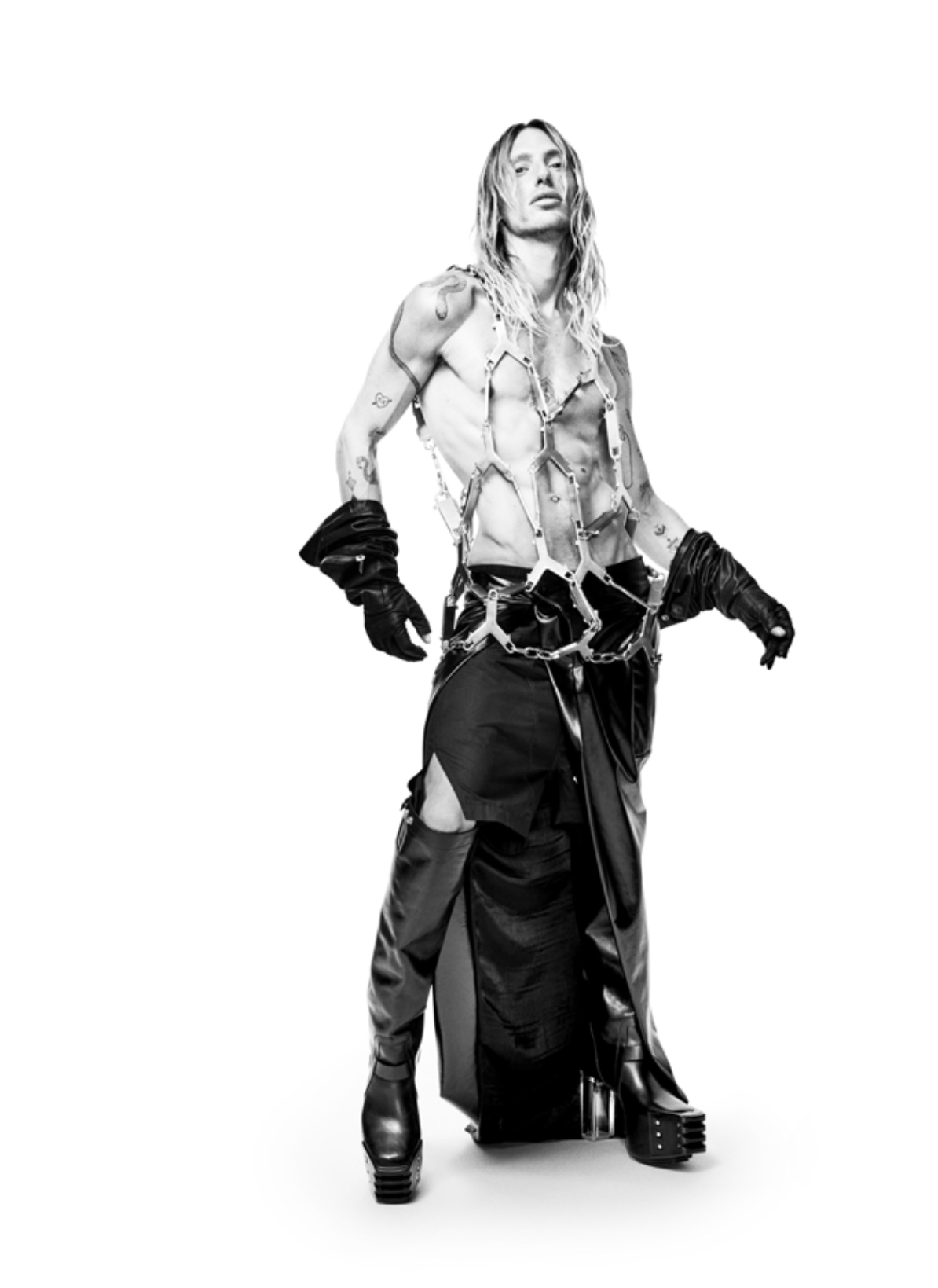
Tyrone, Men’s “Strobe” Collection Fall-Winter 2022 © Danielle Levitt
BRUTALISM
By the late 2000s, critics and journalists frequently compared Owens’s aesthetic to brutalist architecture, highlighting the sculptural force and radical nature of his designs.
CORPOREALITY
Between 2014 and 2016, Owens presented three major collections. Through exposed, naked, or physically challenged bodies, he questioned social and cultural norms and offered a powerful reflection on body diversity.
SCULPTURAL CONFRONTATION
In 2016, as the fashion industry came under fire for its environmental impact, Owens committed to reducing his production’s ecological footprint. Simultaneously, he pushed his artistic approach toward new plastic dimensions: his silhouettes expanded, transforming into sculptural volumes that embodied a manifesto against intolerance.
TENDERNESS
By the late 2010s, Owens shifted his stance. He replaced anger with tenderness, elevating it into a political gesture. He paid tribute to lost figures, his mother, and his Mixtec roots — an Indigenous people of Mexico — transforming gentleness into a new language of resistance.
THE ROOM
The final room of the exhibition recreates the bedroom and wardrobe of Rick Owens and Michèle Lamy in their Las Palmas Avenue studio in Los Angeles. The exhibition closes in this intimate, enclosed space — a place of ideas but also of dreams, tenderness, fantasies, and prayers. Owens’s entire universe continues to live and breathe in this private sanctuary.