in order from the left : Adélaïde Leferme, Jack Dufour, Myriam Schryve, Romain Da Silva
Salon d’Automne 2026
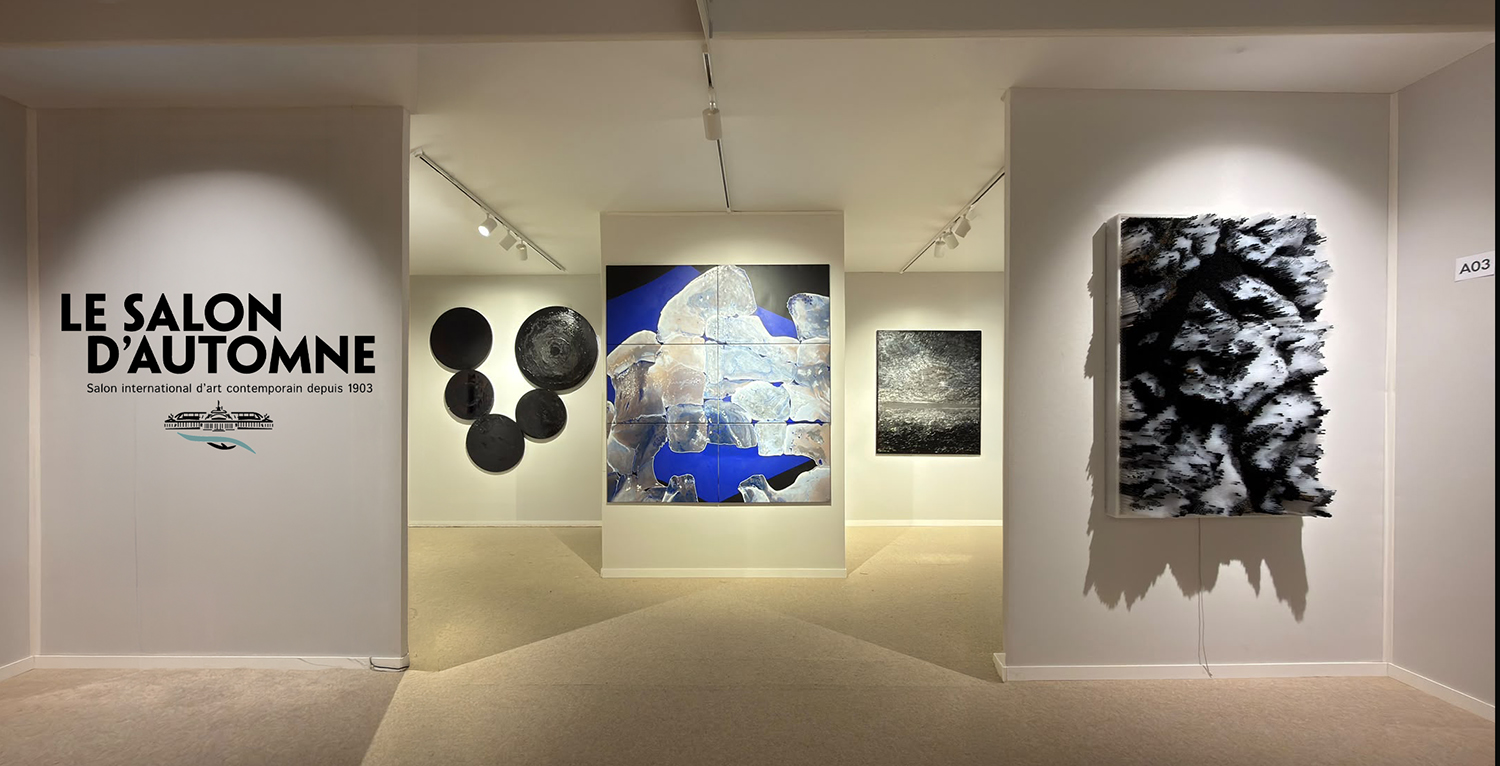
Presented at the Salon d’Automne in Paris, Ad astra V outre noir brings five dark circular forms into a shifting relationship with light. Between painting and sculptural presence, Adélaïde Leferme invites the eye to linger.
by Alexandra I. Mas
Black has many ways of holding our attention. It can close a surface, deepen it, catch a reflection or allow something to disappear. Think of Anish Kapoor’s dark circular forms, where the eye encounters a surface and the brain perceives a void. In Adélaïde Leferme’s Ad astra V outre noir, five circular elements of different sizes spread across the wall, their dark surfaces alternating between reserve and brilliance. The largest catches an almost silver light; elsewhere, reflections emerge from a more elusive darkness. The arrangement suggests a constellation, although its interest lies beyond celestial resemblance. The spaces between the circles give the composition its breathing room. Each element has its own weight and surface, yet belongs to a larger rhythm.
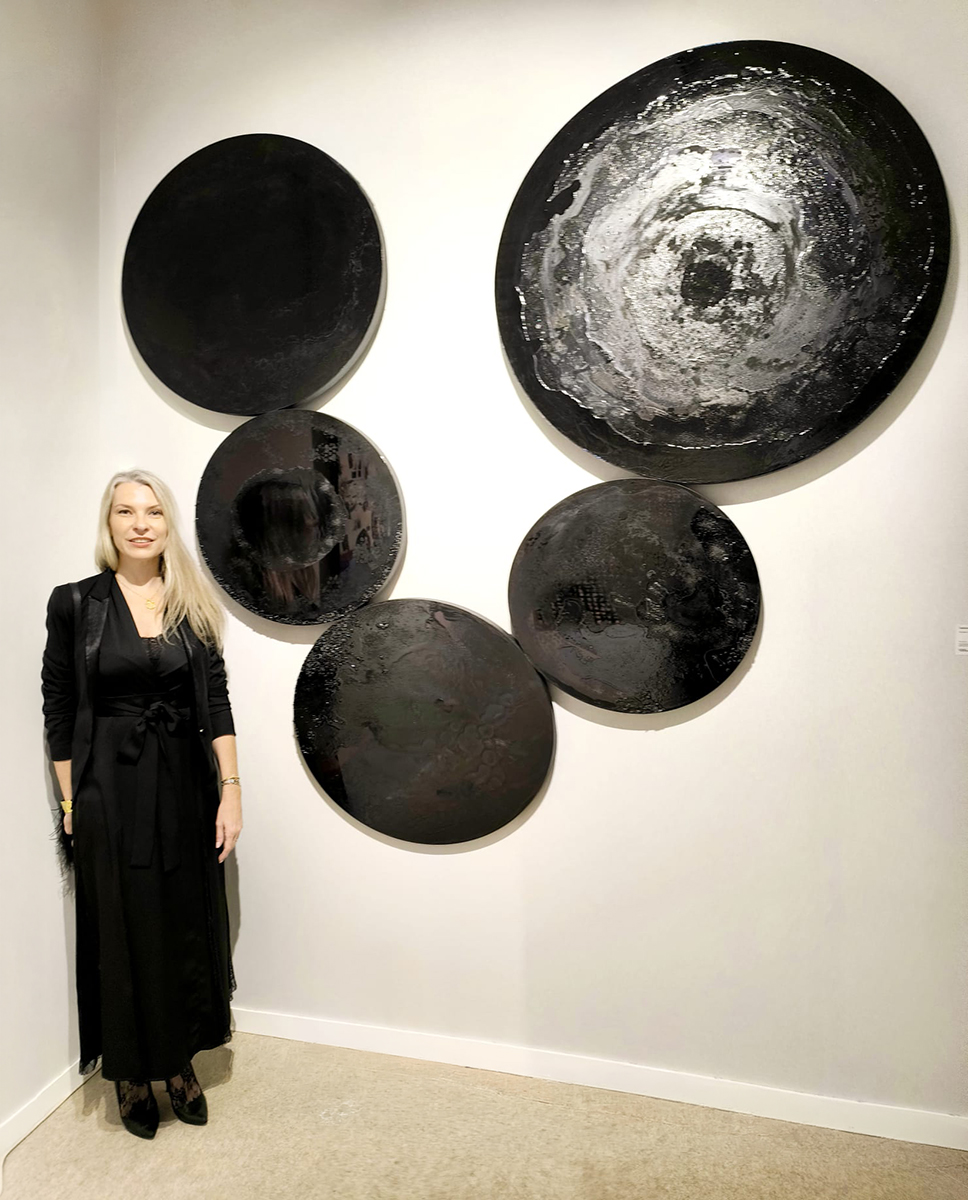
Shown at the Salon d’Automne this autumn, the work enters a particular Parisian history. Founded in 1903 as an independent platform challenging academic convention, the Salon became the setting for the celebrated Fauvist scandal of 1905. Its history is inseparable from the struggle to give colour and form greater freedom. Leferme’s restrained palette approaches that freedom through concentration: how much can a painting reveal when its colour is reduced to black?
The phrase outre noir inevitably brings Pierre Soulages into the conversation. Beginning in 1979, his Outrenoir paintings made reflected light central to the experience of black. Ridges, grooves and smoother passages altered what the surface returned to the eye, making the spectator’s position part of the encounter. Black became a means of painting with light.
Leferme’s fused reflective fibres and deep black pigments open a related enquiry through a different material vocabulary. Her surfaces retain an irregular, tactile character. Light gathers unevenly across them, revealing textures that resist a single, settled reading.
With Anish Kapoor, the connection becomes spatial. His explorations of dark cavities and reflective forms unsettle our ability to judge where a surface ends and depth begins. A mirror can draw the surrounding world into an object while making that object’s physical limits uncertain. Leferme’s circular forms invite a comparable hesitation between looking at something and looking into it.
Yet their worked surfaces keep returning us to matter. Fibres, pigment and irregular reflections hold the eye close to the object, even as the circular forms suggest distance. This tension gives the polyptych its particular character: an aspiration towards the immeasurable, carried by something visibly made.
There is also a personal dimension to this movement from darkness towards light. In a recent interview, Leferme described her practice through resilience, reconstruction and the transformation of fragility. She associates her Ad Astrawork with the Latin expression per aspera ad astra: through hardship, to the stars. Black, in her account, is a place from which something can emerge.
That understanding gives the title an emotional gravity without fixing the viewer’s response. The circles may suggest celestial bodies, pools, shields or openings. Their meaning remains available to the person standing before them.
What holds the composition together is the time it asks us to give. An initial impression of darkness yields to differences of sheen, texture and reflection. The eye adjusts. Details become legible. Our own surroundings enter the work. Within these five forms, silence acquires a surface, and light finds somewhere to remain.