There are styles that persuade by mastery, and others that disarm by innocence. Naïve art rarely moves me. Its frontal perspective, its bright insistence, its refusal of shadow often feel too declarative. And yet this painting does something else. It lingers.
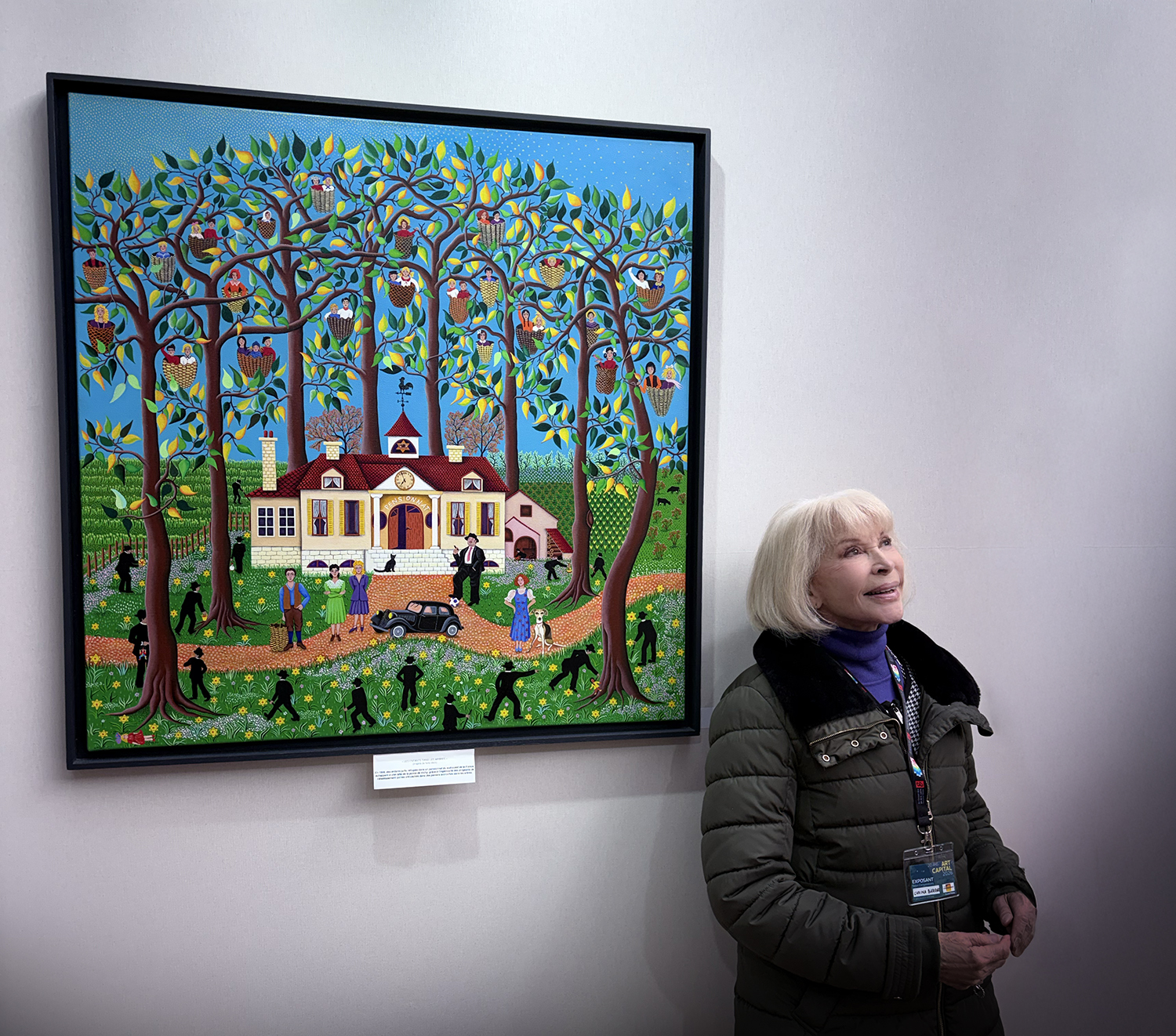
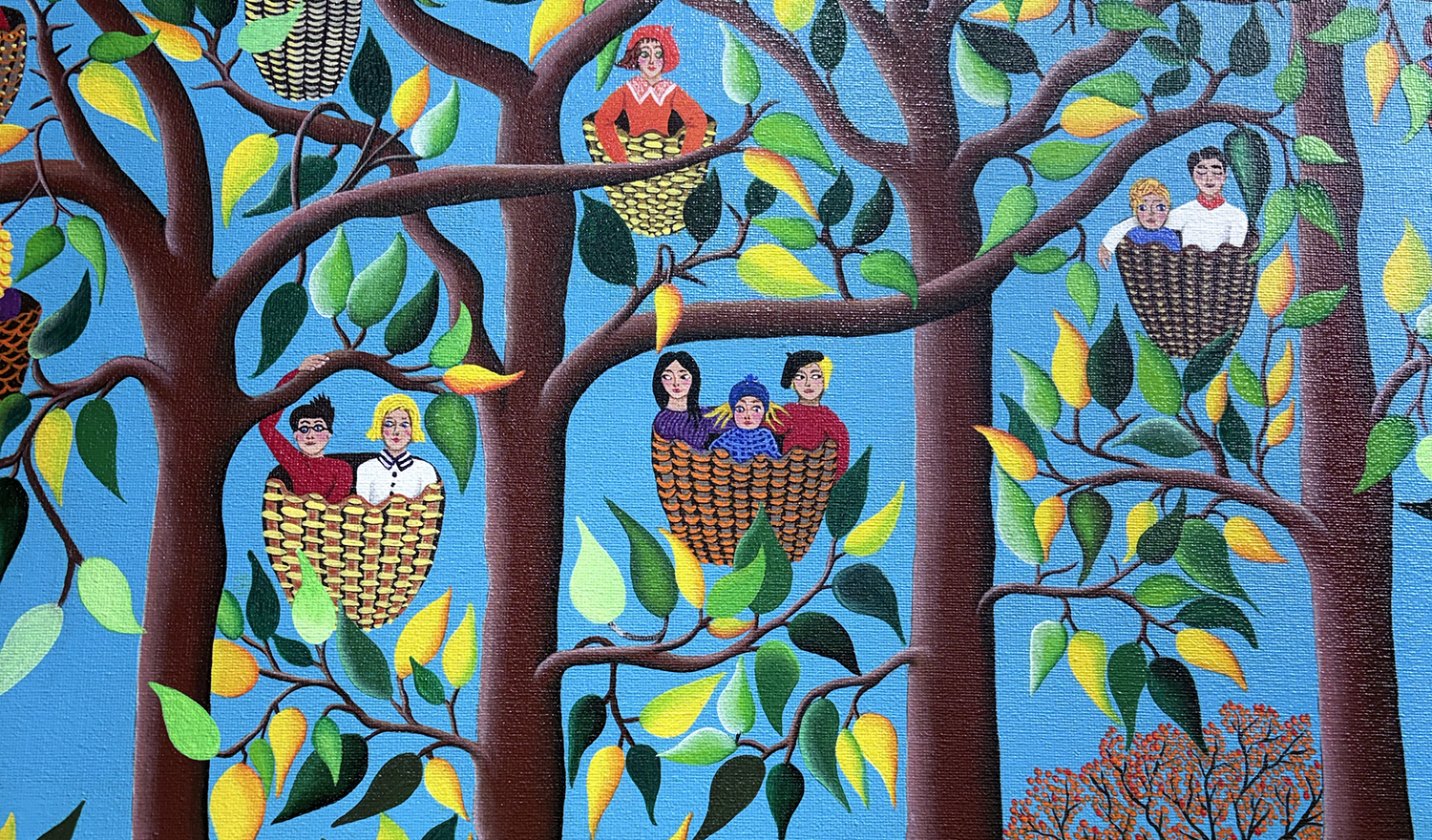
Carina Barone, American by birth and French by adoption, has painted not a scene but a memory carried across generations. Les Enfants dans les Arbres recounts a real episode from 1944: Jewish children hidden in baskets suspended in trees to escape a Vichy roundup in the southwest of France. The facts are documented. The gesture is known. What the painting offers is not illustration, but re-enactment.
The first surprise is tenderness. Not sentimentality. Tenderness. The trees rise like guardians. Their branches form an architecture more protective than the house below. The baskets, carefully researched, woven according to regional techniques, are vessels of survival. Each child sits upright, visible, almost solemn. They are present.
Barone approaches the canvas as a writer approaches a page. She accumulates detail. She contacted one of the surviving children, who sent her photographs of himself at the time. She studied the structure of the boarding school, the way the baskets were constructed. She even traced the story of a local collaborator who understood where the children were hidden and chose silence over betrayal. These elements do not appear as footnotes. They are absorbed into the composition. The precision of the house, the rural path, the gestures of the black-clad figures below, all of it is narrative embedded in paint.
Formally, the work belongs to the lineage of naïve art, yet it avoids its most decorative traps. The flattened perspective recalls Henri Rousseau, particularly in the rhythmic density of foliage and the symbolic use of trees as both setting and structure. There is also an affinity with Grandma Moses in the treatment of rural life as collective memory rather than picturesque scene. One might even detect echoes of Niko Pirosmani in the stillness of the figures and the clarity of contour. Yet Barone’s intention is less pastoral, more archival. Its strength lies insymbolic clarity, emotional directness and narrative transparency. Here, the lack of conventional depth works in her favor. The children in the trees are visible all at once, like a truth that refuses concealment. The danger is implied below — dark silhouettes moving through the garden — but the vertical axis dominates. Salvation is upward.
What moved me is the artist herself. She does not hide behind irony. She speaks of the work almost theatrically, as if standing on a stage, reliving the event through gesture and voice. She wept while recounting her research. There is no distance between subject and maker. In contemporary art, where detachment is often mistaken for intelligence, such involvement can feel almost radical.
The question, then, is how to judge this work.
Naïve art should not be measured by academic standards or technical virtuosity. It should be assessed on coherence, symbolic intelligence, and sincerity of vision. Does the composition hold? Yes. The trees create a vaulted space, a living cathedral. Does the narrative read without explanation? It does. One understands protection, danger, community. Is the emotion earned? In this case, yes, because it rests on documented history, not invention. There is also a moral dimension. Memory, when painted, risks simplification. Barone avoids this by grounding herself in testimony and fact. The painting becomes an act of transmission. Not grand history, but precise history. The kind that survives because someone insists on telling it again.
This canvas remembers.
A.I.Mas