by Alexandra I. Mas
Born in 1970 in Água Branca, Brazil, Célia Gouveiac developed from an early age an organic relationship with the languages of expression. Literature at thirteen, singing at fourteen, contemporary dance at sixteen, theatre at nineteen: before fully entering the visual arts, her body and voice became sites of passage. This original plurality continues to irrigate a body of work in which form is never dissociated from lived experience.
Settling in Paris in 1997, she trained for two years in classical theatre at Les Enfants Terribles. Yet a radical need for autonomy soon pushed her elsewhere. Her encounter with the sculptor Petrus marked a decisive turning point: she became his apprentice for three years while simultaneously approaching painting as a self-taught practice. From that point on, her trajectory unfolded through a fertile alternation between sculpture and painting, two complementary breaths of the same commitment.
Art as Responsibility
In Célia Gouveiac’s work, art is never decorative. It is an act.
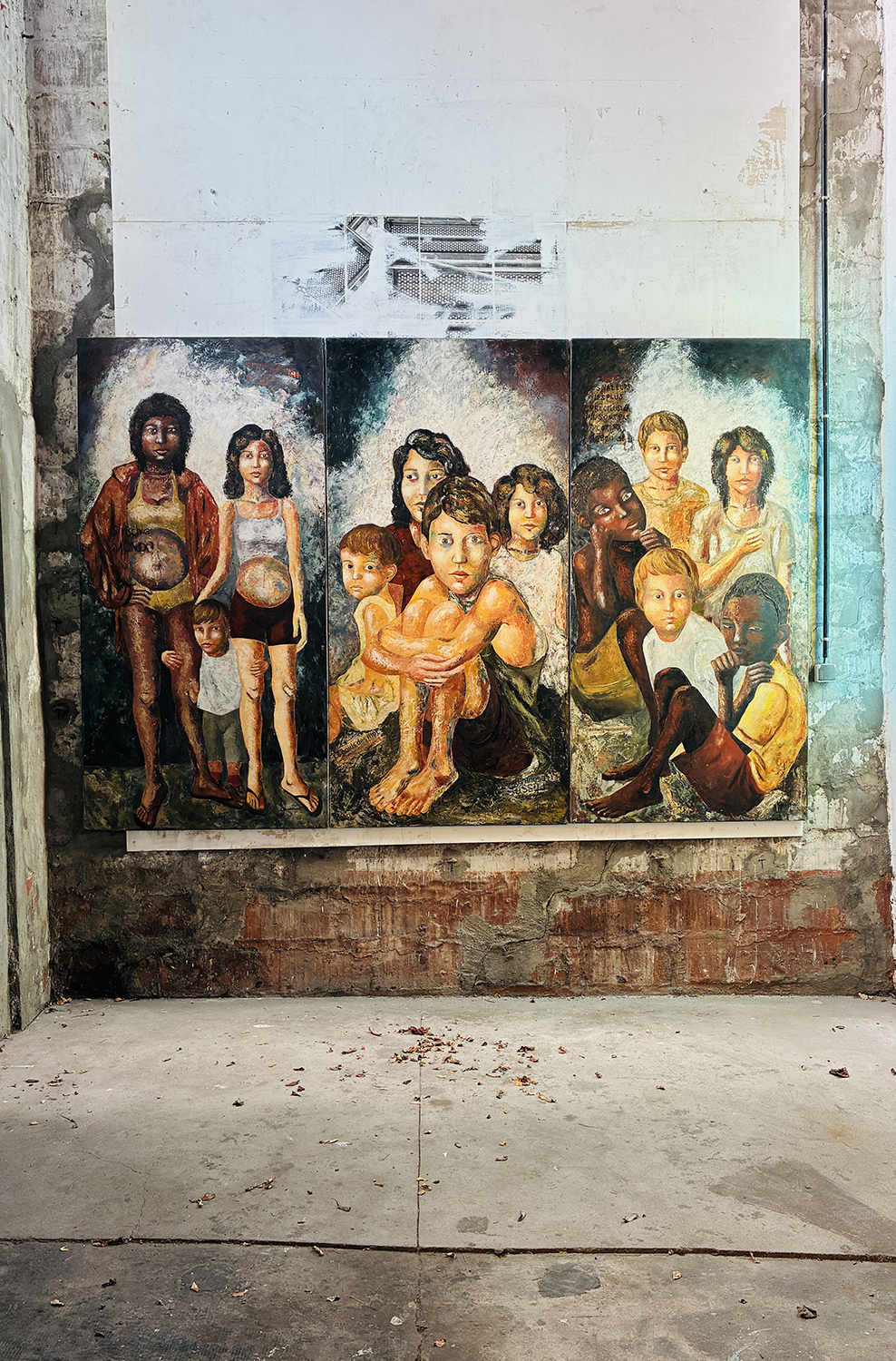
From the late 1990s onward, she engaged in a deeply social practice, leading drawing and modeling workshops with children whose lives had been fractured, notably in Rio de Janeiro. She photographed them, interviewed them, produced documentaries and testimonies. From these experiences emerged the foundational series Portrait d’enfance (1999–2007), including the triptych Dans la rue (200 × 300 cm), presented at the Florence Contemporary Art Biennale in 2003, a pivotal work.
These children’s faces are not icons of miserabilism; they are mirrors. The artist interrogates not only the world’s distress but also our collective capacity to face it. This inquiry continues in the series Cri des espoirs, where the disposable paint palette becomes both support and substance. Faces dissolve into a universal humanity, carrying a cry the artist describes as our own: the one we refuse to hear.
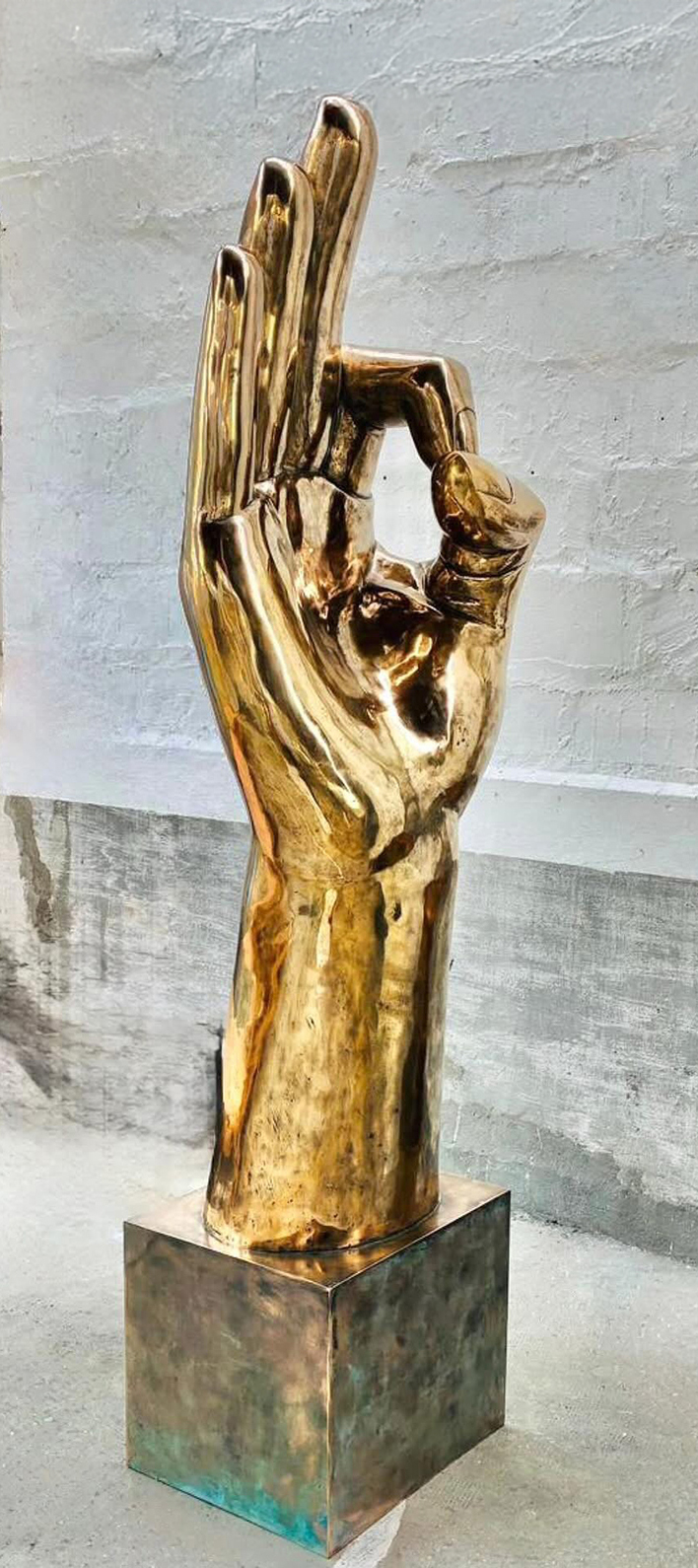
Yes to Life!, bronze sculpture
Sculpting Meaning
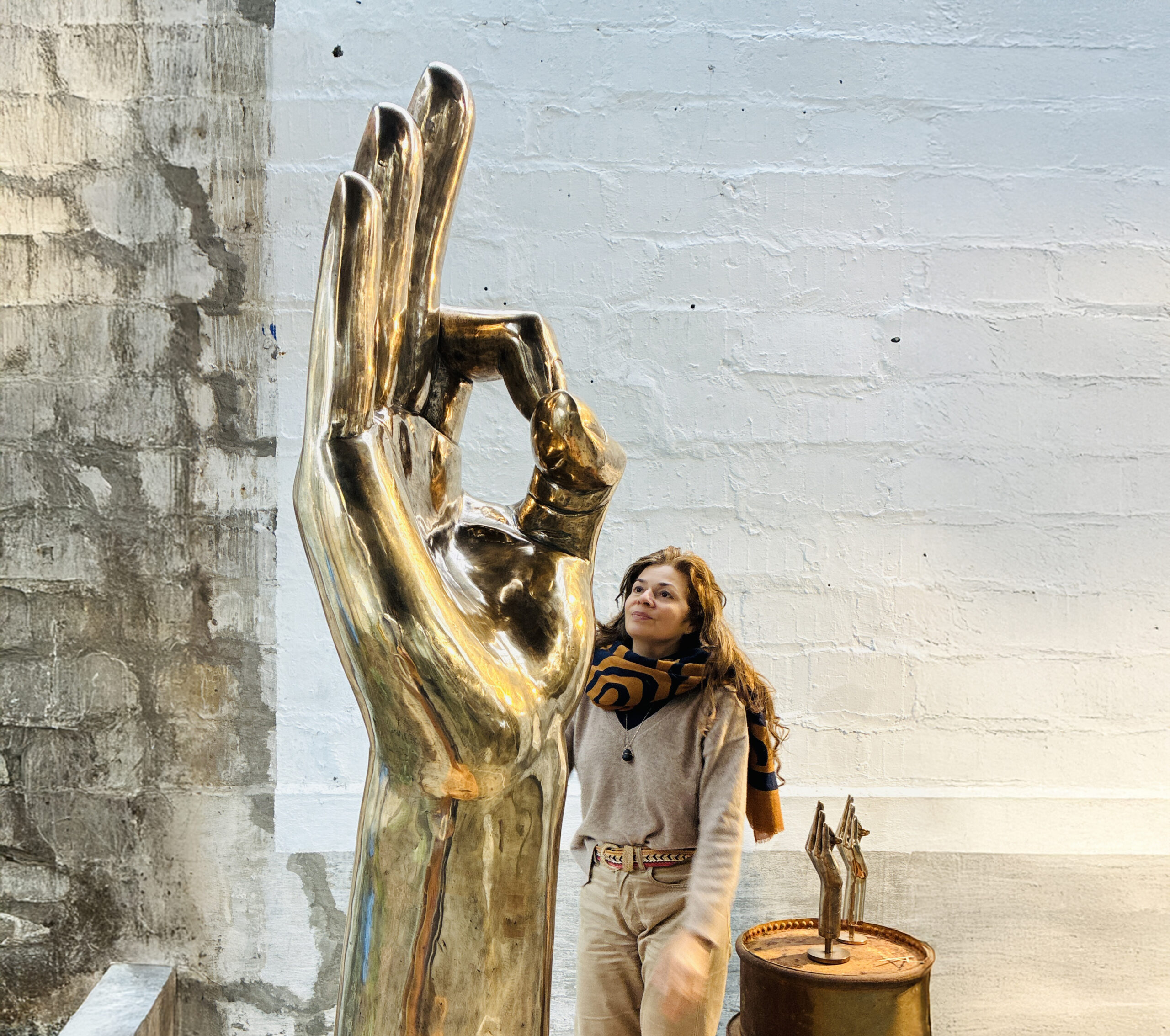
From 2005 onward, based in Nice and integrated into the constellation of artists working along the Côte d’Azur, Célia Gouveiac entered a decisive sculptural phase. Between 2007 and 2016, her work moved out of the studio and into the public sphere, culminating in Yes to Life!, a project whose visibility and resonance marked a turning point in her career.
Yes to Life! a gesture immediately legible yet radically stripped of narrative. Genderless, aconfessional, deprived of lifelines, the hand refuses destiny as much as authority. Its power lies precisely in this neutrality. It does not belong to belief, ideology, or ritual. It belongs to the street, the square, the passerby.
Seen across France, particularly along the Côte d’Azur, where it became a familiar presence, Yes to Life! operates as a civic signal. Its language draws closer to the universality of pop imagery than to the solitude of modernist form: a clear sign, capable of circulating, repeating itself, and embedding itself in collective memory. Like a peace sign, a raised hand, or an urban marker, the gesture bypasses explanation and addresses the body directly.
This logic of circulation is reinforced by the work’s material plurality. Yes to Life! exists in multiple finishes and scales: cast in bronze, patinated in different tones, sometimes painted directly by the artist in vivid colors that heighten its immediacy. These chromatic variations shift the work away from the solemnity of the monument and toward a more vibrant, accessible presence. The sculpture adapts without losing its identity, proof that meaning, here, is alive. The hand neither blesses nor commands. It does not accuse, protest, or console. It suspends. In doing so, it aligns less with the rhetoric of authority than with an ethics of attention. To say yes to life, to the other, to the moment, without prescribing its content.
Conceived as a monumental and nomadic installation, Yes to Life! was designed to travel, to be encountered unexpectedly, to provoke silent dialogue. Its surface returns the viewer to themselves. The sculpture does not speak for us; it asks us to answer. This is where the work’s public success finds its depth. Yes to Life! functions as a shared image, a collective pause, an ethical punctuation mark inserted into everyday space. In an era saturated with directives and noise, Gouveiac chose the radical clarity of a single gesture, one that does not resolve meaning, but opens it.
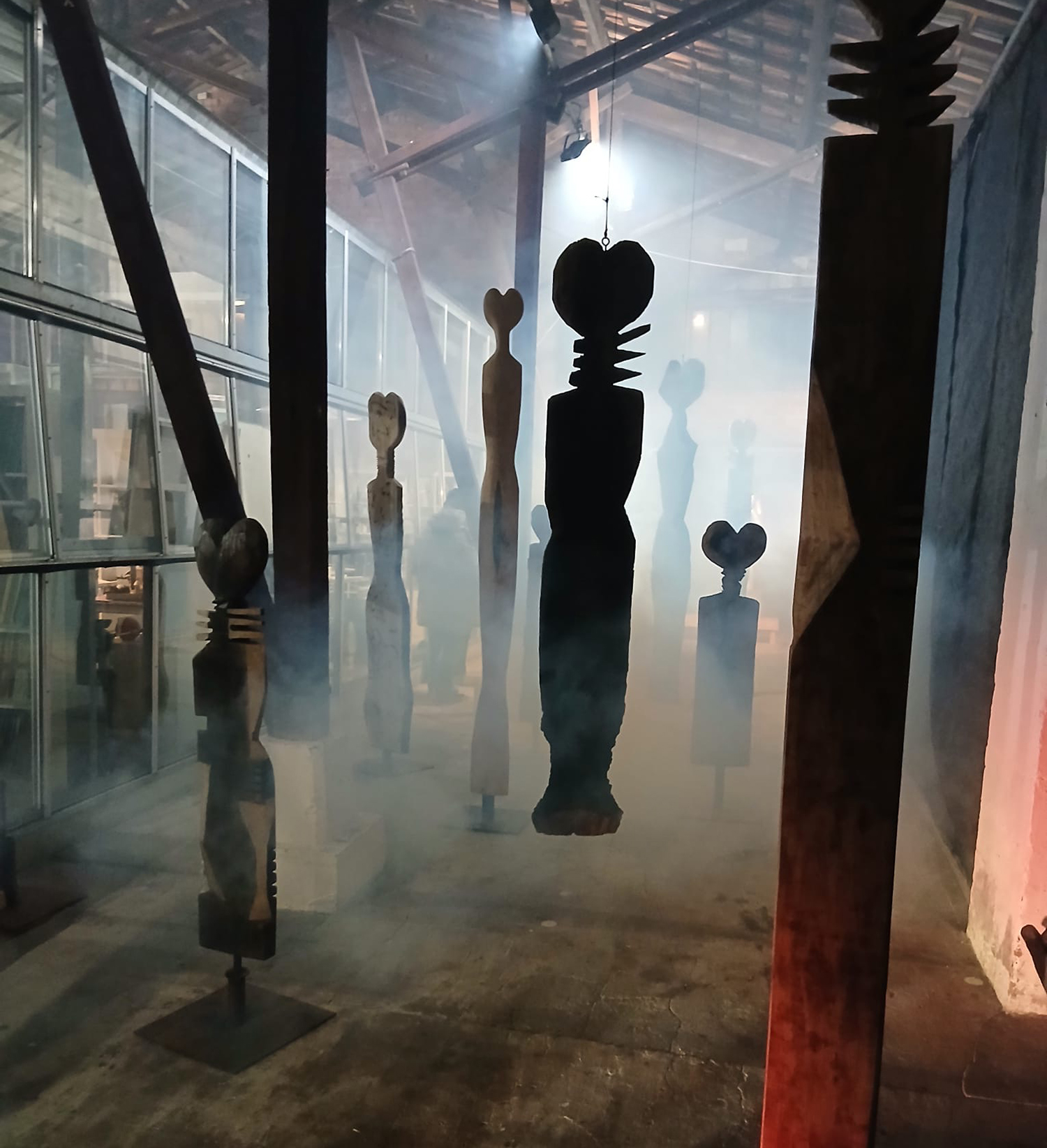
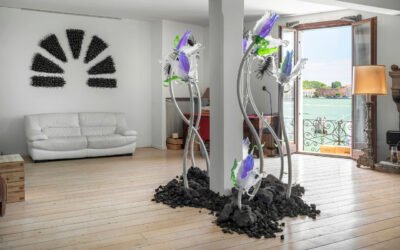
Âmes-Cœurs (installation view)
Carved wood, natural pigments patina
These barked wooden figures, carved directly from the material’s resistance, emerge as raw presences rather than composed forms. Assembled in in situ installations, they summon an archaic energy without ever lapsing into primitivism. Their force lies not in origin myths or nostalgia, but in immediacy. As J.R. Loth writes, they rise “in assault of verticality,” upright not as symbols of elevation, but as acts of persistence. Bifacial, they embody a contemporary duality: inside and outside, fragility and endurance, wound and vitality.
From 2017 onward, Célia Gouveiac’s sculptural practice underwent a radical mutation. Moving away from classical approaches centered on the corporeal envelope, she turned toward a more exposed interiority. With the series Âmes-Cœurs, sculpture no longer seeks to represent the body, but to reveal what remains once the body has been stripped of protection.
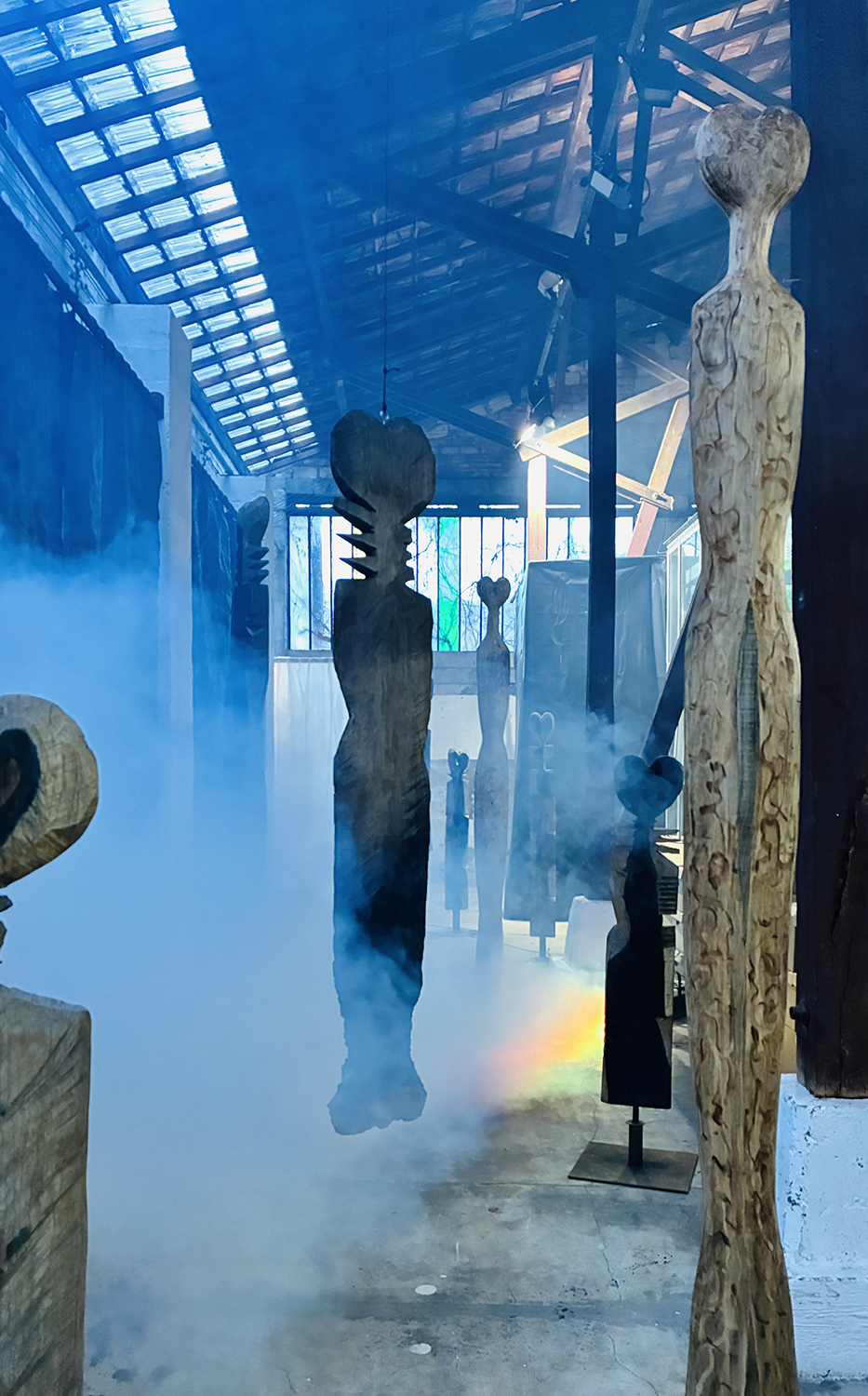
The work belongs to a lineage of universal gestures, somewhere between Giacometti’s verticality and Brâncuși’s essential forms, resolutely contemporary in its ethical urgency. Here, verticality is transcendence but also stance and concentration.
Carved with decisive, sometimes almost violent gestures, the figures retain the memory of impact. The cut is visible, the fracture accepted, the surface left exposed. There is no attempt at seduction or finish. Generosity, here, lies in sincerity: the refusal to conceal the effort, the risk, the vulnerability of the act.
These forms stand as witnesses. Their elongated silhouettes recall standing icons. . Installed collectively, they create a field of presences rather than a hierarchy of objects, addressing the viewer not through authority but through silent insistence.
Âmes-Cœurs articulates a sculptural ethics: one that rejects mastery in favor of engagement, polish in favor of truth. These works reassert the weight of matter and the necessity of standing—quite literally—within the world’s urgency.
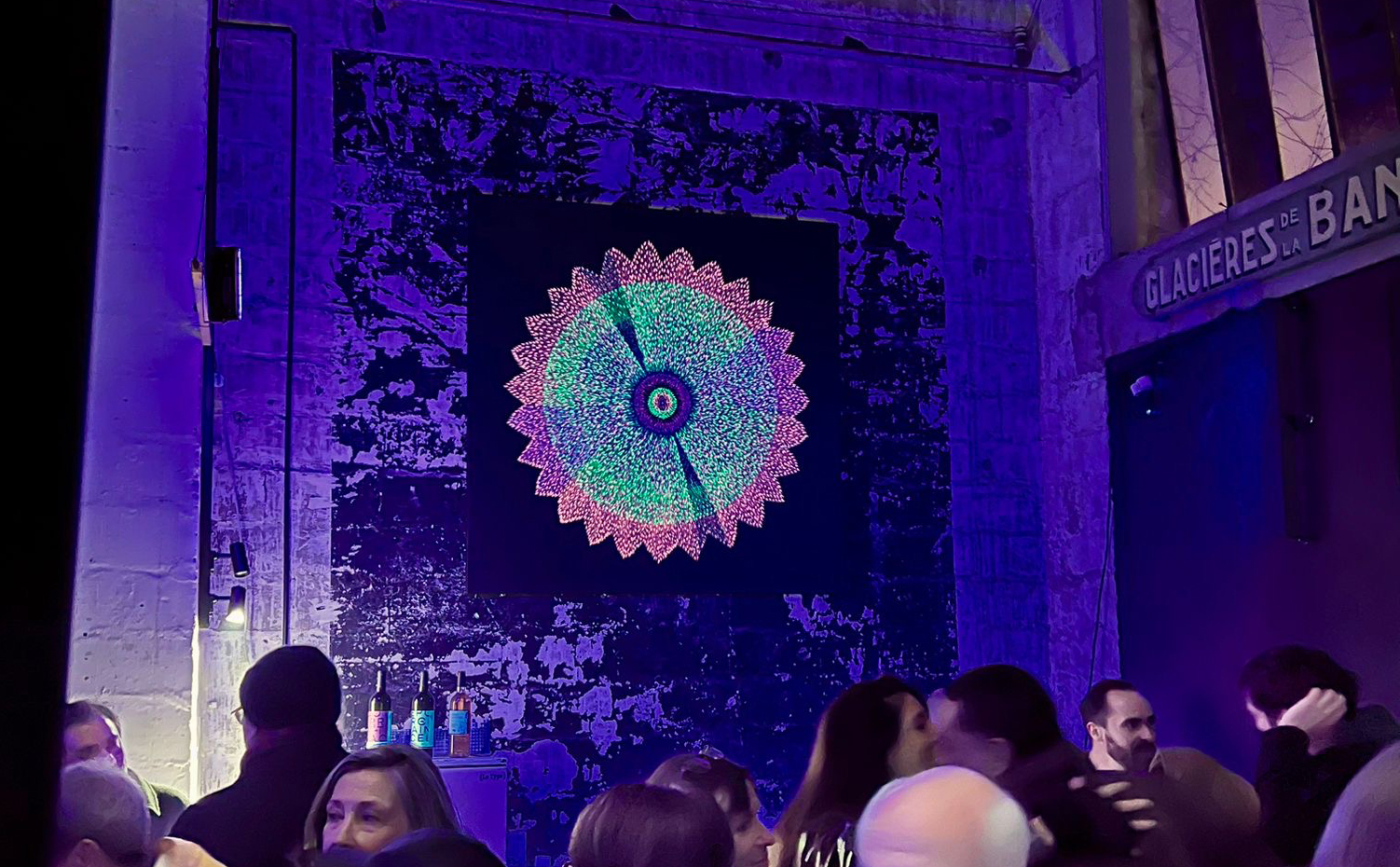
Je suis, acrylic on canvas
In 2022, Célia Gouveiac returned to painting with the series Je Suis – I Am. Vibrational works centered on the cell, they bear witness to a fully assumed consciousness. The artist interrogates her relationship to spirituality, Amerindian heritage, and identity. She travels to Brazil, spends time deep within the Amazon, and reconnects with her roots. This journey resonates with philosophies of embodied consciousness, from ancestral cosmologies to contemporary ecological thought, where being is not defined by domination but by relation.
Far from decorative mysticism, this approach constitutes an existential positioning: art as a tool for inner transformation. Through this body of work, she joined the Artivist movement and exhibited in New York, Paris (Grand Palais), Miami, and Bordeaux.
The series I Am results from a pictorial research initiated twenty-two years earlier. The artist perceives a field of colors evoking vibrational connection, symbolizing ancestral memory. Through repeated gestures, she affirms her own existence and that of others, celebrating each individual as a unique entity living in harmony with nature. Circular motifs evoke universal elements: the earth, seasonal cycles in resonance with ancient art. Colors seem to move, a homage to life inviting viewers to participate in this celebration. Her pictorial movement expands outward, expressing gratitude and encouraging the audience to enter this dance of existence.
| Adresse | 121 Avenue Alsace Lorraine, 33200 Bordeaux, France |
| @groupedescinq | |
| groupedescinq | |
| SITE WEB | www.groupedescinq.fr/ |
| Telephone | 05.56.08.08.88 |
| Horaires | Du lundi au vendredi de 10h à 18h. Le week-end sur rendez-vous. |
A Shared Work
At Les Glacières de la Banlieue in Caudéran (Bordeaux), a mini-retrospective is currently on view, from January 28 to February 27, 2026, bringing together works by Célia Gouveiac from six major series, alongside an installation from La Forêt des Âmes-Cœurs and the video-manifesto La Grotte aux Âmes-Cœurs. This journey offers a coherent reading of an oeuvre that moves fluidly across mediums without ever losing its central axis: the human, fragile and powerful. Célia Gouveiac’s art seeks connection. Awakening. It reminds us, with rare intensity, that to create is also a way of caring for the world.