by Alexandra Mas
photos by Marco Tassini
Ras Akyem Akin-Yemi Ramsey came into my view by way of Barbados, almost by accident, in the manner that serious encounters often do. I had been invited to a gallery of uncommon calibre: Caribbean Brushstrokes, a contemporary hub, studios on site, a living programme, and a communication with the public and the press handled with notable professionalism. There is a sense of purpose in the air, and a respect for work that is practised.
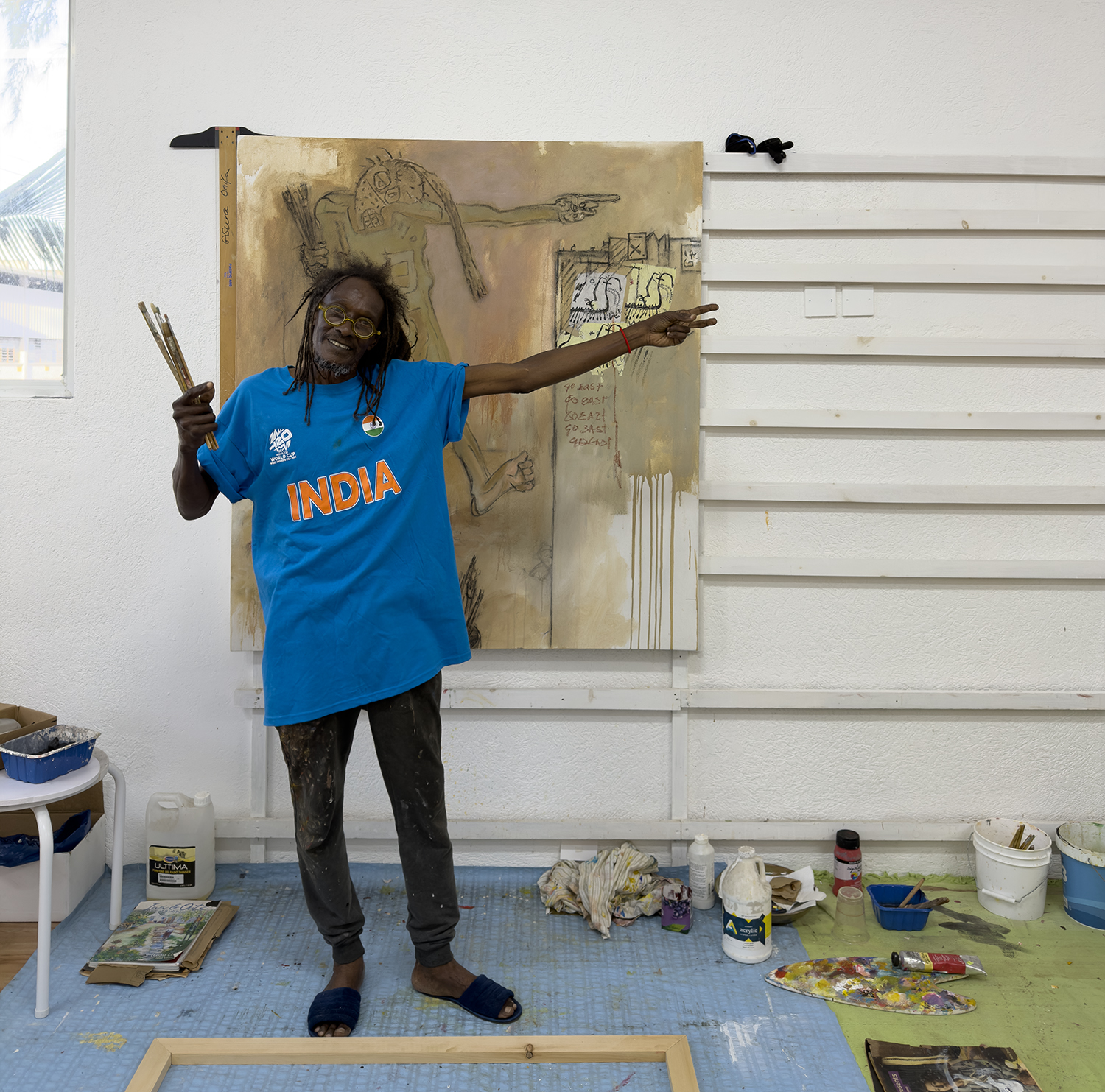
Within that space, I discovered, with a kind of attentive reverence, the paintings of Ras Akyem Akin-Yemi Ramsey. After a conversation with the curator, I met the artist.
He is shy. Slender. Measured in tone. His voice is poised; his manner composed. Yet he carries an authority that does not need to raise itself. The contradiction is striking: a gentleness in the room, and a force on the walls. Perhaps it is precisely because the work speaks where the man does not. His paintings touched me in that direct, unarguable way, before taste, before explanation.
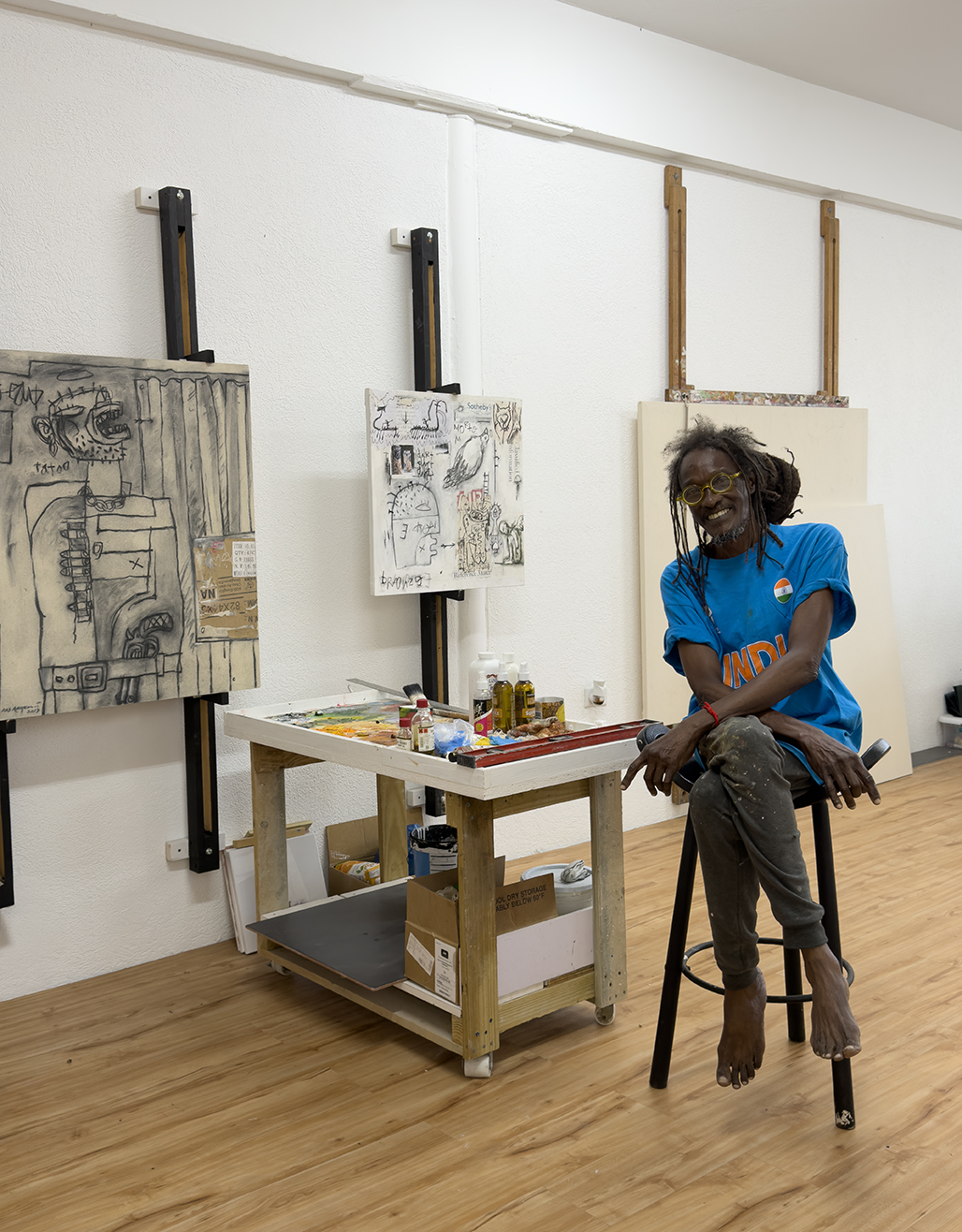
You may be tempted to say it’s because I love Basquiat. And yes, a shared electricity is there, the urgency, the refusal of polite surfaces. But to leave it at that would be lazy. Ramsey’s world is not an echo; it is its own planet, with its own weather. His art is rough in the truest sense: honesty. It is anchored by academic know-how, drawing that holds, composition that knows its history, yet it stands in open rupture with classicism. Mastery is present, only to be challenged.
What is most unsettling, and most alive, is the way he uses reference. He offers it, then asks you to let it go. The canvas feeds you signs so you can renounce them and enter something more raw: a manifesto made of marks, fragments, and insistence. There is a scream in it, but never hysteria. The work carries deep feeling without begging for sympathy. Ramsey triggers something older than commentary. In his images, one senses the island not as postcard or folklore, rather as a universal condition: place, pressure, inheritance, resistance. King and proletarian at once. Revolutionary, yet a keeper of ancient roots. A man of the present with an ear to what came before.
And that, perhaps, is the rarest thing: a painter who can break form without breaking truth. So who is Akyem Akin-Yemi Ramsey… we had a chat:
Alexandra Mas: I saw that you studied in Cuba.
Akin Ramsey: Jamaica first. My first scholarship was in Jamaica at the Edna Manley School of Visual and Performing Arts. Then subsequently, I got a scholarship to study in Cuba at the University of Superior Arts.
A.M: Cuba feels almost mythical.
A.R.: Yes, it was incredible. First of all, the creative environment in Cuba was very conducive to the making of art. The Cubans were very technically astute, very well trained, but they were very invested in the traditions of Europe, because most of the training came through Russia, the Russian painters.
Coming from the Caribbean—the English-speaking side—my temperament was different. There was also a language barrier, so I had to learn how to communicate within that context. But because it was art, the emphasis was really on the language of paint. The verbal inadequacies didn’t get in my way; they became superfluous. We found ways to transcend that problem. Eventually, I began to acquire the basics of the language.
A.M: So the visual language replaced the verbal one?
A.R.: Exactly. Because it’s visual art, the most important thing was the visual language rather than the verbal. We communicate through the image and through creative temperament.
A.M: There are strong classical connotations in your work, both European and Caribbean.
A.R.: I’ve been a student of the arts since I was nine. I was trained in European classical traditions. I learned all the technical areas and became very proficient. I always had a facility for drawing.
But after art school, I realised I needed to develop a voice, a language, a signature that was my own, more subjective. The European way of interpreting the world didn’t fit my temperament. We come from a colonised environment; we live a life of resistance. There’s a more volatile energy, and I needed to speak through that.
A.M.: Is that where the idea of nation language enters your work?
A.R.: Yes. The visual language of Europe was alien to me. I needed something that synchronised with my social and cultural experience. In Barbados, we speak standard English in the classroom, but in the schoolyard we use dialect, a broken form of English with a more direct emotional response. I wanted to find a visual equivalent to that experience. I began developing a visual dialect. That’s when I started to deconstruct reality. I responded to graffiti, something that comes from the gut, a manifesto. I moved away from academic approaches towards something more direct and emotional. I tried to find an equivalent through my mark-making, the abbreviations in the form, the fragmentation. I started to deconstruct reality, reinvent reality.
A.M.: Your work is highly symbolic, often incorporating words. When did that begin?
A.R.: I’m a student of literature and history. I love them. I found ways to marry the visual and the verbal. Sometimes the words don’t have a direct meaning; they act as spatial devices, compositional elements. I also break words into anagrams. When you break a word, its meaning expands. It becomes dynamic.
A.M.: Like your work referencing Basquiat?
A.R.: Yes. He was a kindred spirit. When I made the altarpiece for Basquiat, I broke the word “altar” into “all tar.” It became an “all tar” for Basquiat. It spoke to how he was demonised, then adored by those he didn’t want to love him. That duality interests me.
A.M.: Your creative process seems deeply intuitive.
A.R.: Nothing is fixed. Reality is a series of accidental experiences. I start sometimes with an idea, sometimes just by playing with materials. I turn my intellect off, but not my awareness. I let the materials lead and observe what happens. I work hoping the result surprises me, even before the viewer. The idea becomes a point of departure, not a destination. I drift. I remove the engine. I take down the sail.
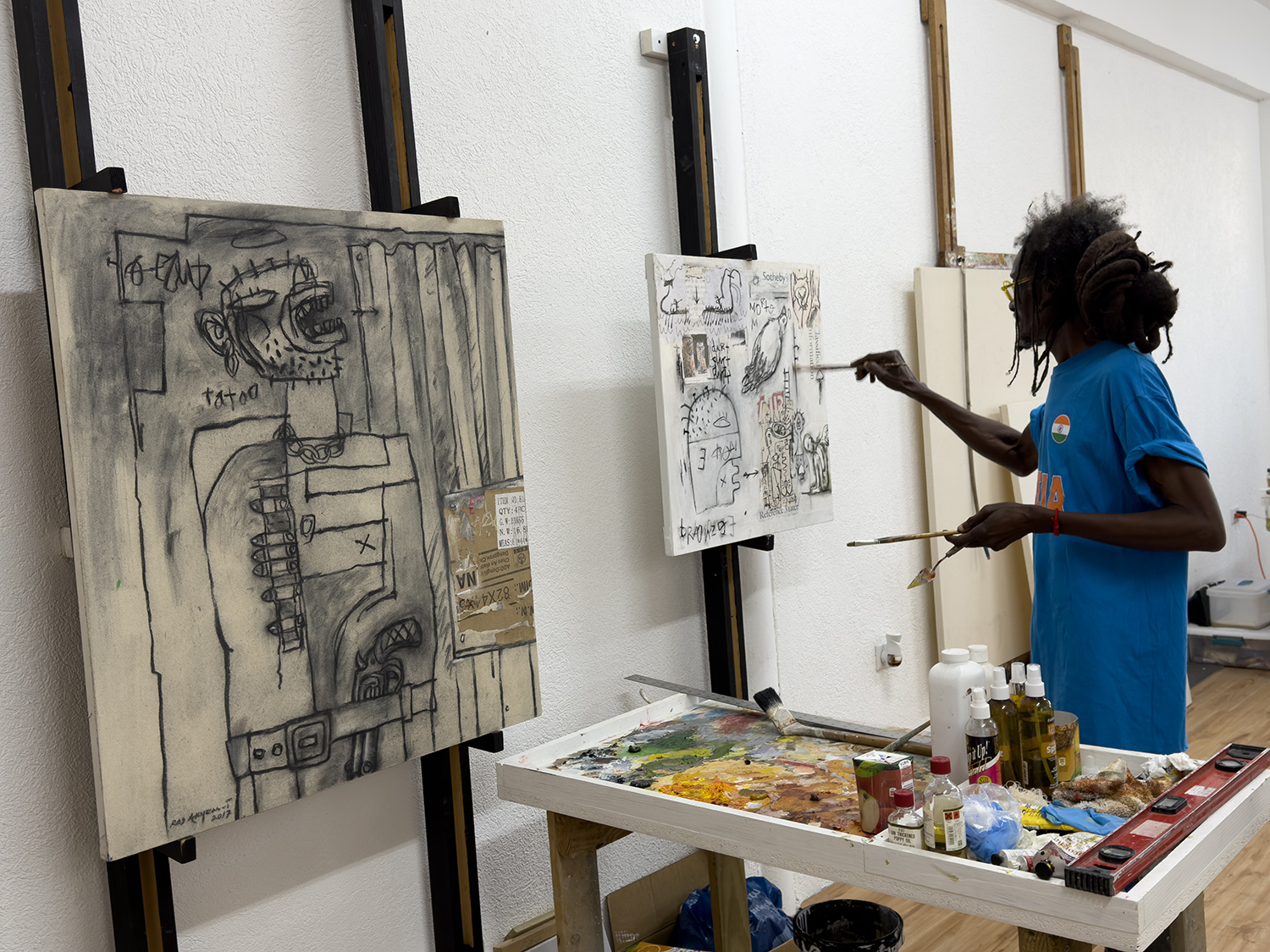
Q.: You describe it almost as a journey without control.
A.R.: Exactly. The runway is only there to gain flight. Once I’m airborne, the runway is irrelevant. Where I take off from is not where I end up. I work very noisily—jazz, heavy metal. Music has a cathartic state. I internalise it; music enters me, and after a while it becomes background noise, a support system, like a mantra. It triggers something in me. It takes me to a place where I can feel, because I don’t paint what I see. It is not so much how the thing looks, but how the object feels. I paint how I feel.
A.M.: I call that visceral work.
A.R.: Because it’s really about a heightened sensibility.
A.M.: You seem to enter a parallel state while working.
A.R.: Yes. Once I’m there, I don’t revisit objective reality until the work is finished. I work until I’m exhausted. The painting decides when it’s done. You have a sense that there’s nothing more you can do. And if you stop before that, you can never get back to that place anymore. If I break that connection, it can take weeks to return—if you get back, if you ever can get back there. It’s a very unique experience to cross over into that parallel space. That’s where I like to go. Where the magic happens. Where you can conjure things. You know that… You become a magician. We have experiences that have no equivalent in objective reality. Ordinary reality becomes really sterile, empty, and predictable. And it’s prescriptive. I especially like it when there are accidents. When the paint spills. Or when a mark you didn’t intend to make happens. Like if somebody else is guiding your hand. But you have to be sufficiently aware to recognise it.
A.M.: Oh. That’s important.
A.R.: That’s beautiful, because it doesn’t follow the prescribed idea of beauty. That very sterile, fixed idea. You’ve cultivated an understanding of what makes those things possible, yet I don’t try to impose it on the work. I’m looking for what is possible, not what already exists. We all understand form, spatial relationships, the dynamics of composition, balance, visual tension. Those are elements that consistently remain with you; it’s a sense of presence.
A.M.: This is how you can make your very own cocktail.
A.R.: But what you have to learn now is how to make it unique. Most of my work is autobiographical. Picasso said great art can only be subjective. In other words, you have to find a source in yourself. A place in yourself to speak from—an honest place, one that is completely unique and individual. You have to learn to trust that, because sometimes it comes into conflict with your academic training. You have to find that in-between world. I often say I live between worlds. I live an ordinary physical life out there. I’m a human like all the others. But I have this ability to cross over, because I’m never fixed in this reality.
A.M.: What was the longest work you lived, the longest time you spent on the other side?
A.R.: Oh, sometimes I work for days until I’m totally exhausted. Sometimes I forget to eat. I have spiritual allies—the weeds. It comes like a trigger for me. Often I forget about it and it goes out. At one point I realise I need to light it, but I don’t have time because I can’t take the brush off the canvas, so I just keep working. Or the music stops and you don’t even realise it because I’m in that other place. It’s like a bridge I used to cross. Once I get over there, I don’t think about the bridge anymore. I stay there as long as I’m able to, until the spirit releases me.
I like to work at night because I can guarantee that no one is going to be bothering me. It’s very difficult to articulate that space. It’s just a state of being; kindred spirits understand that. People who live that life and work in that space understand that when I talk to them, they can identify with that experience.
A.M.: You’re explaining it quite well, to be honest, because it is difficult to explain that path.
A.R.: Because where we go, where we go to find substance, it is somewhere over there. And you have to take risks. If you don’t take risks, you don’t get there, and it’s dangerous.
A.M.: And beautiful.
A.R.: Yes, you cross worlds. There’s no guarantee you’ll come back. But without risk, you don’t arrive anywhere. I’m very compelled by it, and that’s what I like about it. It’s death by astonishment.
A.M.: We could stop the interview on that. Let’s go back to earthlings. Could you share some music that accompanies your work?
A.R.: Radiohead. Dire Straits. Led Zeppelin. The Rolling Stones. John Coltrane. Parker—Bird—Charlie Parker. Janis Joplin. Jimi Hendrix, of course, one of my very favourite figures. Leonard Cohen. I think he’s so sober, and he’s an amazing poet. Amy Winehouse—Amy is really incredible. They all live in my studio; I play them all day. Music creates context. It helps people feel the work rather than understand it intellectually. Because music is so essential to what I do, I never work without it. That’s the first thing I do. I wake up, I put the music on, and I wait. I wait. It’s like a psychedelic process.
A.M.: You also mention working with mushrooms.
A.R.: Yes. I grow psilocybin mushrooms. I’m an amateur mycologist. You’ll see mushrooms in my work.
A.M.: The mycelium—scientists are now understanding its role.
A.R.: They’re medical allies. Psilocybin can rewire neural networks in the brain. It makes you smarter, and it’s good for your nervous system. Mushrooms are healthy. They have been criminalised by certain government structures, but now they’re beginning to see their significance, especially when re-examining the traditions of indigenous peoples and how they have worked with these organic allies over many generations, without the problems that people in cities suffer from. The trauma—it’s not the mushrooms. It’s not the psilocybin or the THC engagement. They are beginning to value them as support systems for many of the ills people suffer in the city’s traumatising environment.
A.M.: Thank you for sharing this.
A.R.: Thank you so much.
I could have stayed in his light-filled studio for hours, talking, listening, observing. Only the awareness that I was an intruder—albeit a fortunate one—pulled me back. I had been allowed into a private creative space, at least its physical threshold, where canvases still breathed and gestures had not yet settled into history.
The rest remains his alone. It is an interior territory one can glimpse through his artworks, windows onto a beautiful mind that teaches the necessity of truth.
What emerges from that space does not ask to be understood so much as felt. Ramsey’s work resists closure. It insists on presence. It stands as evidence of a practice rooted in listening, listening to material, to memory, to inherited tensions that refuse to resolve themselves neatly.
One carries his art not as an image, but as a question, one that quietly demands a reconsideration of what it means to see, to feel, and to remain open to the unfinished, and thus open to perpetual evolution.